
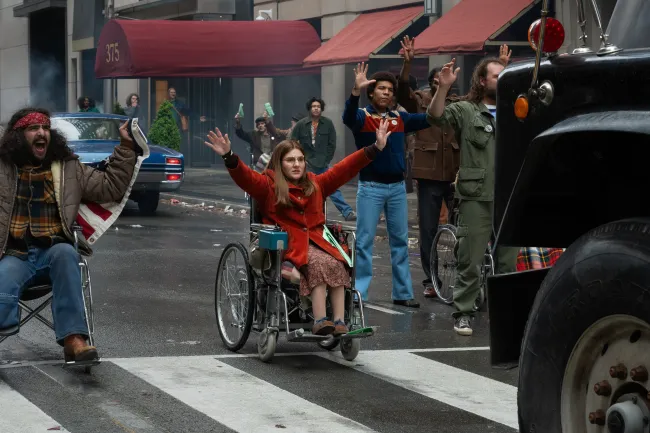
The history of disabled women in movies is usually one of beautiful tragedy, where the heroines suffer in silence and are always grateful for the attentions of whomever enters their orbit. Not so with Judy Heumann, the celebrated disabled activist and subject of the Oscar-contending feature film, Being Heumann, which opens in limited theatrical release on Nov. 6 ahead of its Apple TV streaming premiere on Nov. 13.
In both her own life and on the screen, Heumann doesn’t wait around for someone to instigate change — she is the creator of it. And actress Ruth Madeley, who plays Heumann in Siân Heder’s acclaimed film, hopes to evoke that same feeling. “We’re going for history,” Madeley tells Gold Derby, underscoring the significance of this moment for authentic disabled representation onscreen.

“As an actor, I’ve always been unashamedly ambitious,” Madeley observes. “I’ve always wanted to be at the top of my game. I want to be in conversations where I’m leading Hollywood movies, and I’m in conversations alongside people that I’ve watched for so long and really respect the work of.”
Madeley has been accruing credits since 2009, and her casting in the 2019 miniseries Years and Years led to the role of Rosie being adapted to include a wheelchair user. The actress has also received a BAFTA TV Awards nomination for 2015’s Don’t Take My Baby, and played another disabled activist, Barbara Lisicki, in 2022’s Then Barbara Met Alan. That’s why the prospect of making awards history as the first Oscar-nominated performer who uses a wheelchair doesn’t scare her — especially since she’s well-aware of how limited the number of roles for disabled performers are. “We’ve gotten to 2026 and we’re talking about history being made in the industry,” Madeley says.
Madeley has come a long way, not just professionally, but also personally. “At the beginning [of my career], I would never speak,” she reveals. “I would never ask for the things that I would need.” That’s not to say that she was necessarily asking for much. “On paper, my needs are ‘easy,’ and I was still afraid to ask,” she says, remembers instances where she’d been on sets that required her to avoid drinking anything so she didn’t have to deal with an inaccessible bathroom.

She soon realized that by not advocating for herself, she wasn’t just doing without — the productions themselves weren’t getting the best of her. “I can’t expect anybody to meet my access requirements if I don’t share what they are,” she notes. “I’m not giving a production an opportunity to meet those and then want to hire a disabled person again. I never do a job just for a job. I’m always like, how can I make sure that I am not the last disabled person you ever hire?”
The road to playing Judy Heumann wasn’t a smooth one for Madeley; she auditioned for the film via self-tape before meeting with Heder. “Our ideas for the creation of that character aligned very much so,” she says now. Still, it took three additional callbacks before Madeley got the role. “It wasn’t jus, ‘Let’s have a chat and here’s the role.’ I worked damn hard for that thing, just like any actor does for any role.”
When she finally learned she got the part, Madeley called it one of her best moments ever. “If I could relive anything, it would be that day. Don’t tell my husband it’s not the wedding day,” she jokes.
Because Heder already had experience working with disabled performers after directing a cast of deaf actors — including Troy Kotsur and Marlee Matlin — in the 2021 Best Picture winner, CODA, Madeley wasn’t concerned about having her needs met. She also wasn’t worried about Being Heumann becoming another reductive disabled story, as she could see that Heder understood her limitations as an abled person telling a story in a space she doesn’t inhabit. That’s why the filmmaker enlisted Rebekah Taussig, a wheelchair user, as a co-writer on the script, which is based on Heumann’s own memoir. (Heumann died in 2023.)
One sequence where Taussig’s involvement proved vital is a moment when Heumann’s fellow disabled activists give testimony about their experiences in America. “Sian said, ‘I cannot write that because I don’t have that experience,'” Madeley recalls. “One wheelchair user’s experience might differ completely from somebody else’s.” That scene was a standout moment at the film’s Toronto International Film Festival world premiere in September, where Being Heumann was the second runner-up for the coveted People’s Choice Award.

What comes through clearest when speaking to Madeley is how acutely aware she is that her success goes beyond her and extends to a new generation of aspiring disabled actors. “I received so many messages when the announcement went out that I was cast,” she says. “Messages of excitement and joy for the movie, but with the sign-off of ‘the entire disabled community is waiting for this film.’
“I know the stakes of getting it right,” Madeley adds. “I know what this means for the industry going forward. I’m very much aware that I’m not on this press tour alone; I’m literally taking every disabled creative with me, and that’s both terrifying and deeply comforting as well.”
Asked what her advice would be to any disabled actors looking to break into the industry, Madeley replies emphatically: “You’re so needed. The only way this industry is going to get better is if more people come into it who don’t look like everybody else. If you want to pursue the arts, disability or not, I am not going to sit here and say it’s easy because this industry is hard work. But sometimes the best things in life are.”
Madeley also isn’t letting the industry off the hook, though. “I’ve heard so many times, ‘Where are we going to find all these disabled [people]?'” she says of the conversations she’s been privy to. Her suggested solution is for everyone in the industry — including producers, directors, and casting directors — to participate. “Visibility is really important, and also just thinking differently about the casting process.”
