
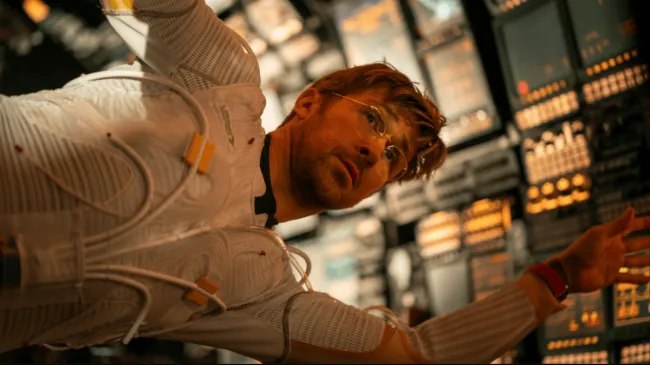
“I had a lot of sleepless nights, to be honest with you.”
So confesses Drew Goddard of the daunting task of adapting Andy Weir’s “uncinematic” novel Project Hail Mary. Despite being an Academy Award nominee for his previous Weir endeavor, The Martian, Goddard had concerns with how to approach a story about a lone astronaut on a desperate, galaxy-spanning mission to save Earth who encounters an alien.
“Everyone’s going to think it’s going to be easy because The Martian did so well, and the opposite is true here,” Goddard tells Gold Derby. “This is a much more complicated, much more difficult adaptation. In some ways that was thrilling, but my own fear at the idea of tackling it made me very hesitant, because I didn’t want to let Andy down or do a bad job.”

Ultimately, Goddard joined the space mission, teaming with old friends Phil Lord and Christopher Miller to mount Project Hail Mary to near-universal acclaim. The film has become one of the year’s biggest hits and is a projected Oscar contender in several key categories, including Best Picture and a second Best Adapted Screenplay nod for Goddard.
With elements of sci-fi, drama, and comedy, Project Hail Mary is the latest genre-bending credit in Goddard’s filmography. He came up as a TV writer on Buffy the Vampire Slayer, Angel, and Alias, eventually earning three Emmy nominations for his work on Lost and The Good Place. He successfully shifted into film with screenplays for Cloverfield, World War Z, The Cabin in the Woods, and Bad Times at the El Royale, the latter two of which he also directed.
As Project Hail Mary embarks on its awards odyssey, Goddard joined us for a lively conversation covering his trepidation about the screenplay, his favorite Rocky moments, and the one subplot from the novel that he wished was in the movie.
Gold Derby: How did you become Hollywood’s Andy Weir whisperer?
Drew Goddard: It’s the craziest story. I was working on a punch-up session for a movie called Let’s Be Cops, which Fox put out. Sometimes they ask you to just come and pitch jokes, and my friend [X-Men producer] Simon Kinberg said, “We bought this ebook that you might be interested in looking at, Drew.” I didn’t even know what an ebook was. He said, “Well, this author’s been publishing a chapter a month,” and that was The Martian. I said, “That sounds crazy, but what’s it about?” He said it’s about a man trapped alone on Mars, and I said, “Well, that just sounds so uncinematic that I’m interested.”
So I read the book and fell in love with it. At the time Andy was still doing his day job as a programmer, so he couldn’t even take work calls at his desk. I’d have to text him, and then he’d go to the conference room so he could talk to me. I remember the day I called him and said, “Matt Damon said yes. You can quit your job, Andy. We’re making this movie now.” So we’ve had a long, long relationship. There’s just a mutual respect. Certainly, I love his writing, and that makes it much easier.

I want to make sure I have the chronology straight: Phil Lord and Chris Miller were on this film and brought you in or were you pursuing it on your own? And were you worried about being pigeonholed as the Andy Weir guy?
I don’t really ever worry about being pigeonholed, because if you look at my résumé, I can’t quite describe what it is I do. It’s so eclectic. I’ve learned to just trust that if I love something, I follow that instinct. I just didn’t want to let Andy down.
Andy and I have stayed in touch. We’re friends, so whenever he’s working on a new book, I’m always like, “If you ever want to show it to me, I’m happy to read it. And if you don’t, that’s OK, too.” I try to set that tone. I think the chronology is Andy, then Chris and Phil, and then it came to me slightly after that, maybe a week later. I’m not entirely sure. It was all around the same time. Chris and Phil and I are all good friends, and we were before that, too. So this was one of those weird Hollywood situations where it was more friends hanging out and talking about what to do than an official movie.
You were friends with Chris and Phil before the movie. I assume you still are?
Going through this has made us much deeper friends, and I love them both so much.
How was your collaboration with them different from working with Ridley Scott on The Martian?
One of the things that was interesting is I had written the Martian script before it ever went to Ridley. I think I was developing it for myself to direct at some point, and then we traded up and got Ridley Scott to do it. Ridley had notes for sure and made it better, but it was kind of done by the time it got to him. On this one, everyone started at ground zero, so that alone shaped a different way to work. It was just the three of us.

Thank God, because when I read [Project Hail Mary], my first instinct was, “I can’t say yes to this. This is going to be way too hard.” Everyone’s going to think it’s going to be easy because The Martian did so well, and the opposite is true here. This is a much more complicated, much more difficult adaptation. In some ways that was thrilling, but my own fear at the idea of tackling it made me very hesitant, because I didn’t want to let Andy down or do a bad job.
Luckily, I had Chris and Phil, and the three of us would say, “Yeah, it’s going to be really hard. That’s exactly why we want to do this.” There was strength in that. It wasn’t somebody telling me it was going to be easy, which is usually stressful. It was, “No, it’s going to be as hard as you think it is, and yet you’re not going to be alone.” That made all the difference.
The books are great reads, but they have elements that are hard to convey on screen — as you said, “uncinematic.” Beyond hiring someone like Ryan Gosling or Matt Damon, what are your tricks for making that material compelling?
The answer — and this is true whether it’s a space astronaut book, a giant monster movie, or a police procedural — is that I start with character and I start with emotion. That gives me at least a skeleton to work off of.
What made this book particularly challenging is it’s all in the main character’s head. He’s trying to piece together what happened in real time, so he’s an unreliable narrator. And on top of that, screenwriting is about dramatizing, right? The only person he can talk to is a rock, and the rock doesn’t speak English. The rock speaks in whale songs. So you have a guy who doesn’t know what’s happening, he’s meeting this thing he can’t talk to, and we’re jumping around in time.

But we just kept coming back to: What is the emotional story we’re telling? I refer to it a lot as, what is the soul of the movie? This is a movie about finding compassion and empathy in places you’re not even looking for them. It’s finding compassion for someone, or in this case something, that isn’t even on the same plane of existence as you, and realizing that’s not a detriment. That’s a blessing. By the end of it, he is finding the joy in being selfless.
We always knew, “OK, that is a soul I can build a movie around.” If we can protect the soul, the rest of it will fall into place, and that kept us from going down crazy detours on the science. It’s very easy to spin out, but the soul of the movie kept us sane.
What were the keys on the page to making sure Rocky landed?
One of the things I really liked about what Andy did in the book is that he really thought through the physiology of Rocky. If life existed on the planet he picked, what would that life look like? That forced you to think outside your own humanity. How would Rocky see the world? That led to the difficulties we were just talking about, but it also led to really interesting things, because I was losing all of my screenwriting crutches, one by one, over the course of making this movie. I tumbled into something new.
This movie required a dance between writer, director, and performer. Yes, all movies do, but because we were creating a creature unlike anything that had been done before, it required all of us to listen to each other, which a lot of the movie is about. How do you just listen to each other? It’ll lead you to interesting places, and that’s exactly what happened.
Chris and Phil really set the standard; they were the ones who said Rocky is going to be much harder to make practically. But if you don’t have a face, we’re going to need to get emotion out of this thing, and that can’t just be us sitting in a room with a computer. We need to actually have somebody react, because then Ryan can react. Ryan can play scenes with James, the two of them can dance together. It was a lengthy process of discovery that I’m so grateful I got to be a part of.
Rocky has become part of the cultural conversation. Lightning round: Is there a Rocky line that gets quoted back to you the most?
“Amaze, amaze, amaze.” That’s the one people come back to me with the most.
I would figure that or “fist my bump” would be the most cited.
“Fist my bump.” I get that a lot. Can I give you my personal favorite?
Of course.
It’s when Rocky says how long he’s been married, and it’s hundreds of years, and Ryan jokes, “Oh, so you’re in the honeymoon phase.” Rocky doesn’t understand, and [Grace] says, “It’s a long time, Rocky. You’ve been married a long time.” And then it’s quiet, and Rocky says, “It’s not enough.” I think that’s a beautiful moment of the film that summarizes Rocky’s heart in a way. It’s moments like that where we really found the character.
Do you have a favorite scene in the movie?
I have so many. Can I give you two? I know that’s cheating.
Yes, go.
The easy one is when Sandra Hüller sings “Sign of the Times.” We always knew in the screenplay that we needed a calm-before-the-storm moment, but we didn’t know what that scene was going to be. We needed to see everybody before everything went bad. We knew we had a bar, so it was probably going to be on the ship’s bar. But it wasn’t until the night before that Sandra said she was willing to sing. I think Ryan asked her to sing. Boy, the movie clicks together. You really feel the heart of the movie click when that happens.
The other one was definitely the hardest scene to write, and it’s my favorite scene in the movie because it was so hard. It’s the scene where Rocky realizes he can save Grace. They have a long conversation for the first half where Grace is being stoic and strong about being willing to give up his life for the greater good. Then Rocky reveals that he realizes he can help them, and Grace completely breaks down and says, “I didn’t.” Rocky says, “I thought you made peace with it,” and Grace says, “I didn’t mean any of that. That’s just something you say.”
I love it because it’s such a wonderful dance between the two of them. That whole scene is a tour de force of Ryan Gosling and all the things he can do so expertly. At the beginning he’s the strong, square-jawed hero. Then there’s nobody funnier, so he’s the comedian laughing it off. And then he just opens up his heart and pours it onto the screen, and the two of them come together in a way. I wrote that scene so many times to get it to where it was, and now when I watch it, I’m so grateful we worked on it that hard.

What was the toughest scene to cut from the book in the screenplay?
There’s a storyline in the book where they realize they have to nuke Antarctica to help with the climate so they can survive longer. I always thought that was so cool. When I read it, I was like, “Oh, this is juicy.” It speaks to the larger themes, showing how complicated a situation we’re in and that there aren’t easy answers. I loved it, and I also knew in the back of my mind we were going to have to cut it at some point. It took so long to explain and then to show, and you just didn’t want to be away from Rocky and Grace for that long. That one hurt. There are lots of little things, but that was the big one that I wish we could have figured out.
What about the other way around? Was there anything in your script that was shot or cut at the last minute and didn’t make it into the movie?
Yeah, lots, for sure. I think the first cut of this movie was four hours. But there’s nothing where I go, “How dare you cut that out?” If anything, I was probably the most ruthless between Chris and Phil and me. Not that we have DVDs anymore, but back when we had extras and deleted scenes, there would be some fun stuff for people to see.
The Martian was famously, or infamously, depending on your point of view, positioned as a comedy at the Golden Globes, where it won Best Motion Picture and Matt Damon won Best Actor in the Comedy/Musical categories. Project Hail Mary is going the same route. How do you feel about the categorization?
It’s a two-part answer. Part one is that I’m very comfortable, because I’ve spent my whole career with people not knowing if what I’m doing is a comedy or a drama. I have to admit I’m attracted to things that blend genres. Is this a horror movie or a sci-fi movie? That’s where I live, and I’m fine with it. I don’t set out to write this or that. I just write what I want to write, and then other people classify it.
With regard to the Golden Globes, I realized a long time ago that I have no idea how they decide to classify. You can go on a deep dive on what gets classified as what, and I leave that to other people to decide. I’m just happy to be there.
