
Since Elsinore‘s debut at the Telluride Film Festival, Andrew Scott‘s performance has been widely hailed as one of the year’s best — there’s little doubt that he’ll be recognized with nominations across the board for his portrayal of Ian Charleson, an actor who took on the challenging role of playing Hamlet on stage even as he was battling AIDS.
But the film also features a powerhouse ensemble, including Olivia Colman as the doctor who treated him; Johnny Flynn as the director of the National Theater; and Billie Piper as Charleson’s best friend, casting director Patsy Pollock.

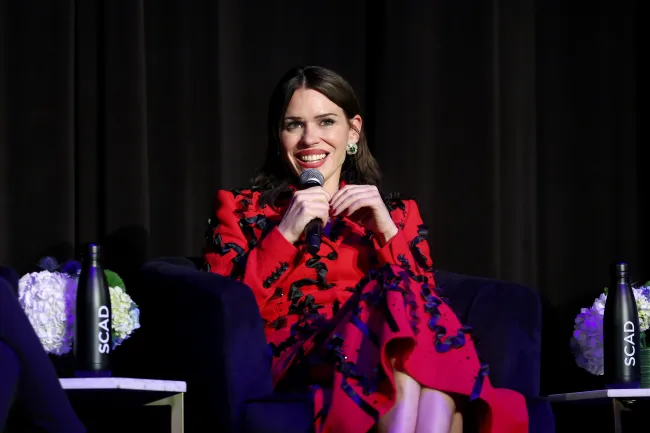
Piper took the stage at the SCAD Savannah Film Festival alongside the film’s casting director Jessica Ronane for a Q&A moderated by Gold Derby editor-in-chief Debra Birnbaum, to talk about working with “beautiful Andrew Scott,” building the cast of theater actors, and balancing the film’s heartbreak with joy.
Gold Derby: How did each of you first hear about the project, and what was your response?
Billie Piper: I came to it fairly late. My agents gave me the broad strokes of the story and mentioned Andrew Scott and [director] Simon Stone. I said yes before I’d even read it. Those names made so much sense together. Then I read it, and I found so much joy in it. The themes are tough, and I knew it would be moving and upsetting, but I laughed a lot on the page — which helps, given how difficult some of the material is.
Jessica Ronane: I think we all came to it quite late; it happened quickly. Simon Stone called me and said he’d possibly just read the best and most moving script he’d ever read. He sent it to me, and we were greenlit because Andrew was attached, so we had to move fast. Billie’s response was shared across the board. We knew we had to be careful about who we brought into the project. People wanted to be part of it, and it was important to honor the real people in the script through thoughtful casting, without letting the project go too wide.

Before we go much further, I want to talk about Andrew Scott. Billie, what did it mean to work opposite him?
Piper: I’d worked with him once before, and I was a huge fan long before that. I first saw him in Sherlock and thought, “Who is that?” I followed his career and was desperate to meet him. We worked together on a Lena Dunham film, where we played husband and wife, and I fell in love with him straight away. I talk about him constantly — I have him in my phone as “Beautiful Andrew Scott.”
I love him, and working with him again — this time as his best friend — was so much fun. There was so much joy to find in that dynamic. Working opposite him is career-defining every time.
Jessica, when you have someone like Andrew as your lead, how do you build the cast around him? You’ve described each role as a little gift. How do you decide who gets each one?
Ronane: For some of the roles, we had to start with the real people. [Screenwriter] Stephen Beresford had done an immense amount of research and offered us these little golden moments to think about. We went through footage, books and photographs to get it right, then worked slowly through the first few roles.
It became more playful when we were building the Hamlet company and casting some of the smaller roles. Simon needed actors he could trust in the rehearsal room, because they truly rehearsed the play. We needed a genuine Shakespearean company. Other small roles were just as key — the parents, for example — so we worked through them strategically. Producer Gaby Tana is incredibly knowledgeable about actors, and Stephen, Andrew, Simon and I all work in theater as well as film, so we had a wealth of actors in mind.
Patsy was a real person. Billie, how did you balance making her your own while honoring the real Patsy?
Piper: I’m sad I didn’t get to meet her. Stephen, the writer, had met her, and I trusted what was on the page as my Bible. I built from there. I’ve known a few people like her in our industry, although they don’t really exist anymore — larger-than-life personalities from the late ’90s and early 2000s. My agent is one of them. I also knew women in my family who were a bit like her, so I could feel her that way.
Ronane: I knew her a little. When I first started casting, I was teaching a casting seminar at SCAD. What I loved about Patsy was her confidence. She needed it to do the job she did at that time, in an industry that was still quite male-dominated. When I met her, she had advocated for a role in a film and pushed through some casting. I came to know her clarity, confidence and absolute self-possession. It’s funny that Billie didn’t get to meet her, because we knew Billie would inhabit her so perfectly — and she does.
Jessica, what was it about Billie that made you feel she was right for the role?
Ronane: She has a timelessness. You need to believe that a successful woman could have been in that position at that time. Billie has the voice, spirit and sensitivity, but also the strength. There’s a line in the film about how a director can draw a performance only from someone who has that performance within them. Our job is to discuss actors we believe have that performance within them. That answers it, really.
Patsy‘s humor brings so much to the film. Billie, what appealed to you about playing her?
Piper: She’s a great role to play. I think she was in a great deal of denial about her best friend dying. She was there for him, supported him, picked him up from the theater and gave him everything you see in the film. But I think she struggled with it.
Her whole shtick was that she was tough. She understood her best mate and knew this was something he had to do at his most vulnerable point. Everyone else was saying, “This is absurd. This is crazy. It’s going to shorten your life.” She understood that doing Hamlet was exactly what her friend needed to process his reality.
She was tough, but she was also a lover of life. She loved actors, and they loved her. She and Ian partied hard and had big, drunken sing-alongs. I think Ian was also fundamental in helping raise her daughter as a single parent. They were like family.
Ronane: She was spirited and tough. I think she came from a working-class family in East London, worked her way up and became a prolific casting director. Her catalog is extraordinary. Her support of Ian is crucial to what the film is about: pushing through all odds and recognizing that doing Hamlet was essential to his healing.
She understood. And there’s also that idea of community — the way it can give life. We’re lucky in our industry, and the students here will be creating an extended family. That community can bolster you in times of trouble. It’s highlighted for Ian at that point in his life. The story shows what we live when we work in this very special industry that holds us up. I think that’s a powerful message.
I often ask filmmakers how they found the right tone. That’s especially critical here: the film could have become maudlin, but instead it carries so much hope, love and life. How did Simon and Andrew help bring that through, either in casting or on set?
Piper: I felt it was all there in the script. That’s why, when Simon says it’s a perfect script, you feel the same way. It was all there. And the actors you pulled together work in a similar way: they’re very good at what they do, but casual and warm — not nightmares. They love their work, but they also love going home. They want to have a laugh.
Their backgrounds are largely in theater, which gives the work a certain thrust: “Let’s do this,” in the spirit of theater. There isn’t anyone in the cast I haven’t seen on stage in the last five years, and many of them I’ve seen within the last year. Building a company like that around Andrew, who had such a mountain to climb, meant finding people who were trustworthy, supportive and egoless — people who would step in with the right frame of mind.
Ronane: Part of my job, which I love and take seriously, is matching personalities to make a company. Casting directors have to get to know so many actors. It’s relentless but fulfilling, because then you have a job like this, where you need absolute confidence that the company will honor the work.
They led from the top. Andrew and Stephen were so closely connected to the script; it’s in their DNA. The stories and community in this film are in us, too. We’ve lived with them and cared about them for so many years.
Given the play within the film, were you always going to cast theater actors? What did it mean to draw from the British theater community? There are so many familiar faces.
Ronane: I don’t think there’s as much of a distinction now between theater actors and film or television actors. People move beautifully between forms, and that’s a great thing — you need all of it.
But the Hamlet cast was particularly important. Simon wanted to shoot it organically and really rehearse the play, so we needed people ready to jump fearlessly into different sections. They had to be able to help someone who lost a line, as they would in a real rehearsal room. They’re a legitimately brilliant Hamlet company.
Many of them were also friends of Ian in real life, some with very moving connections to him. Seeing Andrew look so much like Ian was tough for some of those actors. We had to be sensitive to them and to Ian’s family, who were there on the sidelines. So many people in the film had connections to Ian and his life.
At the London Film Festival premiere, many of the real people were onstage with us at the end. Linda from the stage door was there, as was Margaret with her daughters and Ralph, the dresser. Everyone was in bits. I was floored. Many of the cast had performed at the National Theatre, so everybody knows Linda. If you walked past its stage door, you’d see her sitting there. She’s beloved by actors because she’s tough and direct — not at all indulgent. If you’re having a moment, she won’t indulge it. Everything you see in the film is pitch-perfect; she wrote her own lines.

We can’t go this far without talking about Olivia Colman. Billie, what was it like working with her? I love the line about how she would have made an excellent Lady Macbeth.
Piper: I’d worked with her before on a Shakespearean retelling — Much Ado About Nothing, I think. She’s a great laugh, really good at what she does and very easygoing. She doesn’t like hysteria. She just does the job, goes home to her kids, and loves a laugh. She’s naughty and great fun.
Ronane: Johnny Flynn is also amazing — so soulful. He’s a beautiful actor, and his voice is soothing. Richard Eyre is another stalwart of the National Theatre, and I think he was personally concerned about who would play him. I think he did quite well with Johnny. The scenes between Johnny and Andrew are some of my favorites. Johnny captures Richard beautifully.
One of my favorite moments is the final scene, with all the actors banging on the windows.
Billie Piper: I wasn’t there on the day they filmed the banging at the windows, but the feeling is real. Many of us have experienced it. It can happen before you go onstage as well as after a performance. I always found it a bit stressful, but also deeply moving. Seeing it reenacted was amazing.
Jessica Ronane: It was an interesting day, and my team and I visited the set. What they did was really special. You’d probably have to watch in slow motion to see it, but I think it was Stephen and Andrew’s idea to invite everyone connected with Ian to be part of the scene.
There are so many people at those windows who were part of his life, including Esther, a wonderful director who cast Chariots of Fire. They were filming at the National Theatre on a Sunday, and people lingered around for ages. Everyone who had ever won the Ian Charleson Award at the National Theatre was invited to be part of the scene, too. It was a very sociable day — with a lot of waiting around — but really special.
Do you have a favorite scene or moment you’ll take away from the film?
Piper: I love the scenes where we’re smoking and laughing around the table. Those moments are hard to get right because you want them to feel authentic, while building toward something moving in a different direction. It’s surprisingly technical, but there was a lot of improvisation and joy. I’m particularly fond of those moments.
