
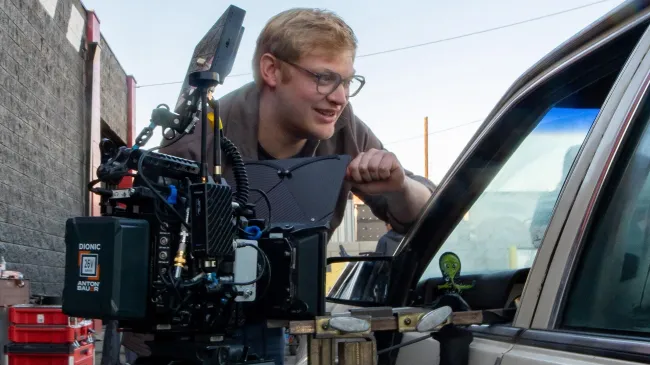
If you have to make like Harrison Ford and shut your eyes during the face-melting climax of Raiders of the Lost Ark, just wait until you see — or, rather, don’t see — what Curry Barker has in mind for his own version of an Indiana Jones adventure.
When Gold Derby chatted with the director behind 2026’s biggest horror hit-turned-serious Oscar contender, Obsession, we made sure to mention that his producing partner, Cooper Tomlinson, had told us that one of his career crusades is making a fresh version of a Steven Spielberg-style adventure epic. And Barker confirms that he’s ready to follow Tomlinson into a Temple of Doom where hearts aren’t the only thing being ripped out of human bodies.


“I would want to do a really f–ked up, rated-R version of [Indiana Jones],” the filmmaker says with a sly grin. “I want to do a crazy adventure movie. That’s something that Cooper and I have talked about, because we feel like we’ve never seen something like that; we’ve only ever seen the family-friendly version. But what happens if two regular guys, or one regular guy, goes on a journey that turns crazy? Literally pushing the boundaries of that genre would be fun for me.”
Barker has already been having the kind of fun year that young filmmakers dream about. After Obsession was snapped up by Focus Features following its Toronto International Film Festival premiere last fall, the horror film had a monster summer at the box office, grossing over $500 million globally. And the film is now on track to follow last year’s horror hits, Sinners and Weapons, into the Oscar conversation. Obsession‘s breakout star Inde Navarrette is surging in the Best Actress race following her Saturday Night Live Halloween hosting gig, and the film itself remains an on-the-bubble contender for Best Picture.
In a lively conversation, Barker shares what defines the “Curry Barker style” and the opening shot that got cut from the film.
Gold Derby: This is top of mind because I Play Rocky is hitting theaters soon, but I’m wondering if you were ever presented with a similar situation to Sylvester Stallone where people were encouraging someone else to make your Obsession script.
Curry Barker: Oh no, there was no way in hell I was going to let anyone else do it! [Laughs] And I’m still that way. I could see myself maybe one day writing something and let another director come in and make it, but that’s mainly so I can keep projects going. It’s hard because when you’re that far along in the writing process where you’re talking about directors, the script has become your baby.
In Stallone’s case, he saw Rocky as the last shot he had. Did you feel the same way about the Obsession script?
Yeah, I think so. It got to that point where it was like, “This is my shot. If this movie sucks, it would be really hard to get another opportunity like this.” But it was also more the opportunity that I was grappling onto, not necessarily this script. I haven’t seen I Play Rocky yet, but I imagine the whole thing [with Stallone] was “This script is everything, and it’s so personal me.” That wasn’t really the case with Obsession, but it was important to me that this movie was everything I wanted it to be. It became my baby, and it always will be. But even if I had chosen a different script, I would have treated it the same way.
Obviously, the temptation with a first feature can be to really ratchet up the visual style to make an aesthetic impression. While Obsession has some striking images, it feels like you really wanted to drill down on mastering story and character.
I did want to put my own visual stamp on it, but my stamp just isn’t very in your face — it doesn’t shout at you. But things like the aspect ratio that we chose and our intentionality with our coverage where we really earn our close-ups is consistent with the visual look that I created in my shorts, including my new one, “Mama Bear.” So I have a distinct style, but story is definitely the most important thing to me.
Is there a particular scene in Obsession that you’d point to as defining the Curry Barker style?
The scene where Nikki (Navarrette) crawls into bed, and Bear (Michael Johnston) walks into the frame. She takes her shirt off from the back, and he turns around so he’s facing the camera and it becomes his coverage. Then he takes his shoes off, turns around, and it becomes her coverage. Then we rack-focus to her as he steps into bed, and we slowly zoom in as they’re both in bed. That type of stuff, to me, is the Curry Barker style. I’m using blocking and using the camera to tell the story without necessarily cutting a bunch of times. I always want to push that to see how far I can go with it; and it’s also really hard, because when you shoot everything in one shot, there’s no room to edit.
Is there a director whose career you’d like to model? I keep thinking about Richard Donner, because he broke out with The Omen and then went on to have a really wide-ranging filmography.
I think Ari Aster does a really good job with that, too, especially in Eddington. Whether you love that movie or not, there’s no arguing that it’s not a master class in blocking and intention, and using the camera to tell the story. All of Ari’s work is like that; you can pause a frame in any one of his movies and think, “Oh my God, I can learn this, I can learn that.” He is also the master of “show, don’t tell,” and that’s what I want to keep doing. And what’s funny is the more that I’ve learned about the kinds of movies that Ari likes to watch, the more I’ve seen where his style comes from. [Laughs]
The other director I really like is Kiyoshi Kurosawa, who made movies like Cloud and Cure. He is a master of blocking, and his shots don’t stop! But it’s not in the Spielberg kind of way where it’s a oner that’s pushing through the world; he doesn’t cut, but he also doesn’t use that kind of dynamic motion. It’s more like the camera’s in the same place, but the blocking is changing. One actor might be winning a scene, but then they sit down and another actor stands up and is towering over that person, and we haven’t cut yet. That’s really cool stuff.
What’s an image that got stuck in your mind while you were writing the Obsession script?
The opening shot changed during editing, but the original version will forever be in my head. The camera was on Bear, then it moved down to his dead cat and then moved upside down on to the TV and you can see that he’s watching a rom-com. So by the end of that shot you realize, “Oh this guy loves romance, and wants romance.” And then the last shot that’s still in the movie was supposed to mirror that where the camera starts on Nikki, goes down to Bear, and then upside down on the TV.
We filmed the original opening and put it in the movie and it was there for awhile, but then we did reshoots and decided to change up the ending so it didn’t make sense anymore. But I was holding onto that image for awhile and it still sticks in my head. I wonder if that’s the same for other directors, too.
One of the key moments in the film is the car scene with Nikki and Bear before he makes his wish. There’s been some discussion about how that scene was supposedly filmed two ways — one where Nikki made it clear she was into Bear, and one where it was clear she definitely wasn’t. When I spoke with Inde and Michael about that scene, they didn’t recall that happening. Care to offer the final word?
There was always a lot of discussion around keeping Nikki’s feelings for Bear ambiguous. It’s not like we said, “OK, in this take, you’re going to be flirty, but in this take, you’re not going to be.” We didn’t do that. I think that became some sort of internet thing that someone said somewhere. But I was very much playing with the idea of “Does she like him or does she not like him?” So that’s very intentional, but in the way it’s written, we would have her kind of flirt with him by saying “babe” or something like that, while also making you think, “Maybe she talks to everybody that way.” And you can see how after years and years of that, it might make someone think, “Does she like me?”
Inde also credited you with helping guide her through the process of playing multiple versions of Nikki in one body. What was your approach to directing that aspect of her performance?
Oh man, I had to be so specific about it. Some of that was stuff I had already toyed around with in past work; I did this short film called “The Chair” where I had an actress popping into different emotions. So when I came up with the idea of Obsession, it was something I was really excited to explore and it was a huge part of the audition process. I wanted to see if the actors that were auditioning could smile and then frown, and change those emotions really quickly.
But also, it’s not a gimmick — it has to be real. Like that scene on the bed where Nikki is kissing Bear and then she freaks out and flies back; that’s not supposed to be this cool, scary moment. The idea is that the real Nikki remembers being outside by the car, and now she’s all of a sudden on this bed kissing Bear and how confusing that is. Inde and I talked a lot about what that feels like and how it affects how you take in your surroundings.
In moments like that one, Nikki has to wake up and try to figure out where the hell she is, all in a couple of seconds. And if there was a take where that didn’t happen, we’d do it again, because it couldn’t just be her screaming. I would always tell Inde, “I need you to see the room, and I need you to see Bear.” And we’d keep doing it until we got it right.
This interview has been edited and condensed.
