
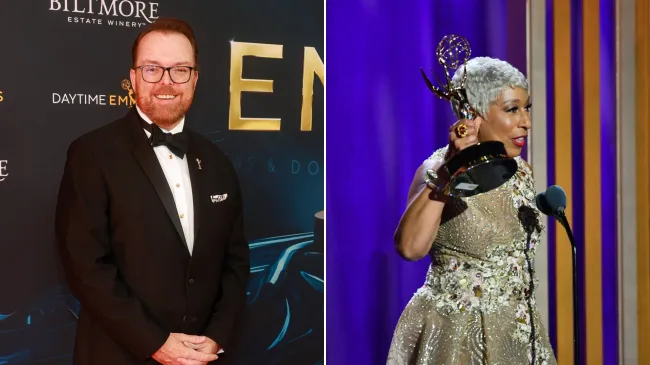
The debate is over: Emmy Awards that are handed out by the National Academy of Television Arts and Sciences at the Daytime, Children’s & Family, News & Documentary, Technology & Engineering, and Sports ceremonies all count toward EGOT status, just like the Primetime Emmys.
“Yes, it is the same statue,” confirms Adam Sharp, president and CEO of NATAS. “It is all the same Emmy Award, the same standard of excellence. There is no difference.”
The NATAS boss joined Gold Derby Tuesday for a postmortem on the 53rd annual Daytime Emmys and the state of the awards. He’s back in New York now, proudly wearing his “I Voted” sticker on Election Day.

During our conversation, Sharp covered a range of topics related to the Daytime ceremony and more, from the Beyond the Gates contingent “blowing the roof” off the theater after the show’s historic first win, to the emotional tributes to former soaps, to how John Oliver is indeed eligible to be nominated for guest-starring on both Days of Our Lives and General Hospital.
He also offered an update on the ongoing merger talks between NATAS and the Television Academy, saying, “I’m feeling rather positive on where we are right now.”
‘PLEASANT SURPRISES’

“I think we had a fantastic evening,” Sharp said of Friday’s ceremony. “It was a new venue, a new format, and so it was expected to be a night of planned firsts.”
The envelopes bring “pleasant surprises” every ceremony, and this year was no exception, with inaugural wins for Tamara Tunie, Tracee Ellis Ross, and Star Jones, plus Beth Maitland and Roger Howarth setting records for the longest gaps between Emmy wins.”
He continued, “We knew it was going to be the first showing for Beyond the Gates, and everyone was reasonably confident that, coming in with 15 nominations, we’d see them on stage at least a couple of times. And so I think it was an exciting night there.” The first new broadcast soap opera in decades ended up winning four awards: Best Lead Actress for Tunie, Best Emerging Talent for Ambyr Michelle, Best Hairstyling & Makeup, and Best Lighting Direction.
‘LOUD NOISE ALERT’
There were so many ticket requests for Beyond the Gates that the awards show had to set up an “overflow” section in the balcony, next to Sharp and other NATAS members. “When they got that first win of the night [Best Hairstyling & Makeup], we were laughing because the loud noise alert on the Apple Watch started going off on all our phones at the same time. The excitement was literally blowing the roof off the place, and rightfully so.”
For many years, there was a “lack of recognition on the Daytime Emmy stage for Black performers and Black-created programming across the board,” Sharp said. “What this year’s awards illustrated was that this wasn’t for lack of desire by the Academy voters. They were waiting for the content to vote for.
“A few years ago during the height of the Black Lives Matter movement, I remember having a lot of conversations internally about this, and we were looking back at many of our performance categories and finding that half the time there wasn’t even a performer of color submitted in many categories. That was a reflection of the casting patterns at the time.”
“As exciting as it was to see Tamara Tunie on that stage, the fact that we are celebrating anything in the single digits in 2026 is a disappointment,” Sharp continued. “It is a testament to the groundbreaking nature of Beyond the Gates and turning that expectational tide in terms of what the audience was looking for in the daytime soaps.”
‘SUPERFANS FIRST’
The ceremony had a “reunion feel” as it featured emotional tributes to gone-but-not-forgotten soaps by the actors who starred in them: Crystal Chappell (Guiding Light), Lesli Kay (As the World Turns), Joe Lando (One Life to Live), Eva LaRue (All My Children), A Martinez (Santa Barbara), Juliet Mills (Passions), and Alicia Leigh Willis (Another World).
“I often say that our team is made up of superfans first … you really have to love television,” Sharp explained about the tributes. “Those look-backs really were the brainchild of our Head of Daytime, Rachel Schwartz, who shared a photo of herself meeting Joe Lando at a fan event when she was, I think, 13 or 15. The whole idea wound up being a bit of a full circle for her there.”
The team “went back and forth on including clips in those packages,” but ultimately decided not to because of a mix of time constraints and rights issues. “We felt that we needed to be even-handed, that it was an all or nothing,” he said. “If we couldn’t put together what we felt was a proper clips package for everyone we recognized, we shouldn’t have one for anyone.”
‘CHANGING CONSUMPTION PATTERNS’

Many of NATAS’ Emmy ceremonies stream online, but next year marks a first for its cousin, the Primetime Emmys, as they’ll be streaming on Prime Video. In 2029, the Oscars will arrive at its new streaming home of YouTube. “It’s first and foremost a recognition of the changing consumption patterns for all programming,” Sharp notes about the growing virtual landscape.
“If you view the shows quite simply as a television program, the reality is more people get their programs from streaming platforms than from linear TV. So, at a very simple level, it is just a reflection of how programming is being delivered.
“At a more nuanced level, it potentially gives more opportunity to break the mold a bit and be more creative with these award shows. NATAS may have a little bit more of a track record because we have always been more verticalized in our ceremonies, having shows for Daytime, Children’s, News, Sports, and Documentary.
“Traditionally, the big broadcast events — the Oscars, Primetime, Grammys, Globes — were born out of the linear television construct where there is one TV in the house. It’s a piece of furniture in the living room. You want to find a program that has a little bit of something for everybody, because everyone is going to gather on the couch and watch it together.”
But the “home dynamic” has shifted, Sharp noted. “Everybody has their own personal screen, if not multiple screens, and the number of events and programs that draw people to that communal experience is waning. You’ve seen that in the ratings numbers for award shows. What streaming allows is a bit more flexibility to channel awards programming and segment it out, so that those who are interested in these categories can just consume that part of the show. The streaming platform winds up being the mechanism for channeling those different pieces of the content to the different audiences.”
‘STILL A LOVE FOR SOAPS’

Sharp confirmed that HBO host John Oliver is eligible for a guest performer nomination for his roles on both General Hospital and Days of Our Lives. “Ironically, because he played different characters, he is eligible to be nominated multiple times — were he to so submit,” Sharp admitted with a chuckle.
The NATAS boss boils down Oliver’s summertime obsession as evidence that “there is still a love for soaps” and that audiences have an “intimate attachment” to the programming.
“People grew up on the format, they grew up watching their parents watch it,” Sharp said. “These are shows that you don’t just binge in a weekend and then come back to a year later. They’re part of your routine every day, all year, for decades. That builds a loyalty and connection that no other scripted programming can match. To paraphrase the old quote, rumors of soaps’ demise have been over-exaggerated.”
‘POSITIVE’ MERGER TALKS

Sharp finished by delivering an update about the merger talks between the New York-based NATAS and the Los Angeles-based TV Academy, which have been ongoing since the summer. The groups split in 1977 but are now exploring whether to reunite after the 50-year break.
“Conversations are going well,” he revealed. “We had a team of their senior leadership at the Daytime show on Friday night, so the conversations are continuing — and continuing positively. As we are both nonprofits, we have the luxury of not having Wall Street breathing down our necks, forcing a timetable. So there is no clock on the conversation. It gives us the luxury to be slow and deliberative and reach a framework that puts our membership first. I think that will continue probably through the end of the year, and then we’ll see what happens. I’m feeling rather positive on where we are right now.”
