
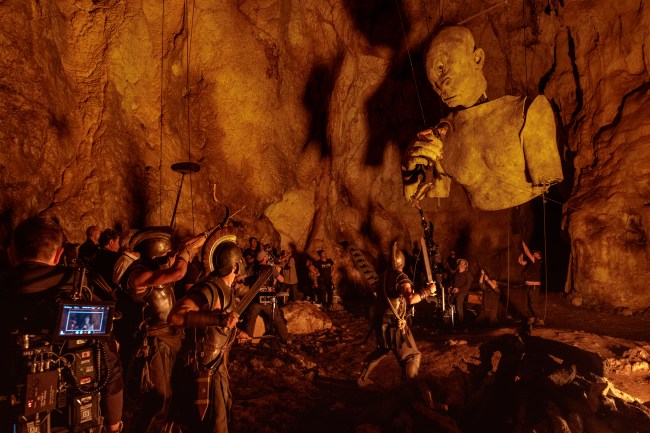
The Oscar-contending VFX centerpiece of Christopher Nolan’s The Odyssey is the giant Cyclops, Polyphemus, son of Poseidon. He traps Odysseus (Matt Damon) and his crew in his cave and devours several soldiers before they blind him and escape the island.
In keeping with Nolan’s grounded, believable hybrid approach to VFX, his DNEG team brought Homer’s mythological monster to life through practical effects — puppetry and animatronics — prosthetic makeup, live performance, and digital compositing.
The centerpiece of the sequence, shot at the historic Nestor’s Cave in Messenia, Greece, was a 60-foot puppet. Bill Irwin, an actor and theatrical clown who voiced and puppeteered TARS and CASE in Interstellar, provided the performance for Polyphemus while wearing full-body prosthetics. Irwin also provided the puppet’s likeness.


“We knew right from the beginning that we were going to embrace the whole gamut of visual effects,” VFX production supervisor Andrew Jackson (Oppenheimer) tells Gold Derby. “We were very keen to find a way to make something that occupied that physical presence in the cave … that we should build something that was the right size.”
Jackson collaborated on the design of one-eyed Polyphemus, inspired by Francisco Goya’s painting Saturn Devouring His Son, with special effects supervisor Scott Fisher and prosthetic designer and creature supervisor Conor O’Sullivan. The team first looked to large French street puppets and began building one during preproduction, planning to shoot the Cyclops cave sequence in Los Angeles at the end of production.
“We had scanned Bill Irwin in full makeup and we’d blown that up, and we were printing molds to make the full-scale puppet,” Jackson adds.

Then something unexpected happened: After returning from a location scout, Nolan decided to shoot the Cyclops sequence on location at Nestor’s Cave. This left the team with only two months to prepare, instead of nine, and forced it to abandon plans for a more complex animatronic puppet with fully articulated joints and a torso.
“Having the time reduced was a bit of a shock, and several people declared that this was not possible anymore,” Jackson admits. “But I was determined to have something in that cave by the time we were shooting. So we stripped away all of the complications of the build and did the bare minimum of the physical body parts [made of thin fiberglass with texture detail], making them rigid and lightweight.”
Jackson was amazed by the result: The puppet’s movement was largely unobstructed, giving it a surprising life of its own. “When you put this thing up in the air, you only had to pull one of the arms around,” he explains. “The whole body would follow and move with it, and it made me feel that I don’t ever want to go back to doing animatronics. I just fell in love with this idea of the marionette, which moves on its own without mechanical input. It was much more than we imagined.”

The puppet was the basis for many shots, including those of the Cyclops looming over the soldiers, lying down and sleeping, and thrashing around beside the fire. The team also created a CG version and tracked it to the puppet to fill in the missing joints. For select shots of the monster yanking soldiers out of the darkness, the team built an animatronic arm.
“For the more complicated action, like opening or closing the cave door, we used Bill in makeup [with his skin wrinkled] in a miniature cave set,” Jackson recounts. “We intercut between the actor and the puppet. And then, for close-ups of the face, we took one of Bill’s eyes and rotated it with 2D software, tracked it onto his forehead and deformed the nose. So we used a CG head and tracked it onto Bill’s head as a guide for transforming the 2D eye. It was a perfect [solution] for retaining the performance of the eye, and all of the performance of the Cyclops’ face was coming from Bill.”
When it came to the performance, Nolan was adamant about humanizing the Cyclops — a lesson he learned from Guillermo del Toro. Jackson has been impressed by the sympathy the character elicits from viewers who see him as a victim.
“Chris was so in love with the way that the puppet moved that we were actually asking Bill to be less demonstrative and perform more like the puppet, which was probably a bit of an insult to the actor.”
One of the more interesting action beats comes when the soldiers spike the monster’s eye while he’s lying on the ground. “He’s thrashing around with his arms and legs, and we did all of that with the puppet,” Jackson recalls. “That was another scene where we patched all of those joints with CG, but we retained as much of the puppet as possible.”

When the Cyclops chases the soldiers out of the cave as they run toward their ship, the team initially filmed him running downhill close behind them. But during the edit, Nolan decided it would be more threatening to show the Cyclops pursuing them from farther away. That also gave the soldiers more time to reach the beach and board the ship before he arrived. Otherwise, they would have reached the beach at the same time.
“We built a miniature forest set, and we shot Bill running through the trees toward the camera, which was right down on the ground,” Jackson adds. “Some of the shots, when we were doing them, you were barely aware that the creature was there. But then, when you watched it in the edit, you saw it every time. Very effective. I thought this was another example of Chris using effects in a very subtle way.”
