
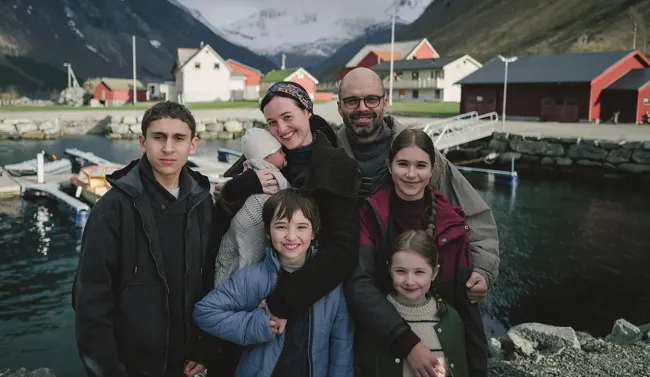
Since winning the Palme d’Or at Cannes, Fjord has been on a roller-coaster ride — sparking fervent praise along with fierce debate. Critics have embraced the film (92% on Rotten Tomatoes), but audiences are proving to be just as outraged over its open-ended storytelling. Spoiler alert: There are no easy answers, and that’s just as the director intended.
The film, written and directed by Cristian Mungiu, follows a religious Romanian family (the parents are played by Renate Reinsve and Sebastian Stan) who resettle in Norway, the wife’s native country, and face accusations of child abuse, which leads to the children being placed in foster care. It’s a cultural clash between their conservative religious beliefs and practices, and the more liberal, progressive Norwegian authorities, who can’t abide even the slightest suspicion that the kids are being harmed.

Does spanking equal physical abuse? Can a progressive society tolerate conservative religious beliefs? Is this just a miscommunication because of the language barrier? Mungiu tells Gold Derby he intentionally provokes his audience with these unanswerable questions.
“There is so much polarization and radicalization that people are no longer very communicative with one another. They live in bubbles,” he says. “I thought that, for once, rather than addressing the film to one of those bubbles, we could keep it open and present the arguments of both sides from a neutral point of view. Perhaps that would encourage people to listen to one another and find a way to communicate.”
Gold Derby: Take me back to the beginning. What inspired Fjord?
Cristian Mungiu: It’s based on a true story, and on a story that is quite close to what you see in the film. There was a Romanian family, with a Romanian husband and a Norwegian wife, who had five children. They were religious and moved from Romania back to Norway. A few years later, they had a problem with the authorities. After losing all their children and going through four or five months of trial, they managed to get the children back temporarily and immediately ran back to Romania.
The case was widely covered in the press about 10 years ago — not only in Romania and Norway, but throughout Europe and in the United States as well. I started collecting information and reading about it. Little by little, I noticed there was a pattern. Whenever families from more conservative countries or territories move to Scandinavia, conflicts like this can appear because the values are so different.

You can disagree about many things, but when it concerns your children, it’s more complicated to come to terms with those differences. I followed the case silently for years. At some point, I decided I might turn it into a screenplay because I began to see a relationship between this story and what is happening in society today.
If you have children, you don’t want to pass on this kind of world — a world with so much aggression and hatred, especially if you read social media. I thought this was a good point of view, and it also followed my previous film R.M.N. In that film, I was studying how a conservative majority behaves when it faces somebody who is very different from them and is not particularly inclusive.
I wondered what would happen if you changed the paradigm and created a society in which the majority was liberal and progressive. Would it behave differently toward a conservative minority? It’s not so clear. Perhaps belonging to the majority is even more important than your values. You start to feel the strength of imposing your values on others, and that should be questioned, because it isn’t very effective.
Why is now the right time to tell this story?
If we look at what is happening around us, the situation isn’t very optimistic. Between my two films, I think there is much more illiberalism than there used to be. We went through a period when societies seemed to be pushing toward greater liberalism and inclusion, but somehow we ended up generating the reverse effect. Now we have right-wing parties in power, and everybody is exploiting populism.
It’s easy to say what doesn’t work, but if you don’t offer solutions, it isn’t helpful. I thought this was the right time because this is what I do with my cinema. From all the possible stories I could tell, I try to focus on things that are important to me but that I feel could also be important to people living at the same time as me. They speak about trends in society and about what is happening today.
I believe it’s time to try to do something and find answers — not necessarily answers about the film, because the film is only a trigger for a conversation, but answers about the situation in our countries and in society in general. How do we get past this dead end, this moment of noncommunication with others? I can’t think of a better moment than when you realize you have this problem.
But the film doesn’t offer a solution. You don’t take sides, which has frustrated some people. What do you want audiences to take away from it?
I’m not more intelligent than everybody else. My task isn’t to offer solutions. My task is to tell a story that says this is something important that you should think about. You should double-check your own values every now and then, look for solutions and doubt that you are right, because I think that’s the main problem in society today.
Everybody believes they are right. We live in bubbles where everybody confirms that we are right. We watch the television channel that confirms we are right. We see people who believe the same things, and we don’t go anywhere.
The solution is to step out of your bubble and make the effort to rebuild bridges of communication. That is why I chose to make this film from a neutral perspective, presenting two different sets of arguments and values about the same thing.
I understand that people are frustrated, but they are frustrated because they have become used to watching films that confirm they are already right. That is the kind of cinema we’ve been making for the last 20 years. It played a part in promoting good values, but cinema should be more complex than this, because life is unfortunately much more complex. It doesn’t come with answers and interpretations.
You see something happening next to you, and then you have to think it over. You have to use your critical spirit. That is what I’m encouraging people to do while watching the film: Watch it with an open heart and understand that it’s not simply a matter of being right or wrong. It’s about opinions.
If you belong to the more educated layer of society, perhaps you have a responsibility to initiate the dialogue. As my mother said, “I expect more from you because you’ve been given a good education. Don’t tell me the others need to start the conversation. You start it, and you start with yourself.”
I’m a parent, and what I’ve learned from parenting is that it isn’t important what you tell your children to do. They are smart enough to understand immediately whether it works. They’re always checking what you actually do — not the beautiful values you talk about. Today, we all talk about empathy and inclusion. But are we practicing them? Not enough, I would say.
The story is set in Norway, but it could have happened anywhere. What made you want to set it there?
From my perspective, it is a very universal story. It could have happened in many other places. But since it happened in Norway, I wanted to understand why. For one thing, Norway has some of the strictest legislation concerning child abuse. On the other hand, the Scandinavian countries represent, for us, a kind of pole of advanced progress — societies with modern views that are widely shared.
If you placed the story in France, the United States, or Italy, it could happen there as well, but those societies are more divided and polarized. In Norway, pretty much everybody shares the view that this is good, and they want to keep society moving in this direction because it was complicated to get there.
While investigating, I learned that Norway itself was a very violent country 100 years ago. After a century of wealth, education and legislation, they are happy to have reached this level and don’t want to become less inclusive or more conservative. So they took the liberty of thinking that if families in society want to pass on different values, that could be a problem.
You are free as a parent to pass the right values to your children. But if you want to return to other values, you might understand that the state could have the upper hand when it comes to your children’s education. This shows you the direction a society can take when a majority, with the best intentions in the world, is not challenged enough to reconsider whether it is becoming too rigid.
People coming from other parts of the world may be at a different point in their development. They may be where Norway was 50 or 100 years ago. You can’t accelerate that. It’s as if you take a green banana and put it on the stove, thinking it will turn yellow. It takes time.
Norway has learned, for example, about how it treated the Sami [Indigenous] population, which was not very nice. Now there is a sense of guilt, and the country tries to address it by giving them many benefits. But the larger conclusion you can draw from the past is that you should treat people living today better. You shouldn’t try only to fix things that have already happened.
If you want to learn something from the past, try to treat migrants living in the United States better today.
Let’s talk about your actors. What did Renate bring to the role, especially since so much is on her face rather than expressed verbally?
Renate chose to play the mother rather than the other part [of Mia, the lawyer who represents the parents]. The decision was open to her. We read together from the screenplay, and she brought the lovely charisma she has as a person, as well as the intuition she has as an actress.
We talked a lot. I introduced her to the ideas and beliefs of these people, and she went with me to understand their biography better. I took her to the kinds of churches they attended. She spoke with people who shared those beliefs and listened to recordings I had made.
At the same time, there was something about her that helped us focus on the truthfulness of each small moment we wanted to shoot. If the screenplay is human, universal and psychologically believable, even when the character has values different from your own, you can sympathize with that character and understand the reasons behind their choices.
No matter what kind of violence existed in this family, they loved their children and were trying to educate them in the best way they knew. It may not correspond with what happens today, but it’s hard to be judgmental about somebody else’s values. It’s also difficult to know precisely what happens in other families.
You have to make choices about people without knowing what is in their minds. They might be lying or manipulative. You don’t know; you only know what they tell you. Renate managed to express gentleness and fragility all the time, while also building a character who was firm and honest.
She is facing a society that is hers, yet she is in the most difficult position in the film. At the same time, she expresses great solidarity with her husband and his beliefs. She did this so beautifully that she also helped me guide the children to play in the same direction as their parents.
This is a side of Sebastian we’ve never seen before. How did you know he could deliver?
It’s wonderful when you can extract actors from being typecast, because that is the greatest danger. Sebastian was a very good superhero, but he is such a complex actor. You can see while talking to him and working with him, that he can do very different things.
We had been talking for about 10 years. We met at the New York Film Festival, and over those years we worked on several screenplays. When I decided to make a story out of this case, I called him and said, “Look, I think I’ve finally found the right material for us.”
It was going to be his first film in Romanian, as he had wanted, and my first film in English, as I had wanted. It’s hard to find a story that offers both of those things. It gave him the opportunity to act in Romanian and English, but also to understand the biography of the character.
He left Romania when he was quite young — at eight — but he still remembers kindergarten, when it was perfectly normal to hold out your palm to a teacher who had a stick. That was simply how things were then. It’s more complicated to explain that to somebody who doesn’t have that experience. Sebastian still speaks Romanian with his mother and has relatives there, so he is closer to understanding what it was like to grow up during a very violent communist era. It’s difficult today to imagine that people can move immediately from that background to a very calm, wealthy and educated society. Values do differ. It was important for me to work with somebody who could understand the character’s background and who was very good at expressing the nuances I asked for.
He also had to work in the complicated style I use. I don’t know how much people notice, but we shoot every other scene in a single shot. That style is complicated for actors because the choreography is very precise. There is no improvisation. They need to know the text so well that they say the same thing in every take. There are children, sheep and many moments when things don’t go as planned. The most complicated scene for Sebastian was when I had all these sheep moving around him next to the children.
I don’t edit and I don’t shoot coverage. I put the scenes one after another, so I need to leave the set with a very good scene and the right rhythm. That is why we may need 10, 20, 30, or 40 takes — however many are necessary. Sebastian was resilient and nuanced. It also helped that he already knew Renate. We had to start shooting right after they returned from the Oscars, with no time for them to get to know each other.
Is there a scene or moment that stands out when you look back on the film?
I would say the trial scene was the most complicated. It was important to make sure all the arguments were right, and it’s difficult to say who is right and who is wrong. At the same time, we had to shoot it in a way that allowed the spectators to focus on the arguments rather than on our style.
Our style is quite complicated. We didn’t cut, even in those scenes, but you don’t necessarily realize it. To stage and block them, I had to invent a very complicated choreography in which people move from one place to another. This is the only situation in which we move the camera by following a character.
For people who watch the film a second time with this in mind, it may be possible to see how inventive we had to be in a kind of scene that is normally very static in the history of cinema. Usually, one character speaks and then we cut to another. Here, we found a way to keep the scene moving.
We came up with this beautiful trial landscape. We only shoot on location, and we found a place in Ålesund where, on one side, there are large cruise ships and, on the other, the trials take place. I don’t know how people can focus on a trial with so much beauty on the other side.
But the setting contributed a lot to what the film had to say. The landscapes and unbelievable beauty are also associated with a certain coldness. Everything in the society is precise, the population is sparse, and people are not necessarily inclined to communicate with one another, even when their intentions are good.
