
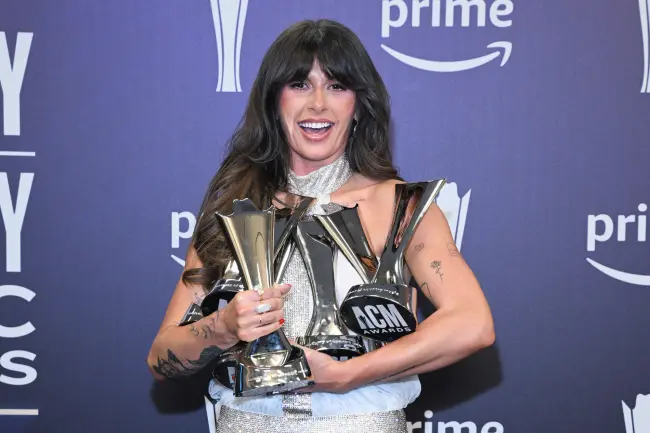
Ella Langley’s “Choosin’ Texas” is not only the biggest hit of the year, but perhaps the biggest question mark when it comes to the upcoming Grammy Awards. The record-breaking country hit has been a commercial behemoth, spending 27 weeks atop the Billboard Hot 100 and counting. With the song already among the biggest Hot 100 hits of all time and still climbing, she is currently predicted to sweep the CMA Awards on Nov. 18. Given that success, why is there skepticism about the song’s Grammy prospects?
Grammy voters have been hesitant to embrace country music outside its own categories. In the General Field, the past few years have been tough for the genre. Since the Nominations Review Committees were dissolved, only two country songs have been nominated in the General Field: Shaboozey’s “A Bar Song (Tipsy),” which earned a Song of the Year nomination, and Beyoncé’s “Texas Hold ’Em.” Both songs had clear crossover appeal. Beyoncé is a Grammy favorite, with wins across pop, R&B, rap, and dance categories, while “A Bar Song” topped pop radio and interpolated a hip-hop hit. “Choosin’ Texas” peaked at No. 5 on pop radio, putting it closer to General Field misses such as Luke Combs’ “Fast Car” and Morgan Wallen’s “Last Night.”

But the bigger question may be perception. As big as the other songs were, neither necessarily felt like a cultural moment in the way “Choosin’ Texas” might. Even in pop spaces, the song has generated attention — positive or negative — but attention nonetheless. Skeptics may argue that much of that attention has come from people saying they have never heard the song or are shocked by how big it is. In recent months, Rolling Stone and CNN have published stories about people questioning whether the song feels as big as its chart success suggests. That perception could influence voters because it reflects a familiar divide: country music can feel local to its audience without being embraced by pop listeners.
That said, “Choosin’ Texas” is genuinely big. It topped the charts in the United States (Langley broke Mariah Carey’s record for most weeks at No. 1) and in several English-speaking markets, including Canada, the U.K., Australia, and New Zealand. That kind of international success is rare for a country song and speaks to the track’s appeal — and Langley’s. However, commercial success isn’t everything. The Grammys passed over Alex Warren’s “Ordinary” last year, despite its status as one of the decade’s biggest hits and its reportedly greater worldwide success than “Choosin’ Texas,” and instead nominated songs by Chappell Roan and Billie Eilish. One could argue, though, that Langley has a stronger presence than Warren: unlike him, she has notched multiple Top 10 hits after “Choosin’ Texas,” and her standing with country voters could give her a solid base regardless of pop support.
Another potential obstacle for Langley could be the polarized political climate in 2026. Thanks in part to the aforemetioned much-scrutinized Rolling Stone article, Langley and the song have been linked conservative ideology, not because of the lyrics itself, but because it is a country song and Langley has not publicly spoken about politics. Her association with Morgan Wallen, her silence on political issues, and the GOP’s use of “Choosin’ Texas” at rallies have led some people to associate Langley with Republican values, making the song controversial in certain circles. Like much of the entertainment industry, the membership of the Recording Academy is generally believed to lean liberal. That raises the possibility that some listeners outside country music may be wary of what they believe the song represents.
The question then becomes: when does a song become too big to miss? The answer might be never. Along with Warren’s snub, huge hits such as The Weeknd’s “Blinding Lights,” Wallen’s “Last Night,” and Teddy Swims’ “Lose Control” missed nominations in the General Field, showing that chart performance alone does not persuade voters. Langley’s position as a newer artist also might factor in; she doesn’t have name recognition of some of the other top contenders in the General Field categories like Taylor Swift, Bruno Mars, and Olivia Rodrigo.
For now, “Choosin’ Texas” remains one of the year’s most-predicted songs, with Gold Derby odds above 90% in both Record of the Year and Song of the Year, and Langley has a 98% chance of a Best New Artist nod, second only to Sienna Spiro. If it is snubbed, the omission could be among the year’s biggest.
Record of the Year
1.

2.

3.

4.

Taylor Swift
The Fate of Ophelia
5.

Ella Langley
Choosin’ Texas
6.

7.

8.

Rosalia, Bjork, Yves Tumor
Berghain
9.

Ariana Grande
Hate That I Made You Love Me
10.

Noah Kahan
The Great Divide
Song of the Year
1.
2.
3.
4.
Ella Langley
Choosin’ Texas
5.
Noah Kahan
The Great Divide
6.
Taylor Swift
I Knew It, I Knew You
7.
8.

Sienna Spiro
Die on This Hill
9.
Taylor Swift
The Fate of Ophelia
10.
Rosalia, Bjork, Yves Tumor
Berghain
New Artist
1.
2.
3.

4.

5.

6.

7.

8.

9.

10.

Album of the Year
1.
Olivia Rodrigo
You Seem Pretty Sad for a Girl So in Love
2.
Olivia Dean
The Art of Loving
3.
4.
5.
Raye
This Music May Contain Hope
6.
Taylor Swift
The Life of a Showgirl
7.

8.
Noah Kahan
The Great Divide
9.

Phoebe Bridgers
Lost Weekend
10.
