
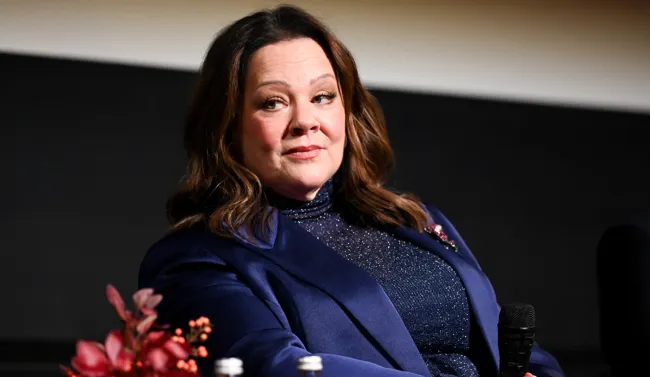
Melissa McCarthy says she was once one of the people judging Patsy Ramsey from the grocery store checkout line. Now she plays her in Netflix’s The Murder of JonBenét Ramsey, the limited series about the 1996 killing of Patsy’s 6-year-old daughter, JonBenét. The series premieres Dec. 10.
“I stood in the grocery stores and I looked at the pictures of JonBenét in the tabloids and I said, ‘How could you do that? How could you dress your child like that?'” McCarthy said Sunday at Netflix’s FYSee event at Tudum Theater in Hollywood, after a screening of the first episode. “And then cut to 20 years later, when I have two girls standing in a grocery store in their tutus and their cowboy boots with my lipstick on. I realized I just got swept up in the sporting event of someone else’s trauma.”


The two-time Emmy winner, who is also an executive producer, was joined by showrunner Richard LaGravenese and executive producer David Glasser for a Q&A about the press and public frenzy that followed JonBenét’s death.
“It made me feel that I played a part in this,” McCarthy said. “And then the more I looked into it, I thought, ‘My God, I’ve never just thought about what happened to this family, what happened to this couple, to this mother of two children.’ I have two children. And it suddenly took on such a different role.”
She came out of it with what she called “a very sweet spot in my heart for Patsy.”
“I think the worst moment in her life, she was just kind of served up, and there’s nothing she could have done to be on the right side of it,” McCarthy said. “I think we would’ve got along pretty great. I think she was funny. I think she was very smart. She loved her kids. She made it through stage 4 ovarian cancer, which is basically impossible, because she said she wanted to take care of those kids. And then after this devastation, the fact that they still kept that family together and she fought for the right thing — there was so much working against her that if she would’ve just hid away, it would’ve been very understandable. And instead she wanted answers for what happened to her daughter. When I watched those clips of her, you see all of that come through, and to me it’s just another mom that’s still fighting for her daughter.”

LaGravenese, who earned an Oscar nomination for writing The Fisher King, said the goal was to give everyone in the story a fair shake.
“This was a case that was turned into spectacle by the press and by the public,” he said. “All of the characters, the police, the DA — I wanted to tell the story so that you understood everybody’s reasons and you could make up your own mind about what had happened, because we were so quick to judge. It was an opportunity to tell a human story about something that had been dehumanized.”
He points to one moment when the coverage turned. “It happened Christmas and the country felt terrible for a few days,” LaGravenese said. “And then about four days after, the television news showed the beauty pageant films, and that turned everyone on. It was like they dropped a bomb on it, because suddenly there was sexuality implied and it became lascivious and it became spectacle.”
That’s where McCarthy jumped in with something she didn’t know until she started digging.
“Patsy said — I can’t remember which interview — ‘We did six [pageants]. I’ve been to 213 soccer games. Should we talk about her soccer?’ And they just wanted to talk about the six,” McCarthy said. “I’ve talked to neighbors of hers down the street, and they were like, ‘We had no idea they [participated in pageants]. They were just normal kids in jeans and T-shirts running around on their bikes.’ So I think the selective narrative we were given is kind of what we all picked up and ran with.”
“If you didn’t have the photos, the pageant or whatever, what did you have to put up?” Glasser added. “By pushing those out over and over and over again, you’re creating a narrative before everybody even understands what’s going on. If you didn’t have those, you’d have a murder that needed an investigation.”
The timing didn’t help either.
“Oddly enough, I didn’t realize that the ’90s had so many of these cases. We started with the Menendez brothers, and then we had the Susan Smith case with her two sons. I think that impacted a great deal on Patsy and John,” LaGravenese said.
“[Susan Smith] was a Christian woman who said, ‘I love my children, please return them.’ She had said that they had gotten carjacked and someone kidnapped her children. Then the whole country rallied around her and felt badly, and then she confessed to killing them,” he said. “So the country had a broken heart and became cynical. By the time Patsy was on camera saying, ‘I love my children and I’m Christian, I would never hurt her,’ no one believed them. And with O.J., the press had gotten this raw meat. They made so much money on covering that trial and all those stories. So here was another big, juicy steak.”

Clive Owen plays John Ramsey opposite McCarthy, and she said the two often came at scenes from different directions.
“We agree so much as people, but we always kind of came into so many of the scenes with a different perspective, because we put our hearts into our characters. I think it shows in the work,” McCarthy said. “It was just two people that were being who they were — that met in the middle — and we had to work it out in front of the camera. To have someone who you can rely on so much — no matter which way you go, you know that they’re going to pick you up and go with you, or disagree with you, which is also a wonderful quality. He’s just a remarkable fellow.”
With the 30th anniversary of JonBenét’s death coming up, McCarthy is still hoping the case gets solved.
“If [this show] advances something, I hope it’s the truth,” she said. “If it can even open up one little answer as to what happened to that poor child — that has always been in the back of my mind. It wasn’t the purpose of it, but I think you can’t help but think about the what-if.”
McCarthy called playing Patsy “such a strange dance.”
“You have to go into it completely open and then realize that you’re full of biases. We have this talk on set all the time where they would say, ‘Stay open.’ I was like, ‘But it’s Patsy,'” she said. “I think you get to walk in someone else’s shoes as much as we actually can. I think it changes you. I do feel changed. There’s something about playing a real person, and a person that had so much trauma put on her and she had to work through so much and still fought her way out, that I think I have this strange relationship with this woman that I’ve never met. It’s hard to place that somewhere, but I do feel changed for it, and I feel grateful for it.”
