
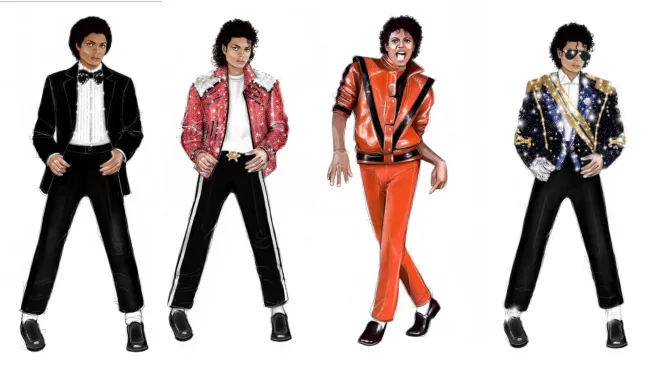
When it came to recreating classic moments for Michael, the clothes really did make the man. And Marci Rodgers, the woman who made the clothes, believes she had some help through the process.
“Looking back, I would humbly say that I think Michael was starting to guide me,” she tells Gold Derby.
Rodgers, whose credits include Spike Lee’s BlacKkKlansman, the Hulu docuseries Wu-Tang: An American Saga, and Prime Video’s upcoming Muhammad Ali series The Greatest, first heard about Michael during the 2023 Hollywood writers strike and reached out to producer Graham King and director Antoine Fuqua. “I remember it being an uncertain time,” she recounts. “I engaged with Graham and Antoine, essentially pitching myself, my tenacity, and excitement to be part of the project.” That tenacity paid off; Rodgers was brought onboard to recreate the wardrobe of one of the most scrutinized pop stars of all time — work that has her in the Academy Awards mix.

Below, Rodgers gives Gold Derby a guided tour of the Michael closet, explaining how she approached designing the seminal looks worn in the film by Juliano Valdi as young Michael and Jaafar Jackson as the older version, how she uncovered secrets behind the original outfits, and when she knew it was all coming together.
Michael would seem like a daunting task. Was any part of you scared about taking on a world-famous star with such iconic looks?
I grew up in Evanston, Ill. — a suburb outside Chicago. My father actually grew up in Gary, Ind., around the corner from Roosevelt High School, which is essentially next door to the Jacksons’ home. When he got wind that I was possibly going to be in the pool of designers, he and I went to Gary. Our first stop was the house. Then we went to the Hard Rock Hotel and Casino, which has a small museum dedicated to the Jacksons in the back. We literally walked around, and I’m zeroing in on the costumes — just curious about how they were built. We ended up bumping into a security guard, and my father — this is a complete stranger — approaches him and asks if we can see the museum in the back. The guard said, “Actually, let me open the door.” And that’s where I actually saw the vest Jackie wore in the “ABC” video that I had to recreate.
So to answer your question: I do believe it was kismet. There was a bit of serendipity. Looking back, I would humbly say that I think Michael was starting to guide me at that point. But once I was actually designing the film, I just put my head down. I wanted to make sure it was accurate.
You had all these distinct eras — the Jackson Five in the late 1960s into the ’70s up to the ’80s superstardom. How did you approach each time period?
It was a bit of both breaking it down by era and being immersed in all of it at once. My research book alone was over 800 pages. I had access to YouTube, Pinterest, vintage magazines. Funny enough, my sister — who passed away months before — was an adamant Michael Jackson fan. My mother would buy her his CDs growing up, and the photo booklets inside spoke to the wardrobe. I called my mom and said, “Remember when you bought Cynthia that album? Is it still in her room?” She said yes, and she sent it to me. I was going through every avenue I could find that wasn’t just on the internet, because I knew I had to recreate the wardrobe 360 degrees.
Beyond photographs, what hands-on research did you do?
I went to the Grammy Museum and saw a replica of the “Thriller” jacket. It’s encased in glass, so you can’t touch it, but I was standing there with a measuring tape, measuring every angle — how far it goes down, the zipper, the notions. And once the film community found out I was designing Michael, things kind of fell into place. Some of the fedoras I made for Jaafar — the vendor who made them was actually an apprentice to the gentleman who originally made Michael’s hats, so he already knew where the mold was. And there’s a fabric store in L.A. called ISW where, when the owner found out what I was doing, he told me that Michael’s costume designer Bill Whitten used to shop there. He said, “We still have some of this fabric, or something similar to it — this is where you go.” I remember it like it was yesterday.

Let’s do some rapid-fire snapshots of the iconic looks. Starting with the Jackson Five era — which outfits did you know you had to get exactly right?
For sure the “ABC” look — I remember that as a child. That’s super iconic. And then the country fair look, because there’s that beloved photo of young Michael in the floral shirt. That fabric doesn’t exist anymore, so I had to have it printed and made correctly for the era.

Moving to the ’70s and Off the Wall — what stood out?
Visually, that almost seems like a quiet moment for Michael, because we go from the Jackson Five, which was very patterned, very of the groove — and then you have Off the Wall, which is sleek. The tuxedo with the bow tie. And he’s starting to incorporate the higher-hem pant, which we then see amplified later: higher hem pants, sparkly socks. The myth is that the bigger the audience, the more sock they could see. That ’70s look was sleek, but it was of the era — and it creates a clear arc, because from there you can delineate different facets of Michael.

And then the ’80s — Motown 25 and the sequined glove, the “Thriller“ jacket, the “Beat It” jacket, the Grammy outfit. That’s when his wardrobe really went next-level.
I’ll start with Motown 25. The actual sequined jacket Michael wore was his mother’s jacket. Jaafar was gracious enough to bring in a replica, because Catherine had two — the black one he wore that became iconic, and a pink one. The design of that sequin doesn’t exist today, so I had to get as close as possible — paying attention to the size of the sequin versus the construction of the garment, and what’s available now fabric-wise. And then you have the studded shirt, which connects from Motown 25 to the Pepsi commercial, and then back to Off the Wall — same tuxedo pants, but now introducing the socks and the glove. And then the fedora hat, the Florsheim shoes. The world was starting to see his personality.
For “Thriller” specifically, I had a conversation with Deborah Landis — she and her co-designer created the original “Thriller” video costumes — and she told me that Michael’s pants had to be dyed because Levi’s didn’t make red pants. So I went through several versions of red-dyed pants to find the one that matched the color chosen for the film.
That was a gem, because that’s nowhere in writing. Someone had to tell you that.

I was also really adamant about getting the zombies right. We know what Michael looks like — it’s the zombies that had to look correct. Even the female zombie in the pink dress: I made sure her pearls matched the video. My desktop was full of screenshots.
For the “Beat It” jacket: the weight of the chainmail on the shoulders, the zipper, the width of the cuff — everything had to be correct. I didn’t want anything to feel like a costume. I wanted it to feel like Jaafar became Michael. And in certain instances, I do believe he did.

I can also speak to the Grammy jacket. From afar, you’d think it was sequins, but it wasn’t — it was small beads, hand-beaded onto the shirt. I had a former assistant go to the Rock and Roll Hall of Fame in Cleveland to take photos of it for me, because you could see it with the natural eye in person versus a circulated online image. Publications are still important for exactly that reason.

Was there a moment on set when it all came together for you?
Motown 25. I was getting the cast ready to come to set and I got a text from Barbara [Ling, the film’s production designer]: “Brava, the shirt is dancing on stage.” When I came to set and stood back, I saw Jaafar with Catherine’s sequined jacket and the rhinestone shirt, and I thought: Oh wow, it’s happening. But to my right was Suzanne de Passe — she worked with Berry Gordy during that time — and I watched her teleport back to that moment. I walked up to her and asked how she felt. She said, “I feel like I’m back in this very moment.” For me, being the vessel of recreating his wardrobe, that was priceless.
What I kept in mind throughout the entire process was that there were still living people attached to Michael who remembered these moments. When we did the Victory Tour, Marlon came to set, looked at his own costume, and said, “Wow, that’s me — I wore that.” His mother is still alive. His siblings are still alive. Suzanne de Passe is still alive. These were people who lived those beats in real time. Getting it right for them was my main goal.
There’s been talk of a sequel. Have you started thinking about later-era looks you’d want to tackle?
First things first — I just want to thank Graham and Antoine for considering me to design the first chapter of this journey. But I look forward to it all. I look forward to the accuracy, and I look forward to bringing the excitement and the moments back to everyone who lived them. I know spiritually that Michael has allowed me to figure out how to navigate this space, so that when the time comes, it all falls into place with the production design, the directing, and Graham’s vision.
