
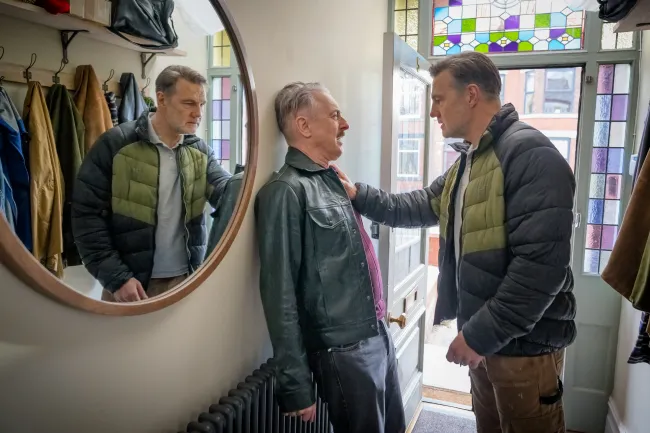
Warning: This post contains spoilers for the series finale of Tip Toe
Russell T Davies always knew that he couldn’t tiptoe around the shocking ending of Tip Toe, the prolific British TV creator’s latest limited series that just wrapped up its five-episode stateside run on Starz. The finale’s last scene depicts an act of neighbor-on-neighbor violence that leaves one man dead, the other man facing a future behind bars, and an entire London block stunned into silence. And because Davies knew the scene would be as impactful to film as it is to watch, he and the show’s director, Peter Hoar, made sure it was the first thing they shot for the final episode.

“What happens in that scene is not a murder, it’s an execution,” Davies emphasizes to Gold Derby. “So we shot that first, and then gave everyone a week off — even though you can’t afford a week off on television schedules! But we all agreed that everyone had to decompress after that to have a rest, have a drink, or have a holiday if they wanted. And then we came back and spent the next two weeks building up that scene.”
The intensity of that scene stems from the manner of the execution. Over the course of five episodes, Tip Toe has invested viewers in the tumultuous relationship of Leo Struthers (Alan Cumming) and Clive Goss (David Morrissey), who only have one thing in common — their side-by-side London row houses share a roofline. Leo is an out gay man who runs a popular LGBTQ+ bar and is something of a father figure to the younger men, women, and enbys who frequent the establishment.
Clive, on the other hand, is a frustrated family man whose conservative leanings cause him to regard anyone of a different gender or sexuality with a suspicion that borders on hatred. Through various circumstances, their separate lives are set up on a collision course that’s teased in flash-forwards throughout the season before being shown in full in the finale.
Venturing over to Clive’s house as he prepares to host a packed viewing party of a football game, Leo eventually becomes the victim of his neighbor’s unchecked rage. Dragging him out into the street, Clive hangs Leo from a lamppost while his guests look on with a mixture of shock, fascination, and — most terrifyingly — glee.
“I’ve got a lamppost like that outside of my own house,” Davies says, confirming that Leo’s life was always scripted to end with a lynching. “And, in fact, my house is very much like their houses — to the point where I told Peter that he could shoot the scene there if he wanted to. Dramas where gay men are beaten up or stabbed and killed are not particularly rare; you see that happen every couple of weeks on crime shows. So I needed a scene that would give it almost governmental status — it’s like the state has done this to Leo or, certainly, the state of society. Society has reached a point where this was allowed to happen.”

For American viewers, lynching has a very specific connotation; the country is less than a century removed from an era when Black citizens were publicly executed in certain states with photographs documenting the carnival-like atmosphere surrounding their deaths. Davies says that he studied those images as he wrote the Tip Toe finale. “Some Americans have these scenes within their living memories,” he acknowledges. “I was also thinking of how [Italian dictator] Benito Mussolini has hanged in the street in Italy, although he was obviously a monster of man.
“And it’s not just a problem in the West,” Davies continues, alluding to the violence engulfing regions across the globe. “The terrible things that societies once dead have not gone away; all of these things are coming back. I once wrote a drama called Years and Years where someone described the past 60 years as a pause — and now that pause is ending.”
While Leo’s lynching is a public spectacle in the series, the production was careful to shield the sight when the scene was shot. “We sealed off the entire street and erected these giant canvases, because we could only imagine what would have happened if someone had driven past and saw it happening,” Davies remembers.
“There was also a public school at one end of the street, so we had to stop work at 3:30 every day when the children were walking home,” he adds. “And on top of that, the tabloid press got wind that something was happening and flew a drone over us to spoil the story. Fortunately, we alerted the police and they took the drone away.”
That prying drone missed capturing the part of the shoot when Cumming himself was briefly lifted up by the towering crane that the production used to simulate the lynching. Davies says the final sequence was accomplished by blending shots of the actor, a stunt double, and a dummy. The dummy stood in for the actor in a moment Davies still can’t shake.
“All of the actors and crew were there in their little tents because it was raining,” he recalls. “Meanwhile, the dummy was getting prepped to be hoisted up and none of us were paying much attention. But then it happened — the dummy was lifted up into the air, and everyone went silent. It was the most horrible moment, but also the most beautiful moment because every single person on set fell absolutely quiet as we watched what was happening, and all of us properly realized the full import of what we were doing. It was quite a profound moment that I’ll never forget.”

To keep the weight of that moment lingering for the audience, Davies deliberately avoids tacking on an extended epilogue to the finale, instead using onscreen text to reveal the witnesses’ fates as the cops descend on the neighborhood and take Clive away.
The fate that stings the most is the one that befalls Clive’s teenage son, George (Jackson Connor), who is wrestling with his own sexuality and found a helpful ear in Leo. But his dad’s actions — and George’s own inaction in face of what happened — ensure that the cycle of rage and depression will continue into the next generation.
“I gave some of the characters a happier ending, because some needed them,” notes Davies. “But when I looked at George, all I could think was, ‘You’re f–ked.’ There’s no way he’s coming out of this with a happy heart, and that’s a shame because the whole story is, in a way, about his coming out. Were it not for him having such a bad dad and events taking such a terrible turn, he would have been all right.
“But he’s never going to be happy, and that hurts,” notes Davies, who came out as a teenager and found love, happiness, and acceptance as he told LGBTQ+ stories in series like Queer as Folk and It’s a Sin. “When I watch the series now, that hurts more than anything.”
