
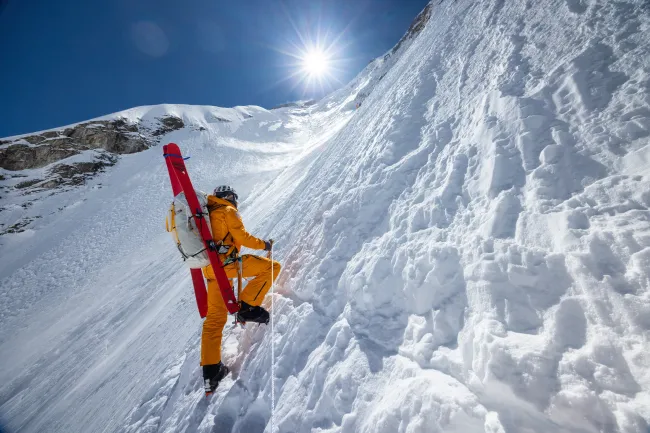
When Everest: The Other Side opens in Imax on Oct. 30, audiences will see the first successful ski descent of Everest’s direct North Face, a historic feat years in the making. But for Oscar-winning filmmakers Elizabeth Chai Vasarhelyi and Jimmy Chin, the story is about more than a record-setting expedition. It’s about what happens when a shared dream survives the death of one of the people who dreamed it, and what it costs to keep pursuing it.
Ski mountaineers Jim Morrison and Hilaree Nelson were partners in life and in the mountains, and skiing the North Face together was the dream they’d been building toward for years. Then, in September 2022, Nelson was swept away by an avalanche as the two skied down from the summit of Nepal’s Mount Manaslu. Morrison had to decide whether to keep going without her. He did, and when he went back to Everest, Chin was climbing alongside him.

Risking too much, or too little

“There’s the cost of risking too much, but there’s an extraordinary cost of risking too little,” Chin tells Gold Derby.
“What is the cost of not pursuing a dream, not pursuing your calling, not pursuing something that is life-fulfilling, that creates the best version of yourself that you bring back to the world?” he asks. “And that’s a cost that everybody in my line of work thinks about deeply, because often they face their mortality and no one wants to die. They want to live the fullest life that they can, and it’s a deeply examined life because they have faced their mortality.”

But Vasarhelyi, Chin’s filmmaking partner and the mother of their children, sees it a little differently. Nelson was always open about how hard it was to balance her climbing with being a mom, and her death made that impossible to ignore.
“I think that for me as an outsider, Hilaree’s death changed everything for me. It was a visceral feeling where I was like, ‘My gosh, we’ve been so lucky to date,’ because the objective hazards are real,” Vasarhelyi says.
The film also hit closer to home because this time, Chin was the one putting himself at risk. “It was the first film that Jimmy, who’s the father of our children, was actively in the line of fire, so to speak,” she says. “And it made me think a lot about agency. I have agency, I know exactly what I was getting into. Jimmy has agency. Our kids don’t have agency.”
“It was very important to try to, as openheartedly as possible, examine the real life costs and consequences,” Vasarhelyi says. “And that’s why we include Hilaree’s passing. That’s why we talk to the children. That’s why we try to bring you right there next to Jim when he’s living this so you understand the awe and his motivation and what he gets from this despite the risks.”
Death on screen
Then there was the question of whether to show the avalanche that killed Nelson. Chin says Morrison and Nelson trusted them after years of friendship, and knew they weren’t out to make “a sensational overdramatized film.”
“There was an obligation here to really look at not just this kind of audacious achievement, but also the real life costs associated with it,” Vasarhelyi says. “And including that scene as respectfully as we could seemed incredibly important because there’s a romantic notion in the mountains of people disappearing. And I think that you just have to see it to really try to understand what that pain is, what that experience is.”
Chin says they talked it through with a trauma therapist before deciding to use the footage. He also thought about what it’s like for families who never find out what happened, including Morrison, who lost his wife and two kids in a plane crash in 2011.
“Not knowing what really happened and not ever really seeing them again, there’s no real closure to that experience,” Chin says. “And to know what actually happened and to see it actually, from my experience, was something that I knew would give some closure to the family, to her boys.”
The footage was shot by Pemba Sharwa Sherpa, a climber Chin has known since Pemba was a kid. Chin and others in the climbing community mentored him as he picked up a camera, and he’s since gone on to shoot big productions.

Chin’s rule for filming in the mountains is simple: “The film’s needs don’t supersede the needs of the subject or the climb.” The camera crew’s job is to stay ahead of the climbers, get the shot, and never slow anyone down or put them at risk.
Vasarhelyi is impressed that Pemba kept filming. “That takes great vision and it takes great fortitude to be able to hold that shot,” she says. “And also it’s just brave. And so it’s that non-fiction thing where you have to read the moment and also not be distracted by the tech part of it so you can feel the moment too.”
Why they do it
Chin also wants people to know that climbers like him don’t take these trips lightly. He nearly died on Everest’s North Face in 2003, and he says the years since have taught him how to read conditions and when to turn around.
“I think there’s a bit of a misperception that it’s reckless,” Chin says. “We’re so focused on the risks. We understand the risks, we identify the risks, we mitigate the risks, we assess it, calculate it constantly.”
It’s also why he believed Morrison and Nelson could do it. He’d spent years on expeditions with them and knew how good they were. Even so, a lot came down to the conditions and the calls Morrison made on the way up.
“I really hope when people see this film, they can get close to the ‘why’ of Jimmy and Jim,” Vasarhelyi says. “And clearly it’s not a decision maybe you’re going to make with your life, and clearly we can bring judgment to it, but we also need to understand why it’s part of this fundamental human paradox of having the audacity of having these dreams, and then also the mania or the psychology or whatever is driving you to the mountain and driving you up that mountain.”
After years of making mountain films, Vasarhelyi doesn’t think there’s a simple answer.
“I don’t think there’s an answer,” she says. “And the film was hoping to be like, ‘There is no answer, but you should try to see through their eyes.'”
Shooting for Imax
Then there was the gear. Free Solo played in Imax but wasn’t shot for it. Everest: The Other Side was made for Imax from the start, so the team had to find cameras that met Imax’s standards and were still light enough to carry up the mountain.

“We cut the tags off our jackets to save weight,” Chin says. “So we wanted to make sure that we could use the latest technology and the lightest possible camera systems to still be able to meet the Imax specs. And of course, carrying the cameras up there and shooting at 29,000 feet, that was pretty challenging.”
Vasarhelyi says the big screen is the way to see it. “It’s how this film was supposed to be seen,” she says. “I would highly recommend everyone to see it on Imax if you can, because every time I see it, it still takes my breath away.”
The end of a trilogy
The film also wraps up what Vasarhelyi calls their trilogy of mountain films. Meru was about friendship, Free Solo was about purpose, and Everest: The Other Side is about what it costs to chase a dream.
Those same questions come up with their own kids, who Vasarhelyi says are already excellent skiers.
“I’ve really come to appreciate everything that Jimmy taking our seven-year-old up the Grand Teton brings to her life, but hopefully she’ll have choices and she’ll be really educated about what she wants to do and why she wants to do them,” she says.
As for whether she wants them to follow their parents into filmmaking, Vasarhelyi has a quicker answer.
“I hope they never become filmmakers,” she says. “You need a miracle every time you make a movie.”
