
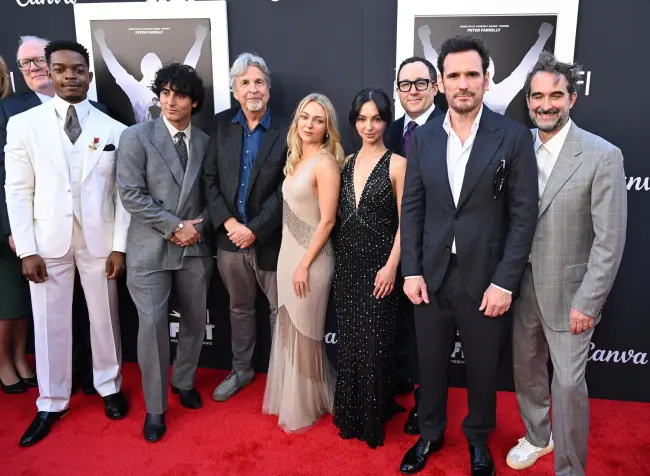
Peter Farrelly’s I Play Rocky is a movie that often feels so meta, you nearly forget you aren’t watching found footage from behind the scenes of Sylvester Stallone’s audacious 1976 Oscar-winning film.
From the movie’s star, Anthony Ippolito, delivering an eerily spot-on portrayal of the Hollywood icon to Farrelly’s deft reenactments of Rocky’s most iconic scenes, the Amazon MGM Studios Oscar contender offers up an endearing love letter to Hollywood that feels especially soothing this season.
For I Play Rocky actor Jay Duplass, the film is also life-affirming.
“Rocky is painfully relatable and painfully timely for anybody trying to make something in a medium that feels like it’s slowly being destroyed,” says Duplass, who portrays the late Rocky director John Avildsen. Here, he tells Gold Derby about the emotional gut punch he felt reading screenwriter Peter Gamble’s spec script; how he pitched himself to Farrelly for the role of the sometimes surly, passionate director; and why Stallone’s underdog boxing hero remains one of his favorite films of all time.

Gold Derby: You’ve called the original Rocky the most formative movie of your life and filmmaking career. When did you first see the film?
Jay Duplass: There is unbelievable kismet to me being in I Play Rocky because my first genuine memory is sitting on my mother’s lap at a drive-in theater in New Orleans and seeing the film in 1976. I was four. I distinctly remember the scene where Rocky is holding onto that bar and talking about his turtles Cuff and Link. I didn’t know what the hell was going on and was probably asleep by the time the boxing started. (Laughs.) Flash-forward 49 years and I hear that there’s a script going around about the making of Rocky. I freaked out and asked my agent to get me a copy. I was so upset when I found out it was going to shoot a few months from that time and that I missed the boat as a director.
Your original hope was to throw your hat in the ring to direct?
Yes. I felt, “This movie can’t not be made by me!” It was heartbreaking when I found out it already had a director. But I got the script and it was the best spec I’ve ever read — written by Peter Gamble. The guy is incredible. Then I remembered, “Oh, right, I’m an actor, too.” (Laughs.) And my agent said, “You know, there’s a world in which you could get one of these parts, maybe play one of the producers?” But it was the role of John Avildsen, the director of Rocky, that sent white lightning through my body. My manager, Naomi Odenkirk, knows Pete Farrelly and got me his email so I sent him a note, which basically said: “I have to play this person. Rocky is my favorite movie of all time. I know everything about it. I know everything about Avildsen and what he went through to get it made.” Then Pete called me and I yapped his ear off.
Did you know each other?
I had met him once briefly at Sundance. My pitch — in retrospect — was basically, “I play Avildsen.” (Laughs.) This character was roughly the same age as I am now and a white dude with Southern European vibes. Nobody else can do it. After 20 minutes he was like, “OK!” Funny enough, he told me he’d actually wanted a real director to play this guy. He said, “So obviously it’s you.”
Avildsen sadly passed away in 2017. What or who were your best sources of research for prep?
I read a lot of books and watched him in old interviews. Avildsen was a curious mix of super confident and cocky, but a real humanist at heart. It was a challenge for me as an actor to be that brash, but also a guilty pleasure to pretend-direct that way. Peter wanted really strong energy so I just trusted him and went for it. At the TIFF premiere in September, I got to hang out with Avildsen’s son Ash, who seemed pleased with my portrayal.

There’s a memorable moment in the film where Avildsen essentially warns Stallone and the producers that he can be “a dick.” It struck me as especially funny to see you say that line considering that such aggressiveness is 100% antithetical to the gentle vibes of a Duplass brothers production.
(Laughs) It’s definitely not the Duplass way of directing, which is what Greta Gerwig once called “The Compliment Sandwich.” You start with a compliment for the actor, then you give the actual direction, then you compliment him or her again on the back end. I remember we were running around the woods shooting the movie Baghead, and Greta was like, “Jay I don’t need the bread. I’m f–king cold. Can you just yell at me and tell me what you want me to do?” I often feel that as an actor, too. Sometimes you don’t want a big conversation and instead the director has to say “Faster, more, louder!”
What was your most surreal moment on the set of I Play Rocky?
All of it? (Laughs.) I mean, I got paid to dress up in 1970s clothes and drive around Philadelphia and pretend like I was directing Rocky, which is literally a fantasy I’ve had my whole life. But the craziest day was when we were at the Philadelphia Museum of Art recreating Rocky’s iconic moment on the steps and the real guy who invented the Steadicam technology, Garrett Brown was there watching. He still lives in Philly. He came up to me afterward and said, “I’m having flashbacks seeing you dressed like this and yelling at me and Stallone on the steps. We were actually only here for about 10 minutes total when we shot this scene. We didn’t have the location, so we pulled up in the van, Stallone got out, ran up the steps and I came up behind him. He threw his hands up in the air, impromptu, we got back in the van and we left.” Unbelievable!
I imagine that was a relatable anecdote for you considering your vast resume as a budget-strapped indie filmmaker.
One hundred percent. In my movie The Baltimorons, some locals from Baltimore asked me, “When you were in this neighborhood, did you eat at this place?” And I was like, “Dude I was at that dock for about 12 minutes.” (Laughs.) We shot that s–t, got in the car and went to the next location.” Flying by the seat of our pants.
What most surprised or intrigued you about being directed by Peter Farrelly?
I’ve mostly worked with female directors. I think that has to do with the fact that they are more collaborative by nature. I’m actually always a little surprised when male directors hire me as an actor. I think some men worry about a guy coming on set who’s made a lot of movies himself. But Pete is such a wonderful collaborator. I mean, he’s worked with Jim Carrey. He’s not easily threatened.
It’s interesting that, like you, he’s also part of a brother-brother filmmaking team.
Yes! Mark [Duplass] and I always talk about the idea that, when you make a movie with your brother — or another close family member — you are already in a shared collaborative system, right? You’re constantly trying to bring things to each other that are beautiful. I Play Rocky was actually a hard movie to make; there are like 10 actors in almost every scene and Peter had to move very quickly. But he made everyone feel important.
How much of an asset do you think having a vast comedy background, as Peter does, is to telling a story like this?
The perfectionism that’s needed in comedy was also crucial here in order to capture the most inspired thing we could within the time we had. I Play Rocky is such a sweet spot for Pete now that he’s moved into more dramatic fare like Green Book. But this movie is also still so f–king funny. It’s painfully relatable and painfully timely for anybody trying to make something in a medium that feels like it’s slowly being destroyed. Stallone’s story is so parallel to how my brother and I felt coming to the business from New Orleans. “We don’t know how we’re going to get into this. We don’t have money. We don’t have connections.” That’s why Rocky has always inspired me in my career. Although when I tell people it’s my favorite movie, they’re like “Huh?”
They expect you to say something like Blue Velvet?
Yes. And I think it’s also because some people associate Rocky with, say, Rocky IV. They see the Rocky brand as a commodity, but that came later with the sequels. Also, come on — Rocky loses in the original film! I tell people, “You need to rewatch the movie because — spoiler alert, motherf–kers — Rocky loses. And it’s unbelievably great.”
What does it mean to you for Stallone to not only have endorsed I Play Rocky, but to say that there were moments he felt as if he was watching himself and his life unfold onscreen?
It’s a huge deal. And I heard that his only stipulation, in terms of blessing the movie, was that Pete cast a relatively unknown actor to play him. And Anthony was a beautiful choice. He is perfect. He’s so hard-core earnest and really works it from the inside out. He got his body to the place it needed to be and worked hard to not just mimic Stallone but play him as a real person who was desperate to be somebody. It’s truly stunning to know what Stallone was able to overcome in his life. In a lot of ways, the story of making Rocky is more unbelievable than Rocky itself. Stallone was living in his car, doing porn, and had to sell his dog. Then he goes on stage and wins Best Picture? It blows my mind!
