
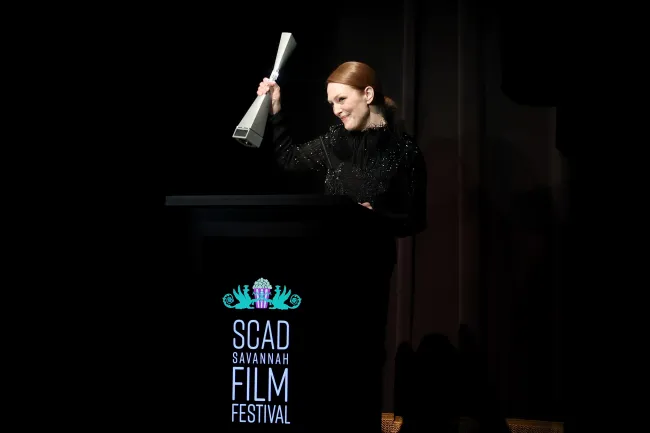
“It was really undersold to me.”
So says Julianne Moore of the role that has catapulted her to the front of the pack for Best Actress. She opened up about her experience making The Debut with writer-director Jesse Eisenberg during a Q&A Tuesday evening at the SCAD Savannah Film Festival.
“Jesse and I had worked together on his first movie, When You Finish Saving the World, and we had a phenomenal experience,” she says. “I absolutely adored him, and after working with him, I felt I would do anything he sent me.”
Then her agent called to say Eisenberg had sent her a new screenplay about a bored housewife who tries her hand at community theater and wanted to know what she thought. Moore says the premise “sounded kind of neutral.”

“I sat down at my dining room table and started reading,” she says. “When I got to that passage—that long monologue—I stood up. I couldn’t believe what I was seeing on the page. It took my breath away. I thought, ‘This isn’t possible,’ and had to get up and walk around the table a few times. I kept thinking, ‘This can’t be happening.’ It was so brilliant and unlike anything I’d ever read.
“So it wasn’t a question of, ‘How do I do this?‘ It was, ‘Do I get to do this? Is this for me? How quickly can I say yes before it’s taken away?'”
She called Eisenberg immediately and told him she was scared — which he misinterpreted to mean she was turning the role down. “Of course I’m doing it!” she quickly corrected him.
Moore says much of her character Mona’s awkwardness was laid out in the screenplay and the stage directions — including the comedic bit about Mona constantly accepting a cigarette but never lighting it. “What I love is that it’s her first foray into imagination,” Moore says. “It’s the first time you see Mona, as an actor, take something and make it real.” She says she asked Eisenberg during filming if it was weird, but he reassured her. “He said, ‘It works. You kind of forget she’s not actually smoking after a while,'” she says.
While there was no improvisation — “everything is word-perfect,” she says — the cast had room to contribute ideas. “Jesse gives you tremendous room to collaborate,” she says. “He gives actors space to bring everything they need to a performance — the time, imagination, characterization, all of it. The language was precise, but that space was there.”

Moore praised her co-star, Paul Giamatti, her co-star Paul Giamatti, whom she had never worked with before; he plays the director of the community theater, who challenges Mona to rise to the occasion. “The minute Jesse mentioned his name, he was the only person I could think of,” she says. “He’s such a joy: thoughtful, kind, modest, a great partner, and so alive when you’re acting with him. When you meet his eyes, there’s so much there. I think we found a lot of joy working together, and it felt like a strong partnership.”
She called out one moment from his performance as particularly special. “When he says, ‘I looked at you standing on that stage, and I wish that was me,’ it took our breath away,” she says. “Jesse and I looked at each other and thought, ‘That was gorgeous.’ That tenderness runs through his entire performance.”

Then there’s the scene at the start of the film in which Mona and Jerry have their shouting match — where he’s training her to demand the rent: “Give me the f–king rent, Jerry!”
“It was scheduled in a really wonderful way: Jesse didn’t put it at the beginning, when it might have felt daunting, or at the end, when I might have been afraid to get to it,” she says. “He put it more or less in the middle. Paul and I were prepared, and Jesse shot it very quickly. There wasn’t a lot of coverage, and we were done before lunch.”
Moore credits her scene partner for helping her get through it. “He’s so gifted — when you hit something to Paul quickly, he hits it back just as fast,” she says. “It was ‘boom, boom, boom,’ and we wanted to keep that rhythm throughout.”
She also was surprised by how much she ended up yelling. “I think Jesse knew he didn’t want to blow out our voices—mine in particular, because I was going to be screaming,” she says. “I didn’t think I was going to scream that loudly at the very end. I knew it would be loud, but I didn’t know my eyes would be bugging out of my head!”
Moore also revealed what inspired Mona’s post-electrocution look, with her singed her hair and missing eyebrows. “Jesse wrote that she comes out with a really strange, choppy hairstyle, which is supposed to be funny and bizarre,” says Moore. So she and her hairdresser started playing around with a bag of inexpensive wigs. “We wanted to pay homage to the great ladies of musical theater — Liza Minnelli and Chita Rivera. … Mona isn’t going to become one of those women, but she’s aiming in that direction. There’s a beautiful, unconscious yearning to be that and to be part of that club. I admire those women so much; that’s what I wanted to convey.”
