
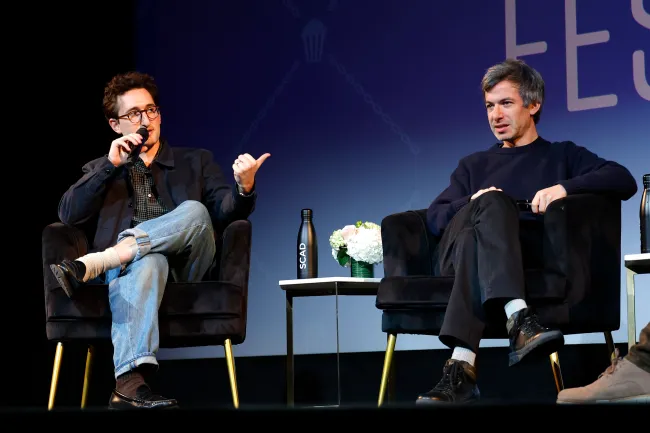
It’s been just over a week since You Can See Everything opened in theaters — and grossed over $45 million at the box office — and co-directors Nathan Fielder and Lance Oppenheim are still figuring out exactly what their hit Elizabeth Holmes documentary is all about.
“We were responding to a real-life human optical illusion,” says Oppenheim. “That’s who she is.”
At a Q&A Tuesday at the SCAD Savannah Film Festival, the filmmakers recounted their path to the screen, which famously began with a night at the Magic Castle, where the chance mention of Elizabeth Holmes’ name led them to remembering that they’d heard that she was talking to A24 about making a documentary — and the rest, as they say, is history.

“I was interested in Holmes, but I didn’t think there was necessarily a documentary there,” said Fielder. “I was curious to meet her, though. When I did, I noticed something happening in me: if I knew nothing about her, I might have thought she was the most sincere, honest, trustworthy person. But I knew what she’d been accused of, and that made me distrust the person sitting in front of me. I was constantly clocking that tension in my own thoughts, and we thought it could be interesting to capture that somehow.”
That tension played out as they began filming Holmes and her partner, Billy Evans, at home with their two young children in the days before she headed off to begin serving her prison sentence. “Things would happen in the house that we all witnessed, but Lance and I — and the rest of the crew — would have very different ideas about what had happened,” says Fielder. “We started to think that if we couldn’t agree on what we were seeing, there might be something there. Curiosity took over from that point.”

They had to move quickly, though, given that she was about to start her prison sentence, and filmmaking decisions were made on the fly — including whether to include Fielder on camera. “At first, we didn’t think Nathan would be on camera,” says Oppenheim. But Holmes and Evans kept asking Fielder questions, he says, pulling him into the film. “It almost felt as if they wanted him to move from behind the camera into the scene. It happened organically.”
The filmmakers decided to use it to their advantage. “I thought Nathan’s presence might be useful,” says Oppenheim. “He could become an accidental investigator of these everyday moments, trying to pull Elizabeth from whatever version of reality she was living in — or bring her back toward the one we were experiencing.”
They call the process “trial by fire.” That meant they had to add another camera and long zoom lenses so they could capture more nonverbal reaction shots. “For a film where you’re evaluating honesty and sincerity on someone’s face, that first moment matters,” says Fielder. “The way a person registers a question can feel important, even before they answer.”
The filmmakers even started showing up at the house early, before the family woke up. (Fun fact: Holmes and Evans didn’t lock the doors.) “That way, when they came out and started talking, we could capture it,” says Fielder. “Billy might say, ‘We’re going to the gym,’ and that becomes a very different scene when you know he believes the gym is something the documentary should film, rather than the idea coming from us.”
Of the viral moments that have caught on since the film has been released — like the scrambled eggs and the “Who’s on First” discussion — Fielder says, “When you’re there, observing, you can’t manufacture anything. You document what emerges,” he explains. “We knew the moments we couldn’t make sense of were interesting because we kept talking about them.”
While he did go into the process with obvious questions, “it wasn’t that simple,” he says. “I told Elizabeth what I believed about her based on what I’d read, and I expected her answers might give me a definitive read. It was slippery. Normally you might try to get into the details with someone, but she would say things like, ‘I’ve never lied in my life.’ That leaves no room for nuance; you have to decide whether to believe her. We had to find other ways to bring out complexity beyond a literal question-and-answer exchange.”
The biggest challenge, says Oppenheim, was figuring out how he and Fielder could work together and approach the doc in a way that felt organic. “Even decisions like the aspect ratio came from asking what mattered: the face, and being close enough to read how someone felt,” he says. “Ironically, what felt new to us was, in some ways, an embrace of documentary filmmaking’s oldest tenets: vérité. As we had less and less access to Elizabeth, we moved into other modes, including having the director on camera and, later, reenactments. People have described the movie as formally new, but to me it draws on many of the ways documentaries have always been made.”
As for the second half of the film, Fielder says “it felt like a phase had ended with her going to prison, but the larger picture didn’t feel complete.” They wanted to talk to more people to try to make more sense of the story, but most said no — except for the [redacted] actress who ultimately said yes, who appears in the reenactments.
Oppenheim points out that while she may have heard of Fielder, that was the first time she and Fielder met.
“There was no discussion beforehand; it evolved as you see it,” says Fielder. “We kept the conversations about what was happening on camera, so the audience could watch it play out.”
Both ultimately call the whole experience strange. “Why us? Why were we there?” says Oppenheim.
Adds Fielder, “It felt as if there was some game happening that we couldn’t make sense of. We decided to go along with it and see what came out.”
Asked if he has any more clarity now, Fielder responds: “F — k no.”
