
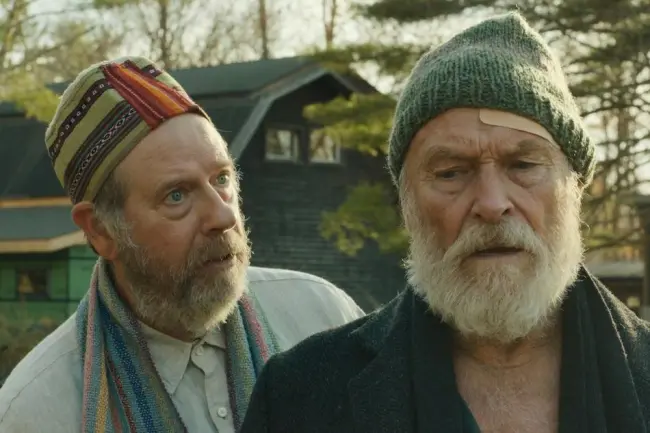
It’s safe to say that Corbin Bernsen knows a thing or two about making television. Ever since L.A. Law catapulted him to stardom in 1986, the actor has been a regular or recurring presence on some of the biggest TV series of the past 40 years, including The Larry Sanders Show, JAG, and Boston Legal — and that’s not counting his feature film roles in rewatchable cable favorites like Major League and The Dentist horror franchise.
Bernsen is still booking plenty of acting gigs, but he’s also thinking like an entrepreneur. Last year, he filmed the pilot for Woodstockers, an independent TV series that he created, writes, and stars in. In addition to kicking off what he plans on being a 24-episode run, the inaugural installment is intended to launch an entire business model that can sustain itself during a time when the legacy broadcast and cable networks — as well as the streamers — are experiencing serious upheaval.

“I was actually leaning toward this being a streaming series, but nothing happened,” Bernsen reveals to Gold Derby when we caught up with him at the 2026 Woodstock Film Festival. “People said they loved it, but it just sat around. But I’ve never been the kind of guy who sits around buried in rejection; that’s when this indie road crystalized in my head.”
Woodstock was an appropriate place to talk about Woodstockers since, as the title implies, the series takes place in the upstate New York town that’s forever yoked to the seminal 1969 concert that celebrated peace, love, and music. Bernsen plays Lenny, a concertgoer who decided to keep the hippie spirit going after the last act played by staying put in town, even as the times a-changed around him. The series also stars Stephen Tobolowsky as Lenny’s best bud, Cal, whose death in the first episode — don’t worry, that’s not a spoiler — sends him into a late-in-life crisis. And Barbara Hershey plays Lenny’s ex-wife, who decided to get the hell out of Woodstock to see what life has to offer beyond the town limits.
We spoke with Bernsen about his plans for Woodstockers, his memories of L.A. Law, and why the line between comedies and dramas is increasingly blurred when it comes to awards.

Gold Derby: You’re not necessarily the first TV star to try and forge an independent path. I remember it was about 10 years ago when Louis C.K. sold episodes of Horace & Pete directly to viewers through a dedicated website.
Corbin Bernsen: Yeah, but that was more of an event thing. I’m trying to launch a series that will run for four seasons — fall, winter, spring, and summer — and consist of six chapters in each of those seasons. This story wants to be told like a novella, so that’s how we’re shooting it. And we’re also the distributor, so we can release one episode a week, or one episode a day over a period of time; viewers can watch one episode at a time or watch them all together. One of our goals is to put it up on YouTube for free and find a way to monetize it through advertising. This is a terrible metaphor, but I liken it to turning on an electric toothbrush and see if it works and if people care about it.
How do you get actors like Stephen Tobolowsky and Barbara Hershey to commit to that kind of uncertain schedule?
You have to be flexible with actors in today’s weird world of availability — especially if you’re doing this kind of long-term thing and want to stay independent. The trade-off is that you don’t pay the normal upfront fees, and we can all be rewarded on the back end. There’s no being screwed over by a studio or network, because we’re it. I kind of view it as having a side project while you’re doing other projects, like the way I’m still appearing on The Lincoln Lawyer and Your Friends & Neighbors.
Stephen dies in the pilot, but you cleverly keep him around as a kind of ghost who haunts Lenny. And there’s a hint that arrangement might become an issue with Lenny’s daughter, Alice (Maggie Lawson), who is concerned that her dad appears to be talking to no one.
We don’t refer to him as a ghost in the show, because that can bring up weird connotations. But he does fulfill the function of a ghost in terms of telling Lenny what he needs to do. And Alice is afraid that Lenny is losing his marbles a little, but I’m not planning to really engage with that unless it organically develops. We’re doing a show about aging people so it would be natural for her to say, “I’m worried you have Alzheimer’s,” but in my mind he’s just smoked way too much weed.
At the same time, I don’t want the show to become about Lenny the pothead — especially if we got a weed sponsor, because they’re not going to want a storyline like “Lenny’s got to stop smoking because it’s f–king him up.” So we’re just treating their father-daughter dynamic as he’s lived his life outside of the guardrails and she’s trying to bring him back.
Do you have the 24 chapters carefully planned out or are you leaving room for that kind of discovery?
Oh yeah. I’m making the show with my son, Henry, and he’s always looking to find things in the moment because it feels more real. And one of the hallmarks of being independent is that you don’t have a ton of money, so you have to invent as you go. On the pilot, we had a plan for the day, but were also open to ideas on all levels.
For example, there was a big scene between Lenny and Alice in the pilot where she brings up her twin brother, who died years ago. We actually took that out, because it felt like there was too much story. Instead, we just showed a photograph of the two kids in swings, and we’ll come to learn that, 20 years ago, her brother walked off into the night. Traditional storytelling in television is all about pulling back the onion instead of putting everything into the first 15 or 20 minutes like you have to do in a movie.
The Woodstockers pilot has already won some awards at festivals like SeriesFest and SXSW. Are you thinking ahead to the Emmys? And, if so, would you submit as a comedy or a drama?
I view it as a drama for one simple reason and that’s because if you say it’s a comedy, there’s an expectation of the show being, “Joke, joke, joke; laugh, laugh, laugh.” But Woodstockers is more about real moments than laughs, and life is filled with drama as well as comedy. I really learned that while making L.A. Law with Steven Bochco. It’s harder when you say you’re a comedy, but if you say you’re a drama, you can fulfill those expectations and still have some comedy mixed in.
The interesting thing to me about the Emmy awards is, would we be allowed to compete? That’s the sort of stuff I don’t know yet. I do know that I feel 100% rewarded if we get all 24 chapters on the air and build a dedicated audience that brands want to reach — not with commercials, but instead along the lines of, “Help us make this thing, whether it’s an episode or a whole season.” If that works, we’ve created a very structured and scalable path forward for indie TV as the new thing.

You mentioned L.A. Law and that show recently celebrated its 40th anniversary. We spoke with Harry Hamlin, who expressed to have some mixed feelings about doing the show. Was it the same experience for you?
I love Harry, but yeah I know he doesn’t necessarily feel like the show helped him. For me, it was everything. Before L.A. Law, I had worked in TV a little bit, but that was really our moment because we were in 23 million houses every Thursday. That show opened the door; without it, I’m not sitting here or winning awards. And the first person I have to thank is Steven for giving me that chance and that opportunity, because they don’t come along everyday. He told me, “I’m entrusting this character to you,” and that’s still a rare moment in my life.
What’s the biggest lesson you took from L.A. Law that you were able to apply to Woodstockers?
I’m on this path of creating a viable, replicable path for indie television because of the two things I learned on that show: TV is about story, story, story and character, character, character. That’s what engages an audience and carries them through a series. Take Gilligan’s Island; that had a very clear story — they have to get off the island. How? One week, they’re like, “Let’s build a raft.” But that’s when the character part comes in because Gilligan’s a fool, the Skipper’s overbearing, and Thurston can’t use his money because it’s useless on an island.
In the case of L.A. Law, early on I remember saying to Steven, “I’m tired of being this guy who just sleeps around. When he goes to court, doesn’t he have any real feelings?” And he was the one who told me about how TV reveals things over time. Back then, it was like seven or eight years — now it’s more like five! But he was always about using story to reveal a bit of character as you go, and that’s what Woodstockers is set up for. You start to see bits and pieces of the characters that you like, and that’s why you follow them through the story.
This interview has been edited and condensed
