
Warning: This story contains spoilers for The Simpsons‘ “Treehouse of Horror”
Dozens of musicians, instruments in tow, begin rolling into the Newman Scoring Stage on the 20th Century Fox lot around 7 p.m. The control room is bustling as recording engineers, producers, and support staff do final checks. It’s Sept. 23, and they’re all here to record the score for The Simpsons‘ “Treehouse of Horror XXXVII.”
Writer-producer Tim Long, a six-time Emmy winner and this year’s “Treehouse” steward, takes a seat. At the board is Russell Emanuel — jovial co-founder of the Bleeding Fingers music collective (alongside Hans Zimmer and Steve Kofsky), score producer, and comic relief — and, in the center of it all, the show’s composer, Kara Talve.


Bleeding Fingers took over The Simpsons in 2017 when the legendary Alf Clausen was fired after 27 seasons — inheriting, in Emanuel’s words, “the crown jewels.” Talve grabbed the reins six years ago. “She used to be a shy little assistant. She wouldn’t look up, she wouldn’t talk,” Emanuel says of Talve. Now, he continues, “she’s an absolute rock star.” Long agrees: “I don’t know when she sleeps, because she’s so good and so fast.” Since joining Bleeding Fingers, Talve has racked up five Emmy nominations and a Grammy nod. In addition to The Simpsons, she’s also scoring HBO’s new Harry Potter series.
“Look, Kara can easily do this job without me — don’t tell her or anyone else,” Emanuel says with a grin. “My job is to take the helicopter view and then take all the glory. I give 10%, she does 90.”

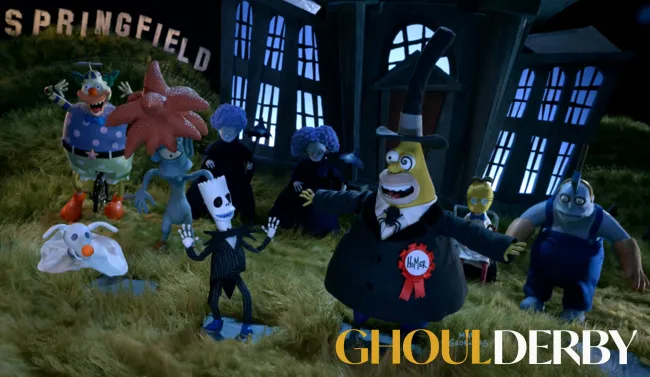
The “Treehouse” episode is the most musically complex of the season, requiring a 43-piece orchestra, complete with a harpist and a live theremin player. The musicians will record nearly 50 cues live to screen, from the opening number — a spoof on “This Is Halloween” from The Nightmare Before Christmas — to the three stories: a Simpsonian take on Holly Gramazio’s BookTok-certified novel The Husbands, a mashup of Pet Sematary and Freaky Friday, and the closing original segment that delves into one of the most terrifying places on Earth — the DMV. The voices haven’t been recorded yet (including guests Tiffany Haddish and Jeff Probst) and some animation is still temp, but the show’s signature humor shines through, accentuated by Talve’s music.
Below, Long, Talve, and Emanuel explain how the episode came together while sharing their favorite Easter eggs and behind-the-scenes details.

‘Genuinely frightening’: Making a scarier ‘Treehouse’
The “Treehouse” tradition dates back to The Simpsons‘ second season in 1990. Each typically features an opening number followed by a triptych of tales riffing on classic scary stories, movies, and shows. Treehouse episodes tend to be bloodier and deadlier, with main characters often dispatched in horrible fashion. Long says that creator Matt Groening had specific direction for the 2026 edition.
Tim Long: Matt had brought it up a few times — the spirit of it is that these should be genuinely frightening, or at least lean in that direction. I took that to heart.

Kara Talve: I just love horror movies — that’s my genre. Every Halloween, I stream a bunch of horror movies, and I love creepy music in general. I love dissonance, so horror is just my favorite. That’s why I love “Treehouse” so much.
Long: We take it very seriously because it’s a show within a show. People look forward to it, it’s always one of our highest-rated episodes. Halloween episodes are not canon — as Lisa sings in the opening — which means we get to have the characters act even more abhorrently than they normally do and, more importantly, start killing them off. The stakes are always high in these stories, and that’s what makes it fun.

A Nightmare-ish opening: ‘Skating a fine line’
The writers room decided early on that “Treehouse “should feature an homage to The Nightmare Before Christmas, with that film’s characters mapped onto Simpsons characters.
Long: The guy in Nightmare who has an ax in his head looks kind of like Comic Book Guy, so we made him that. Sally, the character who sews herself back together, became Marge. Jack Skellington is a great Bart. And Homer — there was just something about the way that [the Mayor] is rendered in Nightmare that seemed perfect.
The animation was handled by Stoopid Buddy Stoodios, the stop-motion animation house behind Robot Chicken. Talve was asked to come up with a spoof of the film’s opening number, “This Is Halloween,” written and sung by Danny Elfman, who, of course, composed The Simpsons theme. Elfman initially planned to come back to perform the parody.

Long: When we wrote the parody of the Nightmare opening song, you can rest easy that they’re going to knock it out of the park. We give them a script and say, “Do a song in this style,” and they come back with it in less than 24 hours, even on weekends. We should probably stop doing that because we abuse that privilege.
Talve: [Elfman] was almost going to do the opening, so the pressure was on. I’m skating a fine line. It’s hard to parody stuff that’s so iconic — obviously you want [him] to sing the original tune. But it was very meta.
Long: He heard about it and expressed an interest, but it didn’t quite work out for timing reasons, which is a shame.
The musical Easter eggs: Oz, Carrie, Psycho, Speed, and ‘Spaghetti’
While the “Treehouse” episodes are notorious for their sight gags and visual homages, the score is also riddled with audio Easter eggs and references.

Long: I always have very specific ideas of what I want each segment to feel like. For the Bart Dog/Dog Bart one, I wanted to evoke the score from the original Carrie — the Brian De Palma film. … So I gave Kara that mandate, and she executed it perfectly. For the driving segment, I always liked the dramatic music in Speed. And a lot of that was also influenced by Spielberg’s Duel.
Talve: I love Bernard Herrmann. You can hear it throughout.
Long: Bernard Herrmann is like one of the absolute greatest. He did Psycho, obviously, and Taxi Driver — there’s just so much menace in his work. It’s great.
Talve: Tim had asked us, way ahead of animation, to do a pre-record of “On Top of Spaghetti,” but scary. That’s such a fun part about this show — it’s always like “it’s this, but in this style, with an extra thing added on top of it.” So it’s always this weird mashup of different styles, and it always comes out really funny and unexpected.
Long: One of our assistants, Alexa Patterson, pitched it — as soon as we see the meatball, we’d get the ominous version of “On Top of Spaghetti.” Every once in a while an assistant will pipe up with something and we go, “Damn, that’s a good idea.”
Talve: One of my favorite [Easter eggs] is in Act 3. It’s a funny Wizard of Oz reference, where Patty and Selma are wearing witch hats, but they’re traffic cones, because they’ve abducted Homer into the DMV. So there’s a little hint of [the Wicked Witch theme] there.
Theremin-splaining: The score’s secret weapon
One of the signature sounds of “Treehouse” is the theremin, the trippy instrument essential to many a classic horror and sci-fi score.
Russell Emanuel: The very first “Treehouse” season we were on, we used a sampled theremin, which we thought sounded good. Then we went to the dub, and Matt Groening was there. He heard it right away. “That’s not a real theremin.” Not only did he know what theremin sound he wanted, he knew the level of distortion he wanted, and he made us go back. We had to actually cancel the dub, go back, and do the session just for a live theremin. We’ve never made that mistake again.
For the scoring session, Lara Wickes, who Emanuel calls the best around, is playing.
Long: It’s the only instrument you don’t touch at all. It’s just sound waves. And she was not only playing written music, she was taking notes and hitting them perfectly.
Last year, I tried to bid on David Lynch’s theremin after his estate sale. It was up to about a thousand dollars and I thought, ‘I can afford that.’ Then in the last 24 hours it went up to $6,000, and I knew my wife was not going to go for it.”
Emanuel: I brought Tim over to the booth to let him try to play it.
Long: She walked me through it — “Do this for volume, do that” — and I asked if something I was doing had an effect, and she said, “No, that doesn’t do anything.” And I said, “I think it’s doing something,” and she said, “It doesn’t do anything.” I realized I was thereminsplaining [Wickes]’ instrument back to her. I had to back off.
