
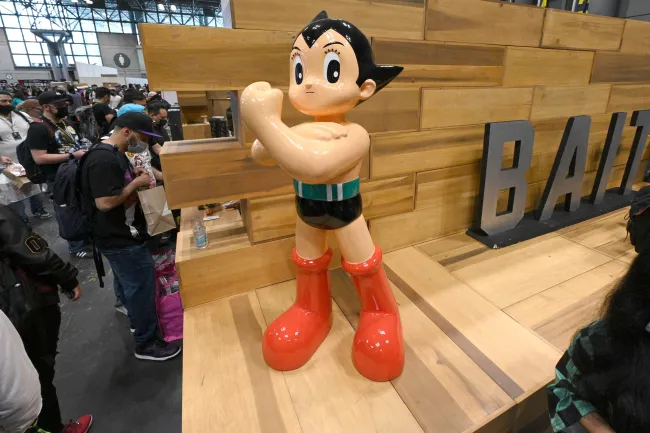
Renowned Japanese artist Osamu Tezuka‘s impact on global pop culture can’t be overstated. Next year marks the 75th anniversary of his signature creation, Astro Boy, one of the most iconic manga characters of all time. And besides that high-flying android, Tezuka is also responsible for Kimba the White Lion — without which there’d be no Lion King — as well as New Treasure Island. His round-curved characters and fleshed-out worlds have captured the hearts of millions decades after his death in 1989.
Now, Peabody Award-winning producer Jason Andrew Cohn is honoring the “Godfather of Manga” with the feature-length documentary Tezuka! God of Manga. The film just concluded a successful Kickstarter campaign, and will feature conversations with many other prolific legendary creators in the animation landscape, from Akira creator Katsuhiro Otomo to The Book of Life director Jorge R. Gutierrez.
Gold Derby spoke with Cohn about his plans for the documentary, and why Tezuka’s legacy still matters.

Gold Derby: What inspired you to do a documentary centered around Osamu Tezuka?
Jason Andrew Cohn: I’ve been a big fan of Tezuka since I was in my twenties; I was living in Sapporo after college, and I used to reward myself with manga as a way of learning the language. I’d usually sit around in coffee shops and read whatever was lying around, which was mostly like sports manga and stuff like that. Then my housemate, who was Japanese and a few years older than me, turned me on to Tezuka and that really got me interested in manga as a serious art form. Some of his stories were super sophisticated. It was hard for me to grasp it with my beginners Japanese but it started me on a long journey.
What project of Tezuka’s were you most influenced or inspired by?
One thing that got me really inspired was seeing Metropolis in the movie theater. It’s based on an old Tezuka adventure story for kids, but was made into a great anime in 2001 a decade or so after Tezuka died. When I came back to California from Japan, I was working as a freelance journalist and I pitched a story about the Metropolis theatrical release to a radio program I used to produce stories for. It gave me an excuse to introduce myself to Fred Schodt, who wrote the book on manga for English readers. He was actually Tezuka’s translator back in the 1970s. Fred got me really excited about Tezuka’s life story and I was able to work some of that background into my radio story about the movie. I guess I’ve been thinking about making this documentary ever since.
How did you get artists like Jorge Gutierrez and Katsuhiro Otomo to speak about him?
It’s been super-fun to engage with these guys that I consider to be total geniuses. I’m sort of a research guy, so I do a lot of prep work and try to learn everything I can about the person I’m interviewing and how their life may intersect with the story I’m trying to tell. But then when you get in the room it’s really just a conversation between two people and you find out all kinds of things you’re not expecting. Otomo in particular felt like a real “get” because he doesn’t talk to a lot of media. It was only because he respects Tezuka so much that he was willing to be interviewed. Jorge seems more media-friendly and we had a really wide-ranging conversation. We talked about Mad Magazine and baseball. We both showed up wearing Dodger hats for the interview so it was very simpatico.
While you’re still crafting the doc, what are some of your favorite topics under the Tezuka banner that you discuss?
I really like digging into Tezuka’s struggles. That’s where his story gets super interesting, in my opinion. He had incredible success, obviously. He created the manga boom in the 1940s and 1950s and virtually every young Japanese artist wanted to be him. And then he literally invented anime with the original B&W Astro Boy series for TV. But success is never as interesting to me as struggle, and Tezuka struggled a lot.
He struggled as a boy during World War II, and he struggled as an adult when he had artistic and business failures. He was intensely competitive and he really needed to be the top manga artist all the time, but it wasn’t always the case. Times would change and he’d be left behind by the latest trends. It almost killed him sometimes. But I love the way he worked through all that and always emerged as a more complete artist on the other side of the struggle.
What was something that you learned about Tezuka that you haven’t before while tackling the project?
I knew very little when I started. Now I know a lot! That’s my work. I start out dumb and I end up sort of smart!
Now that the younger generations of manga readers have the ability to consume manga in various forms, do you think they take print manga for granted in some capacity?
I hope not. In Japan you always used to see people reading manga on the subway, and now everyone looks at their phones. But I noticed that sometimes they’re reading manga in vertical format, so I guess things haven’t changed that much. I really think paper is the best way to read comics of all kinds. You linger over pages much more when you read on paper, and you notice details. As a filmmaker the idea of making movies for people to watch on their phones depresses me a little, and I imagine comic artists feel the same way.
What do you hope for viewers to take away from the doc beyond celebrating and honoring Tezuka?
I hope people take away some of the historical context that made manga and anime such a rich facet of Japanese postwar culture. That period after the war and up through the 1980s, when Tezuka was active, is so fascinating. I think for a lot of people manga and anime start in the 1980s and ‘90s with stuff like Otomo’s Akira or Tomino’s Gundam, but the previous generation really built the whole industry and I think it’s important to understand some of that history.
So I hope people go back and read more Tezuka, but also some of his contemporaries, like Shigeru Mizuki and Shirato Sanpei. There’s just so much great stuff that came out of that era. A lot of it was inspired by Tezuka, because he was the “God of Manga.” But a lot of other artists were doing really innovative stuff and that drove him to become a better artist because he wanted to stay at the top.
Were there any Tezuka-made rare materials you obtained while producing the doc?
It’s not Tezuka, but I will brag about this: Otomo signed the inside of my copy of Domu and he drew a little sketch. I’ll cherish that forever! And I really want to find a vintage Astro Boy figure, like a life-size one, but they’re way out of my price range.
