
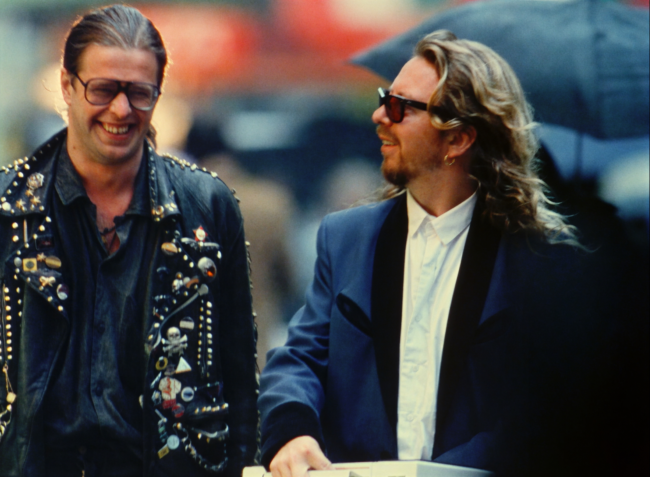
Given America’s strained dialogue with Russia — especially over Ukraine — it might be hard for young people to imagine a time when our relationship with that other superpower was less… chilly. But that was the state of play during the more transparent era of glasnost and perestroika, which followed the thawing of the Cold War in the 1980s. That’s when the teetering Soviet Union loosened some restrictions on their Communist citizenry and even allowed Western rock artists like Billy Joel and Uriah Heep to play there.
Against that backdrop, an underground folk-rock star named Boris Grebenshchikov caught the attention of American managers Kenny Schaffer and Marina Albee, and their interest spurred CBS Records to turn him into a crossover superstar around 1989. Director Michael Apted and producer Steven Lawrence captured that special moment in time via their 1989 documentary The Long Way Home, which is being re-released in a remastered and expanded edition that’s currently streaming across major platforms.

“Their choice of Boris was the best possible choice because he was fluent in English, he had movie star looks, he was encyclopedic about Western rock and roll and folk music, and he had the temperament to handle the challenge,” Lawrence tells Gold Derby now. “It’s also easier dealing with a solo artist — although he had a band, Aquarium — than dealing with a whole rock band like Gorky Park [whom Jon Bon Jovi and Richie Sambora helped promote in 1989]. I think it was a very good choice, probably the best possible choice.”
Having directed and produced the MTV short film Tell Tchaikovsky the News: Rock In Russia, which included Boris, Lawrence became fascinated with the country’s underground rock scene. He also filmed Boris’ first visit to the U.S. in December 1987, as well as the rocker’s initial encounter with producer and guitarist Dave Stewart of Eurythmics fame.
That’s when Apted — the late filmmaker behind Oscar-nominated narrative features like Coal Miner’s Daughter and Gorillas in the Mist, as well as the seminal Up series of documentaries — entered the frame. After learning about Boris’ story through a friend, he became enamored with the idea of doing a film on him and convinced Lawrence to let him direct it. Apted allowed Lawrence to bring his MTV collaborators, editor Susanne Rostock and cinematographer Peter Gilbert, along.
“He was so impressed with Susanne’s editorial talents that he subsequently hired her to cut eight more of his documentaries,” Lawrence reveals. (Apted died in 2021.)
The filmmaking team spent many months with Boris, his band Aquarium, and producer Dave Stewart throughout ‘88 as the aspiring superstar worked on his first English language album in Montreal, London, and Los Angeles. The resulting feature captures a lot of the excitement and drama that swirled around him. In one memorable moment, the members of Aquarium show up to record a song in Montreal, and as with any band, squabbling inevitably happens — especially since none of them had worked in a professional recording studio before.

It didn’t help that the group had been struggling to build up a following since the early 1970s. And now that they were finally on the cusp of bigger things — like playing with Crosby, Stills & Nash at the IPPNW Concert for Peace in Montreal in June 1988 — Boris was looking to be a solo breakout star, and most of the album focused on him.
While there was homeland pride in Boris’ odyssey, many reverent Russian fans expressed doubts and even feelings of betrayal at their folk hero going to the West to do an English-language album. It was a time of change for them as underground bands in Russia were finally being allowed to perform publicly and release their music through the state label Melodiya. A Soviet cultural representative in the film was excited about Boris’ potential Western stardom, wondering if he would become as big as Michael Jackson.
Excited by his prospects, Boris was also under a lot of pressure. This was his first English-language album, and first recording at a major label whose roster included Bruce Springsteen, Bob Dylan, and Miles Davis. The album’s production was slicker than anything he was used to.
Still, Boris enjoyed some wonderful studio moments working with Eurythmics’ singer Annie Lennox, Pretenders frontwoman Chrissie Hynde, and famed percussionist Ray Cooper. The climax of the film features Boris, Aquarium, Cooper, and the Eurythmics (except for Lennox who was pregnant at the time) performing two concerts at a Leningrad sports stadium to fans with both Aquarium and solo Boris songs. Outside audio gear was brought in to improve the venue’s sound.
“It was challenging for his fans,” Lawrence acknowledges. “I think exciting in some ways, but challenging to have one of their heroes disappear to the West and then bring back an album that’s in English. Part of the concerts were in Russian [along with] Boris’s ten new English songs, and you see the looks on the audience’s faces. Some of them are really into it, and some of them are like, ‘WTF? What is this, Boris? What have you done?’”

Something the producer noticed is that there was less surveillance of his crew during the making of this film than his MTV project a year earlier when they were followed more and an Aquarium “groupie” was embedded with them to monitor them. Some government restrictions had certainly relaxed.
“With the time Boris was in the U.S. and the U.K., I don’t recall any real surveillance of him,” Lawrence says. “I can’t say unequivocally that he was on his own, but I think he was making his own decisions, writing his own story, and just being the artist who he is, working to make the best possible album.
“It was a time of change and great hope, and I hope that’s one thing that viewers take away from the film, particularly young viewers who weren’t alive at that time and don’t recall that there was a USSR, a Soviet Union,” Lawrence stresses. “There was this period of time when there was great hope for democracy, freedom from tyranny. Russians were excited, and the country was really opening up. That’s not to say that there weren’t still restrictions and a certain amount of repression, but the censorship that had dominated for so many years was really loosening up.”
The producer says that filming was easy, and the film’s subjects quickly got used to the immersive documentary filming experience which could have taken longer. “A lot of that has to do with Michael’s incredible talent as a director of putting people at ease and getting them engaged,” Lawrence explains. “He was one of the great interviewers, and he loved filmmaking more than anyone I’ve ever met. There was the combination of his attentiveness to people, his talent for putting them at ease, and his complete fascination with the subject, along with his admiration for Boris. It wasn’t that difficult, and as time went by it became easier and easier.”
The film was rolled out in theaters in different countries in 1989 and 1990, with a VHS release landing on video store shelves in 1991. But when Boris did not become a crossover star, CBS Records, who partnered with Granada TV in the UK, declined to promote the film extensively on American shores. They also opted out of releasing a second album — even with the possibility of George Harrison producing — after 1989’s Radio Silence did not sell well.

Lawrence does remember the film’s reception being very different in the In the U.K., though. “Michael was so respected [there] as the director who had been making the Up films,” Lawrence recalls. “It was treated differently there, and then after the early 1990s, it disappeared. I did not want it to vanish, and that’s when I made the effort, starting in 2025, to bring it back.”
Lawrence recalls that Stewart was fantastic to work with, and he supported Boris unequivocally and befriended him. “They became close,” Lawrence says. “You can see it in the film, and I think he did his best to deliver a successful album. There’s a certain point in the film where Boris is in L.A. with Dave and Dave’s engineer Manu [Guiot], and they’re trying to finish the tracks and start to mix the album. There’s a lot of drama around that. This was Boris’s first experience dealing with that level of a recording studio, so in some respects he was like a kid in a candy shop and he was learning. You’ll see in the epilogue where he talks about what that experience gave him.”
While Boris didn’t become a rock star in America, he did continue thriving in Russia and has since attained icon status there. (He recently emigrated to London after making his anti-Ukraine war sentiments known in Russia.) His subsequent post-documentary life is encapsulated in a 14-minute epilogue added for The Long Way Home‘s reissue.
Although only one 16mm print of The Long Way Home survived in Lawrence’s basement for over 30 years, and the original negative was lost, a videotape with the film’s stereo mix along with the assistance of modern video technology has produced a superior, high definition transfer, with a 5.1 surround mix by John Bowen, that Lawrence says has stunned many people with how good it looks and sounds.
“This film offers an opportunity for people in the U.S. and the West in general to get to know one of the best singer-songwriters of the last 50 years,” Lawrence declares, adding that he’s hoping to release a Blu-ray with extra footage and bonus features. “He’s not a household name, but I think the film will engage people and get them interested in Boris Grebenshchikov.”
