
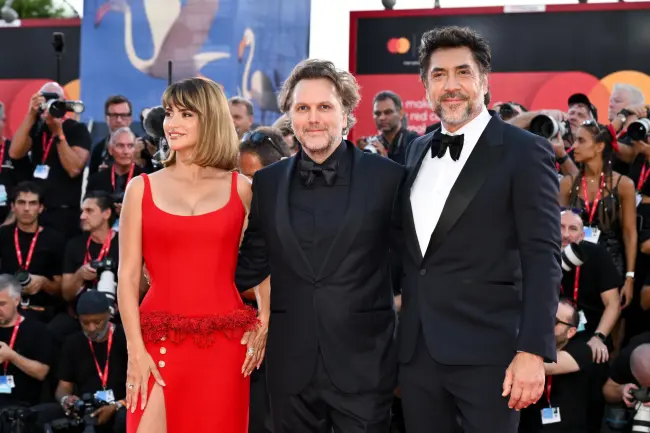
Bringing together Javier Bardem and Penélope Cruz was a long-held dream for writer-director Florian Zeller, who wrote Bunker specifically for the real-life couple. “I really adore them. I was immediately interested in the idea of having them together on screen,” he says.
In the tense psychological drama, Bardem plays Miguel, an acclaimed architect who is asked by a tech billionaire (Paul Dano) to design a bunker in Hawaii. Cruz stars as his wife, Sofia, who views the project as everything she opposes. What begins as a professional opportunity gradually exposes deep rifts between the couple, raising the question of whether two people who built a life together are still moving in the same direction.

The drama marks Zeller’s latest feature after 2022’s The Son and 2020’s The Father, which earned six Oscar nomination including Best Picture and Best Adapted Screenplay — and won Anthony Hopkins his second Best Actor statuette. The French novelist, filmmaker, and playwright, tells Gold Derby for Bunker, he was in awe of Cruz’s strength and Bardem’s sensitivity and watching them play off each other.
The drama marks Zeller’s latest feature after The Son (2022) and The Father (2020). The Father earned six Oscar nominations, including Best Picture, and won two: Best Actor for Anthony Hopkins and Best Adapted Screenplay for Zeller and co-writer Christopher Hampton. The French novelist, filmmaker and playwright tells Gold Derby that, while making Bunker, he was in awe of Cruz’s strength and Bardem’s sensitivity, and of the way they played off each other.
The Sony Pictures Classics film will have a limited awards-qualifying run starting Dec. 11, followed by a nationwide U.S. theatrical on Jan. 15. Below, Zeller discusses collaborating with his famous leads, working with his supporting cast, and the happy accidents that shaped the film’s standout moments.
Gold Derby: Where did the inspiration for this film come from?
Florian Zeller: It all started with the desire to work with Penélope Cruz and Javier Baden. I wrote the script for them. Of course, they are a real-life couple and I was interested in adding layers to every scene for that reason. Not to say that this is their story, but I really wanted them to embrace something that has to do with authenticity and truth. It was about exploring an emotional territory that was really intimate for them. Then I read an article three years ago about a tech billionaire building a bunker for himself in Hawaii. I was really fascinated by that story and by the paradox — a man who made a fortune on the idea of connecting people was at the same time working on a plan to isolate himself.
At one point in the film, there’s a big argument between Penélope and Javier’s characters. What was it like for them to film that?
That scene is almost 12 minutes. It’s kind of unusual in a film to have such a long scene. We had to shoot it over three days with almost no interruption. So emotionally, it’s very demanding. I noticed that a few days ahead of that shooting, Penélope was really nervous and there was a lot of tension, but I was really impressed by her capacity to go for it with so much fearlessness, intensity, honesty. I was behind the camera looking at her and I was really impressed. I’ve been so lucky in my life to have worked with so great actors, especially on stage. But I was watching something unique seeing her do this with courage, grace.

On the opposite end, there are some really sweet, quiet moments, like when Javier is listening to music with his daughter. What was it like to film those more intimate scenes?
With Javier we know all his characters, all his performances that he has done over the years, and usually it’s very masculine characters, sometimes very scary characters, always powerful. But when you know him, you feel like he’s so delicate, so sensitive. I was so interested to capture Javier’s sensibility.
What was the main point about marriage you wanted to get across in the film?
In a long-term relationship, there’s always that moment when you must question whether you still go in the same direction. If you still have the same dreams and the same values. It’s just a small thing that reveals that maybe there is a difference between the two of them. The small thing is this question of a bunker. He is an architect and he’s offered to build a bunker. For him, it’s a very exciting possibility. It’s a lot of money, it’s ambitious, it’s good for his ego as an artist. For her, it represents everything that she hates. I’ve always loved films when a very small thing suddenly reveals that two characters that were supposed to be completely connected realize that they are maybe not that connected or that they have to adjust who they are to go in the same direction.

You can really see both sides of the argument between their characters in the film. Was that on purpose?
For me, films are really a place for questions and not a place for answers. I really don’t like films that tell you what to think and what to feel. I love when there’s room left for the audience to find their own meaning. It’s not about who is wrong and who is right. It’s trying understand all the complexity of what it is to be alive in this crazy world.
You have three amazing supporting cast members in Stephen Graham, Patrick Schwarzenegger, and Paul Dano. How did you go about casting each one?
Like everybody, I was so impressed with what Stephen Graham did in Adolescence. He has something that is very unique; physically, he’s very threatening. You don’t exactly know why, but because in this story he had to threaten Javier, we had to find someone who is capable with just presence, to create this physical intensity so that Javier feels uncomfortable. But at the same time, he is, without spoiling the film, the savior of this story. So I needed someone that was also not only threatening, but also very human. And Stephen Graham, he has that. I remember the first conversation we had, he said, “It’s a small role, but I know exactly what I can do with that, and I want to be part of it, and I really respect that.”
Paul Dano, he’s the tech billionaire and he’s only appearing through a screen on a Zoom call. From the outside, you could feel like, “Oh, it’s easier to do that,” but it’s really harder to share emotions, to send emotions and signal to the audience.
[As for] Patrick Schwarzenegger, I had difficulties finding the right actors for this character. I met a lot of people. I was struggling until that day when I was doing some auditions in London, and he came into the room. I was not familiar with his work. I hadn’t seen at the time White Lotus. And so he came in the room and the desire to prove something was so intense that I was really, really impressed by the commitment and the beauty of what he did. In the middle of the audition, I knew that it would be with him.
Speaking of casting, where did you find that striking cat who plays Penélope and Javier’s pet in the film?
I was really looking for the right cat and I discovered that there are cat agents, casting directors. It’s a real process. So I met a lot of cats, and then we had callbacks, and at the end, I had two cats. One of them was super experienced. He has done already 12 films. You could ask him to do anything, he would do it. This other cat was a beginner, it was his first film, no experience, but he looks so much like a sphinx. Visually, I was really excited about the beauty, but the singularity of this shape. My team was like, ‘You’re not going to work with him. He has no experience. He’s a beginner.’ But for that reason, I went with him. On set, you have so many people and so much noise, so he was completely scared, and he started to freeze. So he was not able to do anything I was hoping for. Suddenly I was like, “Oh, maybe I could use that.” And that’s why in the film, the cat is so frozen. He’s looking at us in the lens as if he was talking to us, and it becomes one of my favorite shots. That’s the beauty of cinema, you have to do something with all the accidents.
