
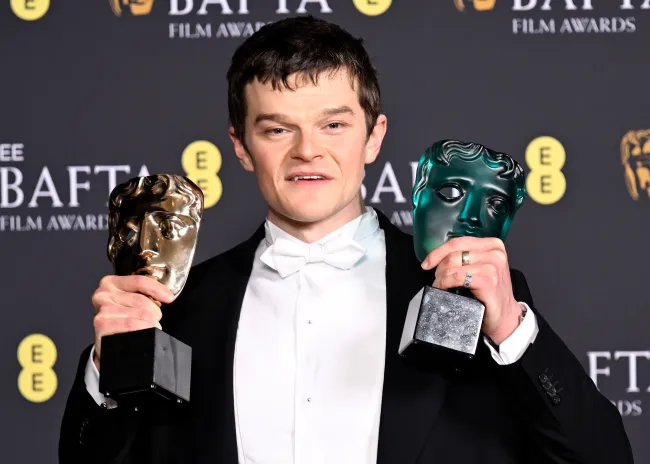
“I honestly can’t believe I won.”
There’s nothing like a surprise winner at an awards show — and perhaps no one was more surprised than Robert Aramayo himself, who took him the Best Actor prize at the BAFTA Awards, triumphing over the likes of Timothée Chalamet, Michael B. Jordan, Leonardo DiCaprio, and Ethan Hawke.
Looking back on that February night, the star of I Swear — who’d already won the Rising Star award earlier that night — calls it a “surreal experience.”
“I felt lucky just to be in the room,” he tells Gold Derby. “Winning was unbelievable.”
But critics and audiences alike embraced his incredibly sensitive and nuanced portrayal of John Davidson, a campaigner for people with Tourette syndrome — and voters responded. A visibly emotional Aramayo thanked Hawke in his acceptance speech, recalling a visit the actor had made to his Juilliard class. “He gave an amazing talk on longevity as an actor, about protecting your instrument and avoiding self-destructive behaviors, and it had a really great impact on everyone in the room,” said Aramayo in his speech. “So to be in this category with you tonight is incredible.”

Aramayo says the shout-out was spontaneous, brought on when he spotted Hawke in the audience from the stage. “It was a nice, honest moment — one you don’t often get at an awards show,” he says.

Unfortunately, the night was marred by a BBC broadcast controversy. An involuntary tic from Davidson, who has Tourette syndrome, included a racial slur while Michael B. Jordan and Delroy Lindo were onstage. The BBC later apologized for airing the slur. For Aramayo, it reinforces the message of the film about the importance of education. “As unfortunate as the incident was, tics can be disruptive for everyone involved — for the person ticcing and for those experiencing a vocal or motor tic,” he says. “When we talk about it, it’s important to acknowledge the whole picture. It makes me think about education and about people understanding more about what tics are, their causes and their involuntary nature. I still have a lot to learn about Tourette’s, so hopefully we can all learn more.”
Here, Aramayo shares with Gold Derby why the win meant so much to him, how he prepared for the role,
Gold Derby: Have you recovered yet from your BAFTA wins?
Robert Aramayo: Not really — I don’t think so. It was an incredible evening, totally unexpected. I still can’t quite believe it happened. It was a surreal experience. I felt lucky just to be in the room; winning was unbelievable.
Have you watched the video of your acceptance speech?
I watched it once, but I couldn’t watch it again because it showed all the people I love in my life. You have to see that kind of joy; nobody knows when the camera is on them, so everyone is unrestrained in this beautiful way. It was lovely to see people’s reactions. I had no idea what I was going to say when I stood up, and I didn’t remember what I’d said afterward. It was nice to see that I was actually quite eloquent.
Did you hear from Ethan Hawke after you won?
I did. We met shortly afterward and chatted for a while. I got to thank him more intimately, away from all the award-show commotion, for being amazing and for all the advice he gave us when we were in school. We took a picture, too. He’s an amazing man. The way Ethan speaks about acting and the world makes me think he’s a wonderful human being. It was a nice, honest moment — one you don’t often get at an awards show. I hadn’t planned to say anything, but I saw him sitting there and thought, “I’ll say it now.”

Has anything changed for you since that night? Have different roles come your way?
It’s been a really interesting time. It’s hard to catch your footing and understand what’s happening to you emotionally and in your career. I feel thankful for all of it. Most of all, I’m grateful to have been part of the film and John’s story. I feel very lucky to have been involved.
What made you sign on to play John Davidson?
I read the script and thought, “Oh boy, this is really interesting, scary and challenging. I don’t know what I’d do with this or where I’d begin.” But I found it interesting. Then I watched Waking Ned Devine, Kirk Jones’s first film. It’s beautiful and has a real sense of community: intimate, but also funny in a grounded, human way. That made me excited to speak with Kirk about the project. I didn’t know anything about John — not how famous he was or anything else — so I could simply approach it as a script I really liked. That was useful.
How did you get the part?
We just chatted, and then he said I should do it. It feels bizarre looking back, because you might expect an audition, especially given the role and subject matter, but he didn’t ask me to audition. I was grateful, because it let me dive straight into the research and learn as much as I could.
Where did you begin your research?
Probably with YouTube and books. I met John very quickly, which was useful, and the research grew from there. I met as many people as I could: first people who live with Tourette’s syndrome, then their partners and parents. That was all through Tourettes Action, an amazing charity in the UK. Then I lived with John for a while. We hung out, and I annoyed him for a few months, bugging him with loads of questions that must have sounded strange to him.
What kinds of questions did you ask him?
John is very forthcoming about his story. He wants to share it and tell you about Tourette’s syndrome and what he knows; education is really his life’s work. But the more time you spend with someone, the more you move beyond that and understand who they are — what they enjoy and what makes them tick. My goal was to spend as much time with him as I could.
What surprised you about the time you spent with John?
This may sound like a strange answer, but his sense of humor. Tourette’s can be funny, so perhaps people might think that’s what I mean, but John himself is very witty and has a great sense of humor. Another unexpected thing was the sense of community in Galashiels. Everybody knows John and has a relationship with him. There’s an incredible, supportive community around him.
Did John share any concerns about the film?
Definitely. John was very integral to the script and its development, and he worked with Kirk. We were always checking in, and new material was being created as we prepared. We’d sit down and talk about it. I would ask him how he felt about certain sequences, especially when John was speaking about Tourette’s or when we were exploring particular aspects of the condition. We spoke a lot, and sometimes he would bring something to me. It was a really collaborative process. At that point, there was no acting; I was just trying to understand as much as I could.
How did you build your performance? So much of it is physical.
The main thing was to get out of my own way as much as possible and focus on John. I Swear isn’t the story of Tourette’s; it’s John Davidson’s story. It’s a biopic about his life. I wanted to focus entirely on doing the job, trusting that the tics and the specific circumstances of his life would be there. By then, I’d researched as much as I could. What mattered was not trying to control the tics, but letting things happen. That may sound a bit mystical, but that’s what it was.
Was there a moment that was especially challenging, when you worried you wouldn’t be able to pull it off?
So many days. I was really terrified. I still feel that way, even now, because I’ve learned so much about Tourette’s. The charities and the work being done in America are amazing, and this means a lot to me. The pressure of thinking, “I really want to get this right; I don’t want to mess it up,” was with me throughout. I think every actor falls into that trap at some point.
I was especially scared when we explored things people may not associate with Tourette’s, such as co-occurring conditions like OCD, anxiety and ADHD, as well as tic attacks, which can be very intense for people who live with Tourette’s. I was also terrified to work with these legends — Peter Mullan, Kelly Macdonald and Maxine Peake. I was so intimidated, but they were all wonderful, and I learned so much from them.
What was John’s reaction when he saw you as him?
I had one conversation with John about the film. He said he liked it. Later, when I went to see him, I felt he thought he had to acknowledge it. He quietly said he was very happy and thought I did a good job. I said thank you and moved on as quickly as possible. I think I brought up Rangers Football Club or something; I just tried to talk about something else. I care about him so much, and I care about what the story is trying to do, so I didn’t want to linger on it.
Was there a scene you were especially proud of, or a moment when you felt you’d finally put all the pieces of the performance together?
No, I don’t think so. It was constantly evolving. Many days, you didn’t really know what was going on. Every take was different, and the filming was very loose. A lot of the shots in I Swear were quite wide to allow as much spontaneity as possible. Because it was a moving target all the time, you could never say, “That was it; I nailed it.” Maybe that’s a good thing.
How much did you get to improvise?
Improvisation was part of the process for all of us. Kirk was keen to make it possible, while keeping it within the structure he had in place. I think that structure created a lot of freedom and space for people to bring or offer something.
How did that approach help you?
I didn’t feel there was anything I needed to force. Even the sound department helped. There was no ADR in I Swear, so we never had to go into a studio to record lines. We worked with an amazing sound person, Simon, who miked us in a way that made that possible and set the levels accordingly. Every effort was made to let things feel as organic as possible. I just had to submit to that and allow things to happen.
How does this role compare with the others you’ve played?
By far, it’s the most difficult thing I’ve ever done. There was so much to manage. During preparation, I worked with the dialect coach and movement coach at the same time. I remember feeling overwhelmed, trying to do so many things at once. You wonder whether you’ll ever feel confident in the space. At some point, maybe you just have to embrace that and accept it for what it is.
What do you hope audiences take away from the film?
I hope people enjoy the film and find some joy in John’s story. Maybe afterward they’ll think, “Who is John? Let me Google him, watch his documentaries, look up a charity, or find out what Tourette’s and a tic are.” Tourette’s is much more common than we think. I hope people enjoy the film and that there’s some education in it, too.
The incident at the BAFTAs involving John was very unfortunate. Could it also be a learning experience for people?
As unfortunate as the incident was, tics can be disruptive for everyone involved — for the person ticcing and for those experiencing a vocal or motor tic. When we talk about it, it’s important to acknowledge the whole picture. It makes me think about education and about people understanding more about what tics are, their causes and their involuntary nature. I still have a lot to learn about Tourette’s, so hopefully we can all learn more.
What’s the biggest misconception about Tourette’s?
That it means shouting and swearing. That’s the biggest misconception about tics. In a way, John’s story is a perfect one to tell because it encompasses so much. It’s a powerful way to tell a story about Tourette’s: people can understand what they’re seeing, but hopefully there’s subtlety, too. There are other little tics you might see, but there are also tics you don’t see. And, as I said, there are co-occurring conditions. The idea that Tourette’s is simply coprolalia — shouting obscenities — is a misconception; it’s a small part of the experience for people diagnosed with Tourette’s. It’s important to learn more, because then you may be better able to recognize it.
Is it harder to play real people with a history like John’s, or fantasy characters? Which do you prefer?
They’re enormously different. The fantasy projects I’ve done are huge: you have enormous sets and massive worlds you’re transported to. You feel lucky to work with the craftspeople who build them. This film was scrappier, with less money; it was smaller and more intimate, but I Swear has a massive heart. I suppose the job is the same. As an actor, what’s interesting is that whether you’re working on one or the other, the job is to tell the truth, listen and work hard. They’re hard to compare.
With I Swear, you have a responsibility to honor a real person. In fantasy, there are often visual effects happening around you that you don’t see.
Definitely, though it depends on the project. With something like The Rings of Power, you feel a responsibility to Mr. Tolkien, who dedicated his life to that work. I think there’s always a sense of responsibility, wherever you are. That’s a good thing; it means you’re doing it for a reason.
Can you give us a hint about what to expect in Season 3 of The Rings of Power?
I don’t know what I can say. It’s darker — it’s going to be darker and wilder. I don’t even know how it can get darker.
You have some new cast members like Jamie Campbell Bower joining you. What can you say about that?
I remember seeing Jamie in his screen test and thinking, “Oh, this guy feels like he walked out of Middle-earth and into the show.” I’m really excited for people to see his work because I think he’s fantastic.
What has playing Elrond in The Rings of Power meant to you?
It’s been a big journey. I’ve been on The Rings of Power for about seven years now, through New Zealand, COVID, London and all kinds of changes in my personal and professional life. Elrond has been with me the whole time. I’ve never played a character and returned to him again and again like this. In some ways, that’s a real challenge; in others, it’s a massive gift, because you get to explore the character differently each time.
