
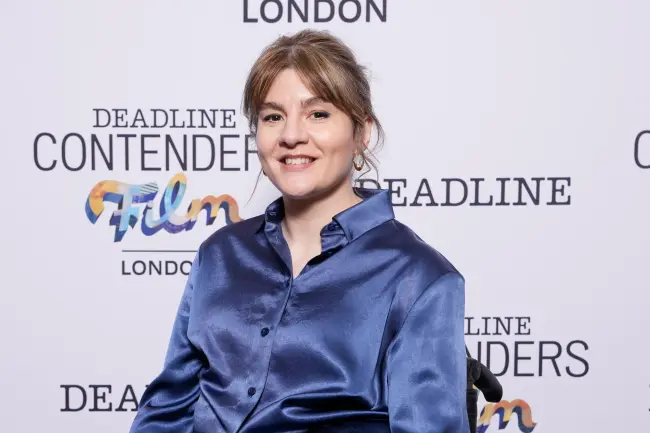
When actress Ruth Madeley first learned that Oscar-winning screenwriter and director Siân Heder was directing the film Being Heumann — about disability rights activist Judy Heumann and the 1977 Section 504 sit-ins — she immediately called her agent and said, “You have to get me an audition!” Her agent said, “They’ve literally just called; you’ve got an audition.”
The disabled British actor, who previously starred in the BBC’s The Rapture and The War Between the Land and the Sea, had long admired Heumann and her groundbreaking work in the disability rights movement. The Apple TV film tells the story of Heumann and the 1977 Section 504 sit-ins, a pivotal moment in the fight for disability rights that helped pave the way for the Americans with Disabilities Act.

Madeley stars alongside Mark Ruffalo, who portrays Joseph Califano, then-Secretary of Health, Education, and Welfare. Califano’s eventual signing of the regulations came after sustained pressure from Heumann and fellow activists.
Madeley believes Heumann, who handpicked Heder to direct her life story before her death in 2023, would be proud of the film’s efforts to introduce both her legacy and the wider disability rights movement to a new audience. Featuring an ensemble cast of more than 20 disabled actors, the film also reflects a commitment to genuine representation. Madeley notes, “She’d be proud of the fact that it’s a completely authentically cast film and that this actor from the north of England was committed to doing her justice, yeah, I think she’d be proud.”
Gold Derby: When did you first learn about Judy Heumann and her work in the fight for disability rights?
Ruth Madeley: I think as a disabled person and now especially with social media, it’s almost impossible to not know who Judy Heumann is. Her name is so powerful, in the disabled community especially. I was learning about this woman who was obviously doing incredible things in the ’70s and before I was even born. She was fighting for things that I fought for in my life. And the fact that she was doing it decades before was amazing to me.
What was your reaction when you learned you had gotten the part?
That call is the most wonderful thing an actor can hear — ‘you booked the job.’ But for this one, it felt really overwhelming in the best sense. I remember just bursting out crying. I was so elated. But it wasn’t just the joy of finding out that I got the job, it was having the sheer privilege of being trusted with such a big story and a big character and such an important one. And then I learned later that week when Siân spoke to me, she said, ‘you do know that this is the anniversary of Judy’s passing.’ I found out on the anniversary of Judy’s passing that I got the job. I feel like that was Judy’s way of saying, ‘I approve, now do a good job or else.

Looking at how far the entertainment industry has come since Judy’s early advocacy, what positive changes stand out to you, and what work is still left to do?
I am eternally optimistic. It is one of my biggest pluses and my biggest flaws. I will always see the positive and I truly think that we’ve come a long way. I mean, Judy went to the Oscars, for crying out loud. She was looking glorious on the red carpet. So, she’d already started this work. I’ve spent over a decade in the industry seeing the really bad stuff and watching it get better. I feel the conversation around authentic casting needed to get better, and I truly feel like it is. I don’t think this movie would have been made this way even three or four years ago. This movie was brave and it made it possible for so many actors to get their start in this industry. But I do think now there needs to be a continued conversation about casting when disability isn’t on the page. It doesn’t mean that disabled actors only have to tell disabled stories. They can just be a character. I think that is something that needs to get better, seeing disabled actors for all different roles.
What was it like working alongside Mark Ruffalo, Dylan O’Brien and Rob Delaney?
That’s an actor’s bucket list stuff. And I never, ever thought I would be privileged enough to read Being Human starring Ruth Madeley with Mark Ruffalo supporting. I mean, what is that sentence really, for crying out loud! I’ve been such an admirer of Mark, Dylan and Rob’s work. All three of them were absolute dreams. I would work with them every day for the rest of my life and not get bored.

Did a particular scene or day on set make you feel like you had really tapped into the heart of who Judy was?
I talked to her all the time when I was on set, especially on the days where my pain was particularly bad physically and I was like, ‘you’re going to have to help me, carry me through this because I’m struggling today. And, she always did. Every day I found out something new and profound and inspiring about Judy.
What was the most important thing you wanted audiences to understand about Judy?
Everybody has this image of her as a leader and a ferocious activist and somebody who got stuff done. And she was this formidable, powerful, fierce woman and this incredible leader. But I was really passionate about showing all the other parts of her that people didn’t know, especially within this movie. This movie wasn’t a biopic of her entire life, this was a specific moment in time. She was learning how to lead this group of people. She’d been advocating for herself and fighting for her own needs, but not necessarily knowing the best way to bring everybody together. I really wanted to show that humanity of her, the fact that she wasn’t always sure she knew what the end goal was. I liked showing that vulnerability and that uncertainty, but also the sheer joy that she had, her joy and her warmth and her humor. She’s somebody who I would want to go and have a drink with. Like, aside from being this icon, she was just an incredible human.
