
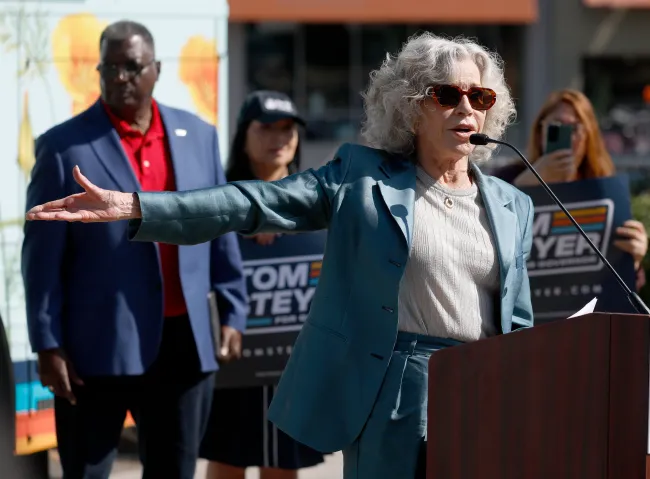
From the Vietnam War to climate change, Jane Fonda has never shied away from using her celebrity to advance a cause. In fact, she’s surprised that more stars don’t use their fame in a similar way. “That’s what celebrities should do,” the two-time Oscar winner tells Gold Derby, matter-of-factly. “Use their presence in a project like this to get more people to watch it.”
The specific project that Fonda’s referencing is Gaslit, a new documentary from director Katie Camosy that explores the environmental ravages occurring in communities across America — ravages that the film attributes to the fossil fuels industry, particular oil and natural gas companies. Two places the film focuses on are the West Texas oil fields and the Gulf Coast of Louisiana.

Fonda serves as the audience’s onscreen surrogate as Camosy’s cameras venture into these towns, seeking information and providing a literal shoulder to cry on. Along the way, she’s joined by a few other famous faces lending their own well-known names to the cause, including Friday Night Lights star Connie Britton and Grammy nominee Maggie Rogers.
That star power has helped Gaslit raise its profile on the film festival circuit over the past year, and should lend an additional assist now that the documentary is available to rent or purchase on digital platforms, including Documentary+ and Prime Video. Starting Nov. 19, it’s also free to stream on Greenpeace USA’s YouTube page, where Fonda is an active presence. And with awards season in full swing, Gaslit‘s makers would no doubt like to see it contend in the Best Documentary categories at all the major ceremonies, including the 2027 Oscars.
But for Fonda personally, the awards are secondary to the mission. “We just want to get the film out there, whether we do that through awards or not, because that means more people have seen it,” says the actress, who boasts seven career Oscar nominations and a pair of Best Actress statuettes for 1972’s Klute and 1979’s Coming Home. “The people that have seen it find it very powerful, and it makes them pay attention to this issue. So the awards in and of themselves don’t matter so much — what they can do is get the word out wider.”
While Fonda is always looking for ways to amplify causes she believes in, she is judicious when it comes to deciding which projects to be a part of. “I get a lot of requests to be in a lot of different things,” she acknowledges, adding that she agreed to become the face of Gaslit after a three-year crash course in its subject thanks to the good trouble she caused with Greenpeace — good trouble that occasionally landed her behind bars.
“We were paying a lot of attention to the Gulf region, and used a lot of archival footage that Greenpeace collected over time,” Fonda says. “They saw what was beginning to happen [with fracking] in what is now the number one carbon bomb in the world; if these proposed projects are completed, it will push global climate goals permanently out of reach, and exacerbate global warming. It’s dangerous to the climate, and as you see in the film, it’s dangerous to any human beings near it in Louisiana, Texas, and New Mexico.”

Gaslit was already out in the world before the recent midterm elections, which saw a blue wave wash over statehouses and Washington, D.C., sweeping a new generation of Democratic politicians into office. That wave even impacted the previously bright red Texas electoral map, with James Talarico becoming the first Democrat to win a U.S. Senate race in the state since 1988. Fonda says she’s hoping to have gained a new ally, but is taking a wait-and-see approach until Mr. Talarico actually goes to Washington.
“I’m not clear on how much attention Talarico pays to climate issue, which means we have a lot of work to do,” she notes. “But there’s no question that because of what happened with the midterms, we now have a greater chance to stop further construction. The other thing we have to do is make fossil fuel polluters pay for what they’re doing, because right now taxpayers are shouldering that burden. We also have to stop the subsidies that we pay these companies that are harming us.”
Now that Gaslit is out in the world, Fonda is seeking to keep the pressure campaign on by going on the road. Her upcoming travel itinerary includes a stop in Mexico in January where gas companies have been building terminals that are impacting the breeding habits of humpback whales — a campaign called Whales or Gas? Fonda will host three screenings of the documentary during her time there, and also meet with Mexico’s president, Claudia Sheinbaum.

Asked whether she hopes to serve as an example for aspiring activists, Fonda instead says that she’s only trying to keep up with the next generation. “We’re all following in the wake of the young people like Greta Thunberg, the Sunrise Movement, and Fridays for Future,” she says admiringly. “They are what motivated me to want to do more, including getting arrested in Washington, D.C.!
“It’s their future,” Fonda notes. “We’re robbing them of a livable future, and it’s going to get worse. Hopefully, we can turn things around by stopping the fracking, drilling, and mining.”
