
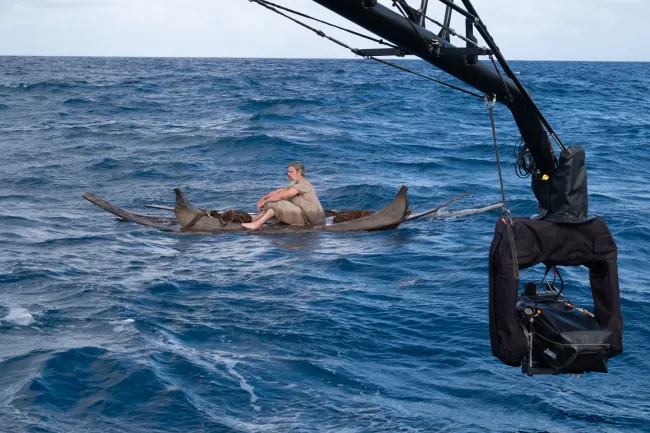
Christopher Nolan‘s The Odyssey marks the first narrative movie shot entirely in 65mm Imax. For the film’s cinematographer, Oscar winner Hoyte van Hoytema, who shot Nolan’s previous four features principally with Imax cameras, including the Best Picture-winning Oppenheimer, this achievement was a long time coming.
“This was the perfect storm, but it was not possible without the evolutionary steps that we had to take before that,” van Hoytema tells Gold Derby. “When we talked about how we were going to shoot this — and, yes, it’s mythological — but it needed to feel grounded like a Chris Nolan film. Our first intuitive feeling is always to ground things.”


The aim was to give The Odyssey a naturalistic aesthetic on large-format Kodak film, while veering off into little pockets of mythology that seamlessly fit within the same world. “Because grounding things has a lot to do with making fantastical worlds believable,” van Hoytema explains. “I think one of the hardest things about tackling mythology is that you can observe it and think about it as beautiful or frightening, but to actually live in it, that’s a whole other thing.”

However, the main problem with shooting in Imax is that the camera is very noisy and unsuitable for sync sound. They tried building a special housing, called a blimp, for Tenet, but it wasn’t effective. So Nolan and van Hoytema tasked Imax with engineering a new housing and acoustic enclosure for The Odyssey, which allowed them to shoot dialogue scenes close up.
At the same time, the pair also worked with Imax to engineer the next-gen Imax Keighley camera, named after the company’s former chief quality officer, the late David Keighley. It is lighter, more compact, and quieter. The prototype was unveiled on The Odyssey, but introduced gradually. They mainly relied on the traditional Imax MSM 9802 camera with the blimp.

“And the interesting thing is that it’s not necessarily always a question of engineering,” he adds. “There’s also the question of training your crew or adapting the way you work on set. And so, that becomes a much broader way of problem solving.”
After improving the photographic image quality in Imax, The Odyssey provided the opportunity to visually convey Odysseus (Matt Damon) and his soldiers trapped in the midst of a war in a very intimate, claustrophobic, and chaotic manner. This was very different from the more expansive approach of classical war spectacles. “For us, it’s not so much about scope, and it’s never about pretty pictures for me,” van Hoytema suggests.

The intense Sack of Troy, with its 360-degree, handheld battle choreography from Odysseus’ POV, required a whole new approach to simulated firelight. “I knew I didn’t want to light this conventionally, which has very much to do with that idea of grounding things,” says van Hoytema. “I really wanted this to look the way that I would imagine walking into that city for the first time together with a bunch of soldiers around.
“Initially, I wanted to light it all with fire, but that proved extremely impractical,” he adds. “So then we started to think about some sort of way to realistically simulate fire. So we came up with this idea of making a three-dimensional shape of fire with an LED company that I work with [Yuji]. They make their own LED cells that they can print on [printed circuit boards]. So they designed smaller PCBs for us that we would stack up on bigger boards in a specific way, which we could then put together in pyramids like a fire space. We called this the Pyrahedron. That then would look like real fire, but not so much in a very realistic sense as in an impressionistic sense.”

The Pyrahedron came in handy elsewhere, including in the scary cave sequence, shot in the historic Nestor’s Cave in Greece, where Odysseus and his crew battle the giant Cyclops, Polyphemus, son of Poseidon.
“We used every trick in the book there,” the cinematographer concedes. “This was beautifully guided by Andrew Jackson, our visual effects supervisor, who came up with a lot of smart ways to do this. It is literally stitched together with many different ways of old-fashioned filmmaking and very modern filmmaking, which really made the final result so compelling.”

This included a 60-foot puppet, prosthetic makeup, a live performance by actor/clown Bill Irwin, and digital compositing. “I used my Pyrahedrons in every night scene in the whole film,” van Hoytema admits. “That became my modus operandi, even for the storm and the ship that breaks in two.”

Meanwhile, for the daytime forest battle with the giant Laestrygonians, shot in Northeast Scotland’s Culbin Forest, van Hoytema relied a lot on forced perspective and other tricks. “Some different frame rates were part of the trick,” he says. “There was a gigantic effort from the special effects department to create very credible fog in that forest. But this was a real puzzle for us because it involved a lot of different kinetics in terms of motion and fights, big versus small. And, for the forced perspective, we used shorter people and very tall people, with extreme differences fighting with each other, which stunned people. It was incredible. The stunt performers had to train to act either slightly slower or slightly faster to match the frame rates that we needed.”

In terms of lighting, the cinematographer was able to leverage natural light, which he adores. “Most light is natural, but I love to figure out how to work with the things that are given,” van Hoytema adds. “It’s very nice to see the forest, understand the forest, and then photograph it truthfully to the way you experience it. And very often, the lighting becomes about replicating or matching scenes that you did earlier that have to match. But then again, lighting continuity is also a little bit overrated in my book.”
