
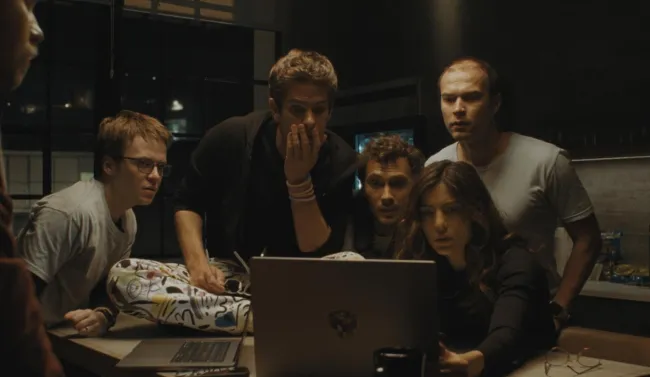
Artificial made its way to Hollywood on Monday, as director Luca Guadagnino and Andrew Garfield held court at the first Los Angeles screening of the would-be awards contender before a packed house of voters and industry influencers at the Academy Museum of Motion Pictures.
The film, which has been entered as a comedy at the Golden Globes, tells the story of the founding of OpenAI, focusing on how brilliant young mathematician and computer scientist Ilya Sutskever (Yura Borisov) and Silicon Valley operative Sam Altman (Garfield) teamed up to create the company that would launch ChatGPT. The film was originally produced by Amazon MGM, but the studio, whose parent company has ties to OpenAI, got cold feet, and the film was acquired by Neon. It’s set for release on Dec. 25.

Following the screening, the director and star were joined by cast members Monica Barbaro (who plays Mira Murati, OpenAI’s chief technology officer) and Cooper Hoffman (Greg Brockman, OpenAI’s president and Altman’s right-hand man), as well as screenwriter Simon Rich, for a lively discussion that touched on everything from the existential crisis of AI — prompting Garfield to drop a Spider-Man reference — to Guadagnino’s reverence for John Hughes’ teen comedies.
Here are the highlights.

The Artificial origin story
Simon Rich: It’s a very strange story. It started in 1989, when I was in kindergarten. I was by far the shortest kid in my class, too small to play sports out of fear of incidental contact. But I did have one friend, and his name was Danny Selsam. He was normal-sized, but he stood out for his freakish intelligence.
He started warning me about AI in 2008. At the time, I thought he had had a schizophrenic break because the stuff he was saying was so delusional to my ears. It seemed like he needed to be medicated, perhaps institutionalized. My friends and I discussed having an intervention.
We started to take him a little more seriously when he joined this new nonprofit called OpenAI and showed us some of the stuff they were working on. It was sufficiently terrifying that I felt like I had a moral responsibility to warn people. But when I tried to tell journalists, they literally thought I was making it up. They thought it was a hoax, probably because I used to write for SNL.
So, in desperation, I wrote a piece for The New Yorker. I wrote something for Time magazine. I published an audiobook that Werner Herzog narrated. None of this had any impact whatsoever on the culture. So, as a kind of long-shot Hail Mary, I wrote this script to try to convince people that the technology was real and as scary and powerful as my friend Dan had claimed.

Luca Guadagnino: I received the script that Simon wrote, and it reminded me how much I, as a citizen — as someone who tries to be informed — was confused and interested in understanding more about the culture behind, beyond, the companies, and, in that specific case, this company and the elusive figure of Sam Altman. I also discovered more people that I didn’t know because they were not on the front pages, right? Like Ilya Sutskever. To me, the idea of trying to tell the story of how a seismic shift in our way of living, and possibly in our future, is happening — and to show that it’s happening through decisions made by a few people, and these few people are kind of morphing our lives — was too huge an opportunity not to try to tell the story.
A John Hughes romance
Guadagnino: At the beginning, my initial instinct was to think of the great John Hughes and his amazing teen comedies that I grew up with. But then I realized that John Hughes was full of hope, so the difference became that we had to try to see the polarization between these two characters, Ilya and Sam, and try to be with them instead of judging them. We had to try to understand them, even though understanding them can be tough at a certain point, particularly when understanding Sam.
I’m interested in telling stories of people, and I think that, paradoxically, this is a very human story. It deals with all the frailties of being human and being driven by personal emotions that can be ugly or inspiring, and that can eventually lead us to an unraveling.

Garfield: It’s a film about human beings — the human beings who are ushering all of us, the kids who are ushering all of us in the John Hughes way, the adolescents taking us with them to see some shaman, when they don’t even know what the shaman’s going to do. But it’s like, “It’s going to be great. It’s going to be cool.” It’s terrifying, but I don’t know. I feel like if enough artists and enough people who have power can regulate, can be part of a conversation to make sure that we aren’t just giving our future away and losing all of our autonomy, I think we’ll maybe be OK.
‘With great power’: Garfield on Altman
Garfield: The journey is so authentic to me. Weirdly, as the person playing Sam, I can tell you there is no deception in the character. It’s a strange thing from the inside of the character: No moment feels like deception. Every moment feels like the truth.
From being the best camp counselor for a tech startup in Silicon Valley, incubating incredible talent, looking at people who I want to change the world with, thinking that we’re going to revolutionize how people work — or don’t work — or have more free time, you know, the magical ability of this incredible, insane technological discovery. It’s like opening a chest and finding something ancient and archaeological, far away — like finding Atlantis and going, “Oh my, the technology was more advanced.” It’s that kind of thing. And, of course, with that kind of power comes… fill in the blank. I won’t say it.
But starting there, in such a sincere, genuinely altruistic, genuinely idealistic and hopeful place, and then very sincerely going where Sam goes — it’s a really fascinating thing to find. There’s no darkness there for me in terms of playing him. It all has to be me [as Sam]; otherwise, it’s going to be Elon f–king Musk, and no one wants f–king that.
The first time I saw Sam, he was testifying in front of Congress, and he was saying incredibly righteous stuff. He was talking about transparency. He was talking about the risks. He was very casually saying, “No, I don’t have any equity in OpenAI. I’m just doing this because I love the technology, and I’m passionate, and I actually care about human beings.”
I also thought it was incredibly courageous for an out gay tech genius to be sitting in front of Republican congressmen who probably don’t believe in his right to exist. All of these things were adding up for me, and I was in such deep admiration of him. I was like, “Oh, we need more of these. … This guy might be my future best friend.” I was like, “Oh no, he’s genuinely great, and he seems to really have his values and priorities in the right place.”
That was my first flush with Sam as a persona in the world. And then, of course, the more you know, the more you realize that that quote about him being “king of the cannibal island” is accurate. You know, he convinced me that he was nothing but purely altruistic, which he — I mean, it’s all playing out. I’m not going to comment on those things. We’re all seeing what’s happening, and we can all have our own feelings and opinions about that. I still strangely have hope, but I have hope especially because, as Luca said, it’s a very humane film.
‘The ring bearer was a robot’
Cooper Hoffman: I got told something before we started shooting that was really interesting: Greg would leave his wife for Sam Altman. That’s kind of all I needed to hear, really, because that’s enough to go off of.
Barbaro: Didn’t they get married in the OpenAI—
Hoffman: Yes, yes, yes. They got married in the OpenAI offices.
Barbaro: How crazy is that? They’re all very close.
Hoffman: They’re all very close, like a family cult. The ring bearer was a robot. I didn’t know that. That’s crazy. But, you know, you hear this about someone and you’re like, “That’s something you can build off of.”

‘I’ve never been so scared’
Garfield: I think we were all pretty terrified every day that we were playing these characters. I think we all felt on the edge of ourselves every day. I remember saying to Luca at the beginning, just before we started shooting, “I’ve never been so scared to start a film.” He said, “I like it. Stay there. I like you there.”
Guadagnino: There is vibrancy in these characters, so we wanted to have a sort of vibrancy in the way the movie unfolded. Intimacy, too, because it’s about relationships. It’s true that it’s a story that spans 20 years and more, but it’s all about how each of these people relate to the other, and how these connections and disconnections are eventually going to be disrupted.
It’s easy to have the position of the doomer, right? But what we have to try to do is grasp onto the hope that something good can happen, because these are people, and they can try to be better.
