
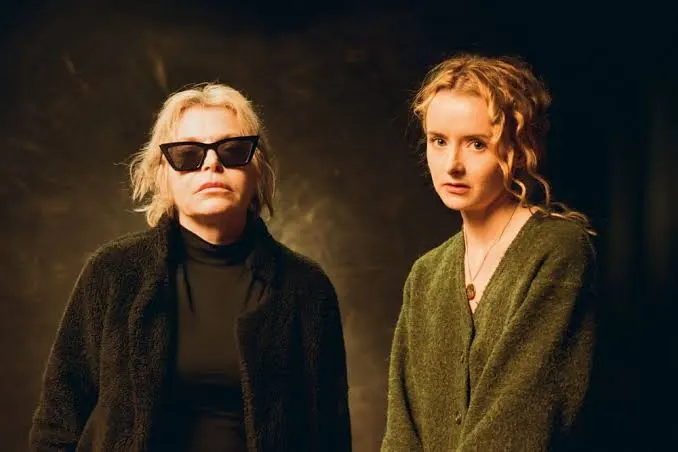
About 11 months ago, Myrid Carten’s debut feature film, the documentary A Want in Her, an exploration of intergenerational trauma, mental health and addiction, was honored with three British Independent Film Awards (BIFAs), namely for best feature documentary, the best debut director – feature documentary, and The Raindance Maverick Award.
On Wednesday, the Irish artist-turned-filmmaker was revealed as a member of the 2026 U.K. BAFTA Breakthrough cohort, supported by Netflix.
A Want in Her was written and directed by Carten, who also appears in the doc and handled cinematography. It follows Carten and her mother, Nuala, who goes missing somewhere in Ireland. The creative’s search for her takes her into a family feud, a house dispute and a history that threatens to take everyone down, including the filmmaker herself. The doc had its world premiere at the 2024 International Documentary Film Festival Amsterdam (IDFA) in Amsterdam.
On the occasion of her inclusion on the U.K. BAFTA Breakthrough list, Carten talked to THR about her journey behind A Want in Her, just how vulnerable she made herself in the process and what’s next for her.
What led you to take on such a challenging film project, for which you made yourself so vulnerable?
I was led very much by impulse, which comes from my artistic background. I studied fine art, and there, if you have an idea, follow it. Don’t think too much about outcomes! And then, as time went on and the film started to grow, I developed what I call my north star. I felt this adult-child story, the story of the children of people who suffer from mental illness and addiction, isn’t really told that often. So I felt compelled to do it for that particular cohort.
But even in the development process, everybody I met was like, “Oh, I have experience with that.” There’s a statistic that every addict touches 10 other people’s lives. I felt the addict story is often the one that’s told because it’s dramatic with a capital D, but this story felt really important.
On the vulnerability issue, I just really focused on making a film that worked. With myself as a character, it actually felt in some ways that the vulnerability served the film.
Did you ever expect to win three BIFAs?
I was never thinking about BAFTA or BIFAs when I was in the middle of this old, derelict house and all this drama. My dream was just that the film would be seen in some cinemas. That was the height of my aspiration, and it’s gone beyond that. It’s done better than I thought it would do, especially because it’s quite an experimental film. So the fact that audiences have really taken to it has been a great boost of confidence. People are very smart. I think we often don’t acknowledge how much audiences get things, even if they’re not spelled out for them.
What is your hope for BAFTA Breakthrough?
BAFTA are the best of British and arguably world cinema. I was nominated for this outstanding debut category, and there tends to be one doc in there. But I really want to make a fiction film.
Wow, tell me more!
That’s always been my desire. I tried to use as many dramaturgy elements in A Want in Her as I could. I think it’s going to be an interesting move into fiction and blurring that space.
Myrid Carten, courtesy of BAFTA/Sane Seven
It is just amazing with that transition into fiction because I feel BAFTA is really a bed for lots of producers, directors, creative talent who are all drawn to BAFTA. So the idea is that I am going to create meetings.
What BAFTA Breakthrough does is it puts you in the role of a mentee, and you can ask people for meetings in more of a mentor capacity as opposed to meetings that are all about collaborating and business. I’m really interested in talking to people who have done debut fiction films that I think are extraordinary and chatting to them about how they did it, not just navigate the industry, but maintain artistic integrity.
I’m also really looking forward to having the BAFTA [View streaming] player and watching all the films. When you have a toddler, you can’t go to the cinema that much. So this is perfect for me.
Do you already have any ideas for a fiction film that you want to start developing?
I have one idea for a doc hybrid that I’ve put on the back shelf, and I’m developing two ideas for fiction films. I am trying to think about how to bring that sense of reality and rawness to this form that is artificial or has artifice in it. Doing screenplays is a whole new process. My story editor always says you learn about making a film by making a film.
Is there anything else you’d like to share?
I’d love to have a career like Jonathan Glazer, in that each of his films is so different. But the person I’d really love to meet through BAFTA Breakthrough would be someone like Lynne Ramsay.
But I have my own path, and actually, that’s what really worked in A Want in Her. I wasn’t trying to make a film like anybody else. I have to really hold onto that.
And the big reference for A Want in Her was The Wizard of Oz, which most people wouldn’t even know.
Wait, what!? Now I am curious to hear more…
At the start, we called it No Place Like Home. That was the working title for years, and we would shoot the house as though it was Technicolor. It was this idea of this dream, this fantasy of the house and trying to return to that. So, [The Wizard of Oz] was one of the early references, but it’s so buried that people wouldn’t even recognize that. I like when things are kind of subliminal.
