
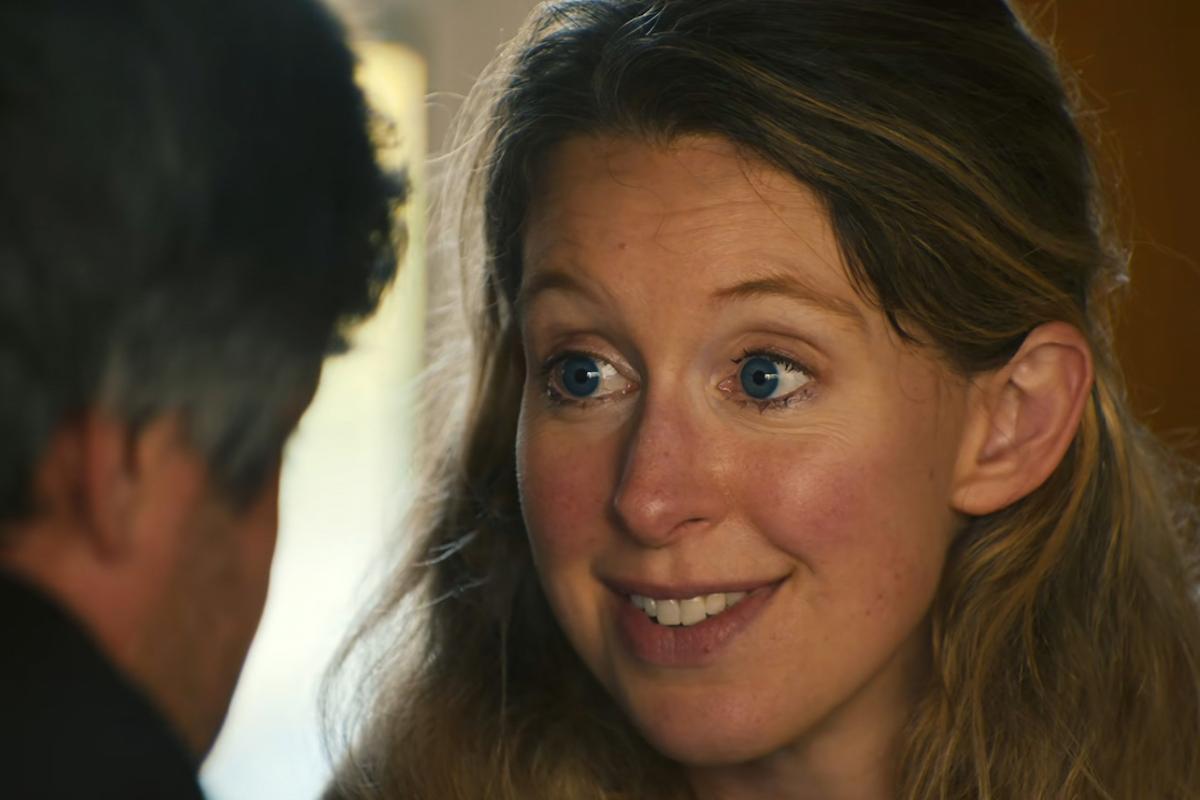
You Can See Everything (now on VOD platforms like Amazon Prime Video) reminds us that the closer you look, the less you see. Or maybe you see too much? Either way, heads spin and brains boggle at filmmakers Nathan Fielder and Lance Oppenheim’s rule-breaking post-meta quasi-documentary about Elizabeth Holmes, the disgraced former CEO of med-tech company Theranos. She’s currently in prison for defrauding those who invested in her nonfunctioning blood-testing equipment – but she spent the month prior to incarceration with Fielder, allowing him access to her home and family. The film became a cultural phenomenon, grossing more than $100 million as it tested the very notions of truth and fiction.
The Gist: Countdown: 34 days before Holmes enters prison. She and partner Billy Evans are holed up in a beachside San Diego cottage with their two children, including their month-old daughter. Holmes – or “Liz,” if you’re about nine inches away from her, like the camera so frequently is – and Evans, in pursuit of, in their own words, “radical transparency,” have invited Fielder to live in their guest room and film them in their day-to-day mundanity. So far, so good, and also, very weird.
This is an attempt to humanize some likely terrible people. Those are my words, and yes, they’re subjective, because this is a subjective analysis of a film that’s about the ceaseless tension between subjective and objective perceptions of reality, specifically, how “Liz” told lies that landed her an 11-year sentence in federal prison, but repeatedly tells Fielder she never lied, and has indeed never lied once in her entire life, which itself is a fucking lie, and when Fielder presses her on it, she responds with the vague and elusive language that comes to define her for the entire three hours of this film, and that stands in wild contrast to her wide, literally unblinking blue-eyed stare, which fills the frame in countless closeups and render her disarmingly close to unreality, like she’s a Muppet or AI concoction.
Fielder is either center-frame or lurking around corners with headphones on, listening to his mic’d-up subjects. He’s in their world now, while the rest of the world “believes a reality that isn’t true,” Billy and “Liz” insist. They cook breakfast, they tend to the children, they attempt to build another business around “Liz”’s disgraced technology, they reply to Fielder’s shockingly direct questions with frustrating, and in a way impressive, elusiveness. Are they truly unvarnished or just calculating? Who can tell? We get one bombshell of a scene after another, including an all-timer of a Rorschach-test moment when “Liz” doesn’t understand the joke of the old “Who’s on first” comedy routine. There’s also the scene where Fielder shows them The Dropout, the fictionalized miniseries in which Amanda Seyfried plays Holmes. Then “Liz” goes to prison and the documentary is only half over, so Fielder essentially replaces her with Seyfried. Like I said, head-spinning.

What Movies Will It Remind You Of? YCSE tests the limits of documentary filmmaking like Sarah Polley’s Stories We Tell – or Borat, which held a similar grasp on the zeitgeist. And those who want a more straightforward nuts-and-bolts doc should look to HBO for The Inventor: Out for Blood in Silicon Valley.
Sex And Skin: Exactly how unfettered was Fielder’s access? Full dong as Billy Evans showers. Why the guy let the camera in the bathroom is a question with no answers, or too many answers, just like every question in this film.
Our Take: I feel like Werner Herzog would burst with pride over Fielder and Oppenheim’s pursuit of the ecstatic truth within this densely tangled story. Herzog’s doc-filmmaking method fudges the line between fiction and fact in pursuit of clarity, but YCSE’s truth is grossly ironic: clarity is impossible. Fielder explores gradations of truth, of people’s personae on and off camera, of personal and professional lives, of the very methods and procedures of documentary filmmaking. The film layers realities – ours, Fielder’s, Holmes’, the media-consuming public’s, Seyfried’s – into the ultimate documentary hyperconstructive deconstruction of a narrative. All of these perspectives are built up and torn down and built up again, overlapping, shifting, splintering, re-forming kaleidoscopically until the straight line of truth bends into an ouroboros, which then twists into the symbol of infinity.
I exaggerate, but only a little. The “full transparency” referenced in the film’s opening scene is anything but, as we attempt to figure out what’s “staged” and what’s “real” in the doc, and as various “characters” attempt to control the narrative. There are dozens of unbelievable moments in this film, and in its spirit, I leave that assertion purposely vague. I will say that Fielder and Holmes arguing over the implications of the word “can” – verb, not noun – is an exasperating depends-on-what-your-definition-of-the-word-“is”-is moment that shreds to bits the very act and idea of functional human communication. The only certainty here? That Seyfried’s distinguishing Very Large Eyes can indeed get even wider, especially when Seyfried watches Holmes watching Seyfried play Holmes – and suddenly, we’re very aware that we, too, are watching Seyfried watching Holmes watching Seyfried play Holmes. We can see… everything?

Our Call: You Can See Everything is a truly groundbreaking masterwork. STREAM IT.
John Serba is a freelance film critic from Grand Rapids, Michigan. Werner Herzog hugged him once.
