
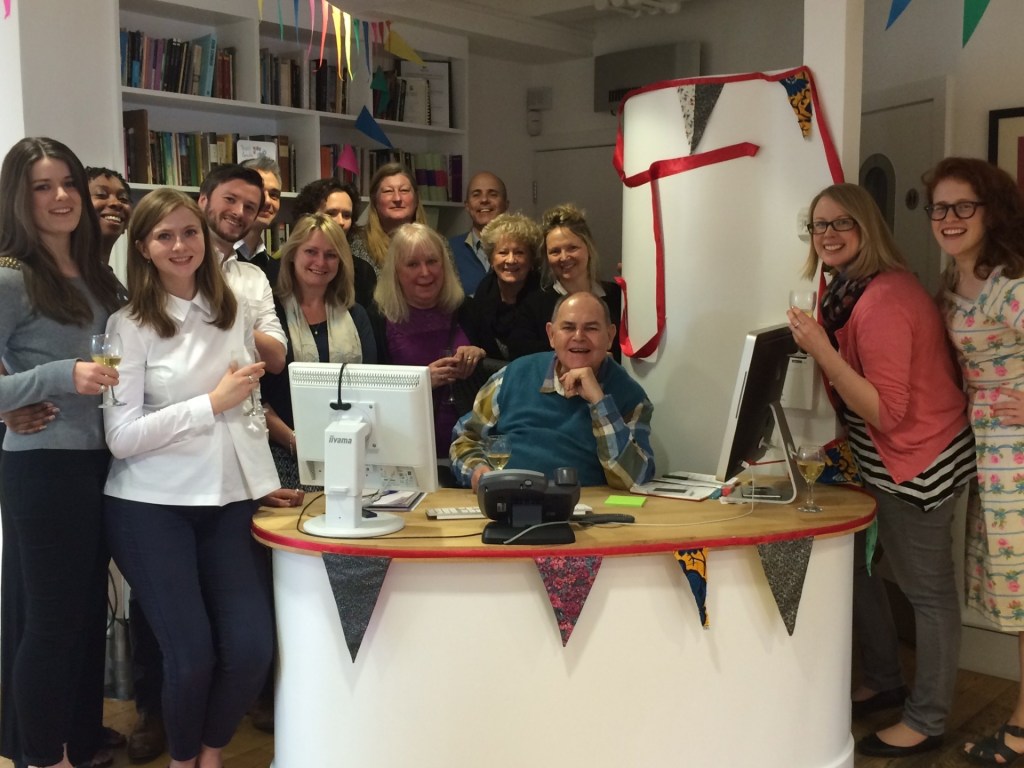
Jeremy Conway — an artiste’s agent, and a titan of the industry with an unerring eye for the stars of the future — died earlier this month aged 87. His client list was legendary, a rollcall that included Anthony Hopkins, Brian Cox, Helena Bonham Carter, Benedict Cumberbatch, Claire Bloom, Greta Scacchi, Noma Dumezweni, Joanne Froggatt, and David Harewood,.
Over 50 years ago, Conway founded his eponymous agency. In 1980, Nicki Van Gelder joined him, adding her name to the shingle. There were just three of them in the office then, and when John Grant joined in 1994 there were nine. “We are now 32!” Grant recently told Deadline of the company that’s now a powerhouse called Conway Van Gelder Grant. Grant confirmed that Conway — “his friend and mentor” — had died on 1 November this year. Conway was CVGG’s principal partner until he retired in 2015.
In a tribute penned for Deadline, Bonham Carter, who’s still with the agency, recalled a note she had written for Conway’s retirement party thanking him “for my career.” She meant it. She continued, “I don’t think any of it would have happened if it weren’t for him. He started it all; 42 years ago, I was 17 and sitting in Jeremy’s office on a rather low futon or sofa watching him pace up and down in front of me in mild frustration. He had seen me in a Channel 4 drama playing an Edwardian ghost [1983’s A Pattern of Roses] and was convinced I had something. I wasn’t so sure. I thought I should go to university. ‘Look,’ he said somewhat impatiently. ‘I really am one of the top five agents in London.’ And so began one of my longest partnerships in my life. We did, I think about 20 years together. And I never did go to university. And nor did I ever train.”
Conway wasted no time. He fired off a message to Trevor Nunn suggesting that he consider Bonham Carter for the title role in Lady Jane, Nunn’s film about Lady Jane Grey, the 16th-century “Nine Days Queen”. Next, Conway took Celestia Fox, Merchant Ivory’s casting director for a jolly supper, where he advocated Bonham Carter for the role of Lucy Honeychurch in their upcoming production of A Room with a View.
During this period, Grant remarked, “Jeremy represented several of each cast of the Merchant Ivory Films.” Anthony Hopkins and Bonham Carter both starred in Howard’s End, while Hopkins went on to make Remains of the Day. Cross-referencing the Merchant Ivory catalogue, it’s possible to discern that, over a period of three decades, scores of CVGG artistes populated their films.
I met Conway many times over the years — at first nights, at Oscar-night soirées in Hollywood — and every now and then we’d have lunch. He once explained that, as the son of Colonel Charles Maxwell Orr Sawers, a colonel in the 9th Royal Deccan Horse who served in India and Burma, he knew all about “getting work done and just getting on with it.” I found that comment from Conway in a red Silvine notebook, one of hundreds that I forgot to throw away. The army-brat background, I think, gave Conway that carpe diem attitude, but it was cloaked by his avuncular bearing.
But he was definitely getting on with it when he got his hands on Ted Tally’s screenplay for The Silence of the Lambs. And he was getting stuff done when suggested that the film’s director Jonathan Demme go and watch Hopkins in David Hare and Howard Brenton’s play Pravda, which opened at London’s National Theatre in May 1985. The part of Hannibal Lecter won Hopkins his first Academy Award.
Conway loved actors. I would often catch him at plays well into their runs, featuring thespians that he didn’t represent. He wasn’t out to poach them; he just wanted to watch great performances.
Jeremy Conway’s Spotlight page
Born David Maxwell Sawers, Conway attended Radley College in Abingdon, in Oxford. After that, he studied drama at the Guildhall School of Music & Drama., which is where he met his life-long partner Neville Phillips, with whom he entered into a civil partnership in 2005. Parts in Z Cars, early episodes of Doctor Who and stage roles followed, but Conway enjoyed watching the likes of Judi Dench, Maggie Smith and Hopkins at the Old Vic rather more than treading the boards himself.
Deciding to become an agent, he joined forces with former Royal Academy of Dramatic Arts-trained actor-turned-agent Norman Boyack. Together they formed Boyack and Conway, where their roster included John Thaw, Sheila Hancock and Edward Hardwicke. When Boyack decided to leave the business, Conway set up on his own, representing Hopkins, Susan Penhaligon and Trudie Styler, then an actress, early on in her career.
Once Van Gelder joined, the business grew. Grant observed that Conway was “definitely one of the first agents in London to represent European and world film actors from various countries. As wide a range as Romania, Scandinavia, Germany, France and India. Notably Jesper Christensen, Lars Mikkelsen — who’s still with us — and Om Puri.”
Aside from his film, theatre and television passions, Conway loved to cook and entertain, and he would regularly host dinner parties at the weekend, inviting the good and the great of the entertainment world. Grant added that he was a keen gardener and collector of art and artefacts. “He was also an avid reader,” Grant marveled, “and somehow found time to read many books alongside a large volume of scripts. He had an encyclopedic knowledge of plays and could frequently be heard discussing why someone was specifically right for a role.”
For over a decade Conway was a board director of the London Academy of Music and Dramatic Art, where he was first in line to scoop up tomorrow’s stars. He was also long associated with Bafta, having been a member for 60 years.
A better-than-thriving CVGG is Conway’s legacy; he always had one eye on the future by partnering with Van Gelder and Grant. How he went to bat for all his actors mattered most. I remember being on the set of Guy Ritchie and Matthew Vaughn’s Lock, Stock and Two Smoking Barrels when Jason Flemyng inched his way over to me for a chat and he was almost in tears as he told how Conway had saved his life by “giving me a career”.
That’s precisely the side of Conway’s character that Bonham Carter reflected on in her tribute to her beloved agent, which I’m posting in full below…
“I think for Jeremy’s retirement party I wrote a note saying, ‘Thank you for my career.’ I meant it. I don’t think any of it would have happened if it weren’t for him. He started it all; 42 years ago, I was 17 and sitting in Jeremy’s office on a rather low futon or sofa watching him pace up and down in front of me in mild frustration. He had seen me in a Channel 4 drama playing an Edwardian ghost and was convinced I had something. I wasn’t so sure. I thought I should go to university. ‘Look,’ he said somewhat impatiently. ‘I really am one of the top five agents in London.’ And so began one of my longest partnerships in my life. We did, I think about 20 years together. And I never did go to university. And nor did I ever train.
“Jeremy was my industry parent. He was my champion. And patron. My enthusiast. He was bossy, impatient, and had formidable energy and appetite for all things life had to offer. He had great taste. His house, when I last saw him, was brimful of paintings and objects of beauty. He loved his job and he loved it for the culture of it — the plays, the acting, the life, art, the people. His interest and curiosity was acute.
“Of course, most of our relationship was conducted on the phone. He had a great, handsome, fully resonant telephone voice. He had trained as an actor and would always intone, ‘CON-sonants, Helly!’
“One of my favorite poets, Mary Oliver, ends one of her poems, by saying, ‘I don’t want to end up having simply visited this world.’ Jeremy didn’t just visit it, he ate it, and he tasted it. He explored, and he made people’s careers and opened doors, and he grew an agency from seed that lives and thrives.
“His legacy and his children are the agency and all those he impacted, people whose lives would be utterly different without him. His family of connections and tentacles of influence over decades in the industry is like a tree with many roots, an old oak that will far outlive us all.
“I think of him with huge love and gratitude. I was all his idea. All his fault.”
