
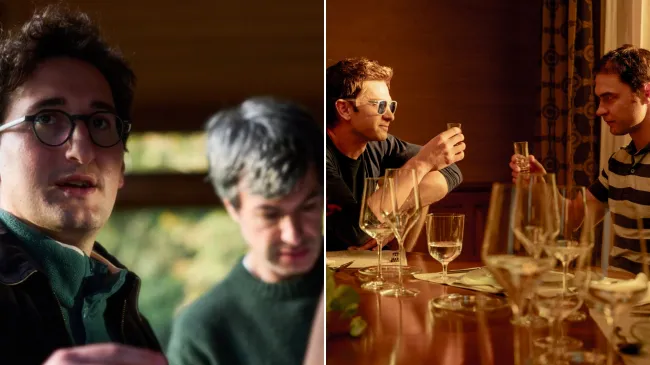
Here’s a novel solution for how to best determine category eligibility at awards shows like the Golden Globes, the SAG Actor Awards, and the Oscars: Let’s just allow Cate Blanchett to decide.
During a recent conversation with Gold Derby about her new short film initiative, the Displacement Film Fund (look for that story soon), the two-time Oscar winner let it slip that she had recently seen Lance Oppenheim and Nathan Fielder‘s conversation-dominating You Can See Everything, a film she specifically described as “genre-defying.”
Since the movie’s precise genre has been an ongoing topic of conversation since its Telluride premiere in September, we felt compelled to ask Blanchett if she considered it a documentary or… something else. “I think it’s invented a whole new category,” the actress replied, simply and sagely.

You heard Lydia Tár awards bodies — time to get cracking on some new categories.
Doc around the clock
Let the record show that the Critics Choice Association is not following Blanchett’s guidance on You Can See Everything. The group — which counts Gold Derby as a member — lavished the A24 blockbuster with a clean sweep at its recent Documentary Awards, held last weekend at Manhattan’s Edison Ballroom. You Can See Everything went 5-for-5, winning Best Music Score, Best Editing, Best Cinematography, Best Director, and Best Documentary Feature.
Oppenheim, sans Fielder, accepted the last two statuettes, which were presented back-to-back, resulting in an awkward moment where he waited in the wings after his Best Director speech and then almost immediately reemerged to say a few words about the movie’s Best Documentary Feature win. By that point in an overlong evening, the audience’s attention had started to wander and the early enthusiasm for You Can See Everything‘s wins had audibly dimmed as the other contenders realized the juggernaut they were up against.
Navigating the crowded after-party, Gold Derby overheard some tables of filmmakers and assorted doc talent openly discussing the “Is it really a documentary?” question with no obvious answer forthcoming. We happened upon Fielder collaborator and HBO superstar John Wilson — a CCA Doc winner himself for Best Narration for his first feature, The History of Concrete — by the bar and chatted briefly with him about how he views their specific voice in the non-fiction space. His take? It’s complicated. (By the way, Wilson mentioned that was also one of the very few who knew You Can See Everything was happening during its top-secret three-year production process.)
Absent a blanket ruling by say, Empress Blanchett, the documentary question will be settled group-by-group; days after the CCA Documentary Awards, the Cinema Eye Honors recognized You Can See Everything in seven categories at its 20th awards ceremony, tying the film with American Doctor, a more aesthetically traditional doc.
Gold Derby’s expert prognosticators — many of whom cast their CCA ballots for Elizabeth Holmes and Billy Evans — are anticipating that the Academy’s notoriously conservative documentary branch are going to crumble in the face of the movie’s pop culture impact. You Can See Everything currently occupies the No. 3 spot on our Best Documentary Feature leaderboard and seeks to challenge front-runners Once Upon a Time in Harlem and Naza for the top spot.
Best Documentary Feature
1.

2.

Once Upon a Time in Harlem
3.

4.

5.

6.

7.

Rehearsals for a Revolution
8.

9.

10.

Everybody to Kenmure Street
But just in case You Can See Everything misses the Best Documentary shortlist on Dec. 15 — or the final five nominees when those are announced on Jan. 21 — A24 has smartly been playing the long game since Telluride. From the jump, the company has tacitly acknowledged the difficulty the movie could have with the documentary branch, which lit the fire for an unprecedented Best Picture campaign among younger moviegoers that’s now raging full blast.
Gold Derby’s experts have You Can See Everything firmly ensconced among the Top 10 contenders in that race; the film is currently sitting at No. 8, and could climb higher if the doc branch goes “Who’s on eighth?” and leaves the film off their shortlist, giving its champions a fresh rallying cry. On other hand, making the Best Documentary cut could also have the opposite effect, cooling the film’s Best Picture campaign and allowing in an on-the-bubble narrative option like I Play Rocky or Elsinore. These are just the hard truths that come with being a documentary unicorn.
Best Picture
1.

2.

3.

4.

5.

6.

7.

8.
9.

10.

Seyfried’s testament

Welcome back to the awards circuit, Amanda Seyfried. The Oscar nominee is [REDACTED] no more as You Can See Me‘s secret weapon is now in full public view for reprising — after a fashion — her Emmy-winning role as Holmes in the resurgent Hulu hit The Dropout.
“Now that they’re going to let me loose and show up, I’m down!” Seyfried told The Hollywood Reporter about her plans to hit any and every red carpet and FYC event on the campaign trail to Oscar nominations morning. “A campaign is a lot. It’s time-consuming. It takes all your energy. And I’m totally willing to do it.”
The Testament of Ann Lee star will definitely need to put in the hours because — arguably more than anyone else associated with the film — her candidacy hinges on how voters answer the “documentary or not?” question. The Golden Globes, BAFTA, and SAG have already ruled that she’s not eligible for Best Supporting Actress honors at their ceremonies due to the mix of reality and reenactments at play. But the Academy’s acting branch could be more lenient as it makes its final ruling; certainly, they know they’ll be meme-fied as villains all over the internet should they deny Mother Amanda’s bid.
Following her conversations with Rolling Stone and THR, look for A24 to start including Seyfried in upcoming You Can See Everything events, in addition to building shindigs specifically around her. Since Emma Stone was instrumental in connecting her with Fielder and Oppenheim, don’t be surprised if the two-time Oscar winner is called into service as moderator for one or more Academy conversations. Seyfried also has plenty of other cool friends she can call on to testify on her behalf, from Mean Girls mastermind Tina Fey to her Mamma Mia! mama, Meryl Streep. We can only imagine the Miranda Priestly put-downs that Streep could direct Evans’s way should he try to derail the Seyfried express train to a second Oscar nod.
For now, our experts have Seyfried ranked at No. 4 for Best Supporting Actress — a race that’s been sleepy for several weeks as prognosticators filled four out of the Top 5 slots with a pair of Odyssey stars (Anne Hathaway and Samantha Morton) and two Penélope Cruz performances for The Invite and La Bola Negra. But Cruz’s Bola bid has faltered since the movie opened in theaters and spotlighted her minimal screentime, opening spots for the more substantial presences of Seyfried and All of a Sudden‘s Tao Okamoto in their respective contenders.
Cue up the ABBA, because here Seyfried goes again.
Best Supporting Actress
1.

Anne Hathaway
The Odyssey
2.

Samantha Morton
The Odyssey
3.

4.

Amanda Seyfried
You Can See Everything
5.

Tao Okamoto
All of a Sudden
6.
Penelope Cruz
La Bola Negra
7.

8.

Mariana Di Girolamo
Wild Horse Nine
9.

Kate O’Flynn
Tender Loving Care
10.

Sandra Hüller
Project Hail Mary
A Garfield Christmas
Despite being based on real events — specifically the rise of OpenAI under tech guru Sam Altman — Luca Guadagnino‘s Artificial is most definitely not a documentary. Instead the thorny question surrounding that film (and one that we weren’t able to ask Blanchett to rule on) has become, “Is it a comedy?”
Neon opened the floor for that debate when it submitted Artificial in the comedy categories at the Golden Globes, which raised eyebrows along with expectations among audiences that weren’t in the room for the movie’s New York Film Festival world premiere last month.
Based on the reactions that Gold Derby overheard at the movie’s first big Los Angeles FYC screening, held at the Academy Museum of Motion Pictures, those expectations weren’t necessarily met. The packed crowd of industry folks, actors (including Heated Rivalry‘s Francois Arnaud), guild members, Globes voters, and Oscar voters enjoyed the movie, which opens in theaters on Christmas Day, but wouldn’t put it in the same comedic company of, say, Abbott and Costello Meet Frankenstein.
Guadagnino seemingly sensed their skepticism, because he used the post-screening Q&A to boast about his movie’s comic bona fides. For example, he noted that he employed 30 comedians as actors — including Ike Barinholtz’s hilarious take on Elon Musk — and compared it to a John Hughes romcom like Sixteen Candles and Pretty in Pink.
Garfield backed him up on the latter point, pontificating: “It’s a film about human beings — the human beings who are ushering all of us, the kids who are ushering all of us in the John Hughes way, the adolescents taking us with them to see some shaman, when they don’t even know what the shaman’s going to do.”
The group’s “Artificial is a comedy” campaign served as an interesting contrast to a Club Kid event we attended earlier in the week where the film’s producer, Alex Coco, emphasized why the raucous New York story is actually a drama, befitting its submission in the drama categories at the Globes. Coco indicated that writer-director Jordan Firstman incorporated more overt comedy into the early drafts of his father-son story, but decided prior to shooting that it needed more emotional gravity. Still, it wasn’t lost on us that Club Kid is funnier on a scene-to-scene basis than Artificial and yet they’re playing for opposite genre teams when it comes to the Globes.
So how is Artificial faring in its quest to make ’em laugh at the Globes? Our experts currently have the film just outside of the six Best Film Comedy/Musical contenders, right behind the equally “hilarious” Obsession and Digger. That indicates that Guadagnino still has some work to do in terms of turning those frowns upside down.
Best Film Comedy/Musical
1.
2.
3.
4.
5.

6.
7.

8.

9.

10.

Teenage Sex and Death at Camp Miasma
But Garfield — who is very funny in the movie — doesn’t have to worry about proving that he can make like Marc Maron and do a tight five on command. By going the Best Supporting Actor route, he’s competing in a Globes category that includes drama and comedy contenders, and is comfortably ranked at No. 5, two spots below his No. 3 placement in the equivalent Oscar category.
You might say that prognosticators don’t see anything artificial about his chances.
Best Film Supporting Actor
1.

2.

Sam Rockwell
Wild Horse Nine
3.

Guitarricadelafuente
La Bola Negra
4.

John Leguizamo
The Odyssey
5.

Andrew Garfield
Artificial
6.

7.

8.

Steve Buscemi
Wild Horse Nine
9.

10.

—Additional reporting by Jaclyn Ben-Porat and Marcus Errico
Note: Golden Globes producer Dick Clark Productions is owned by Penske Media Eldridge, a joint venture between Eldridge and Penske Media Corporation, which owns Gold Derby.
