
Warning: This post contains spoilers for the series premiere of 12 12 12
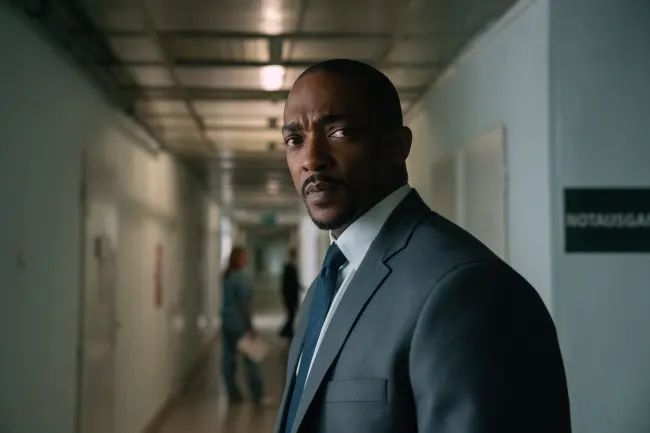
You might say that master criminal Paul Galvin (Jamie Dornan) and FBI Agent Jack Strickland (Anthony Mackie) are two sides of the same coin. The new Apple TV thriller 12 12 12 brings them together in a high-stakes game of cat and mouse across Europe, centered on an audacious attempt to steal 800 million Swiss francs in 1,000-franc notes from a bank vault deep beneath the streets of Zurich.
But the first two episodes — which began streaming Nov. 13, with the six remaining installments to be released weekly on Fridays — gradually reveal that their conflict is about much more than the money. Both men are chasing something they believe they have lost, and neither seems willing to walk away until he gets it back.

In a Christopher Nolan-esque timeline gimmick, 12 12 12 moves between three timelines: the 12 months of planning leading up to the heist, the 12 hours of the heist itself, and the 12 days that follow. One of the events connecting those timelines is a previous robbery in Newark, N.J., which continues to haunt both men. Jack is convinced the Galvins were involved, but the authorities have never had the evidence to prove it. The operation also cost him his colleague Sarah, making his pursuit of Paul deeply personal.
For creators Dudi Appleton and Jim Keeble, the contrast between the two protagonists is central to the story. “You get two guys who might have grown up on two sides of the same road,” Appleton tells Gold Derby. “But one decides to steal money and the other side decides to protect money, to be a cop.” He sees them as belonging to two different tribes, each committed to a code that can take them to extremes. “They will die to steal the money — but they will die to stop you stealing the money.”
Paul’s relationship with crime, however, is complicated by his desire to build a different life. After years of being let down by his family, he has found a home with Severine, and wants to protect the future they are creating together. Appleton says that sense of belonging is what Paul has been searching for all along.
“For a guy whose family always let him down, whose brother always screwed up, whose father brought him into crime, a home is sort of really all he’s ever wanted,” the creator explains. “And I think that was very important to really understand what it is he’s searching for, what it is he’s trying to get back to.”
Keeble adds that Paul has also constructed a particular narrative about his own past, one where he was never really a bank robber and his family was responsible for his choices. “He’s somebody who loves to tell himself stories,” the showrunner notes. “He tells the world stories, but he actually tells himself stories that he kind of believes, and he finds this home in Marseille that kind of proves to him that he’s a good guy. But that’s the question, is he? And that’s what we wanted to explore: the lies we tell ourselves.”

Dornan sees Paul’s return to crime as a painful contradiction. “There’s a real reluctance from him to go again,” the actor says. “But it ends up being the very thing that he is trying to hold safe. And the family is the reason that he does it because he’s trying to protect them, so the very thing that he wants to get out of is kind of the reason he ends up doing the heist.”
Jack’s motivations are equally personal. In Episode 2, he tells Serge — Paul’s father-in-law and a key member of his crew — that he wants his “halo” back, referring to the reputation and respect he believes he lost because of Paul and his brother, Bobby. But Mackie says revenge is the agent’s strongest driving force at this point.
“Hatred has to be fueled by something,” the Marvel Cinematic Universe fan favorite observes. “And I think the way he’s perceived by the world matters some. The way he’s perceived by his family matters most, but I think the desire to inflict the pain and harm on him that he inflicted on Jack is by far his biggest driving force.”
While Paul is trying to protect the family he has found, the loyalty within his crew is also put to the test. Jack has been receiving information from someone on the inside, but neither Paul nor Bobby knows who is betraying them. For Keeble, the mystery is connected to the idea of chosen families and the trust that holds them together.
“You have this crew who become a family, and the idea of loyalty between disparate people was something we wanted to explore,” Keeble says. “The idea that there’s a rat from the very beginning and you then meet these characters one by one — it’s a nice narrative drive, right? You’ve got a puzzle to solve.”

That question of family and loyalty becomes even more significant with Serge’s death at the end of Episode 2. After being taken to the hospital, Serge jumps from a window to avoid being used by Jack against Paul. “We originally had Serge dying in Episode 1, but we all fell in love with him, so we managed to push his death back a whole hour,” Appleton reveals, describing the character as the show’s “truth teller.”
“Because we didn’t kill him in Episode 1, we wanted to give him a particularly spectacular death in Episode 2,” he adds. “So he sacrifices himself in quite a fashion.”
“Serge is a real father figure to Paul,” Dornan explains. “And it’s kind of the worst case scenario of getting involved in this criminal world again.” For his part, Mackie says that Serge had become an opportunity for Jack to get to Paul, and once he’s dead, his character loses that leverage. “That’s where I am at the end of Episode 2, just trying to start over or rebuild back to where I thought I was before Serge’s demise.”
As for what’s ahead for the rest of the eight-episode series, the creators say the three-timeline structure will continue to reveal information that may only become meaningful several episodes later. “It’s a big jigsaw puzzle,” Keeble says. “Because of the three timelines, you might have something that happens in the planning in episode four that you only really realize the import of right at the very end in the takedown of episode eight.”
“The clues are all there,” Appleton adds. “And the fun of the structure is picking out the things that you know that you feel are going to be significant as you get along later. Everything you thought was true might not be completely true.”
