
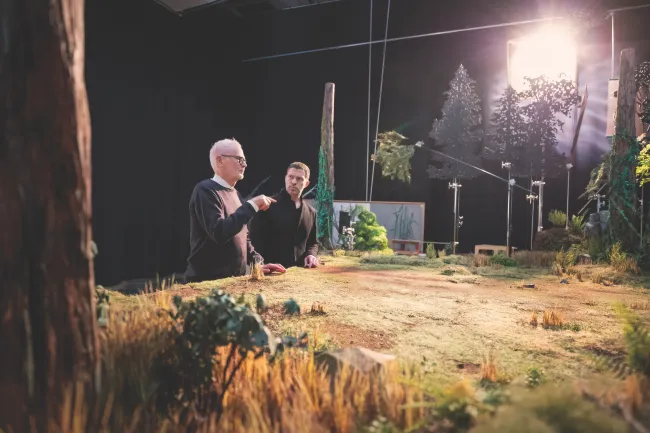
It’s a crime that legendary cinematographer Caleb Deschanel (The Natural, The Right Stuff, The Black Stallion) has been nominated six times but has never won the Oscar. He’s arguably the best at combining naturalism with hyperrealism, which is exactly what Laika’s epic new stop-motion fantasy adventure, Wildwood, required.
“I’m always looking to doing something I’ve never done before,” Deschanel tells Gold Derby about tackling stop-motion. “Which means working on a project where I have no idea what the hell I’m doing. I filmed Never Look away in German, which I do not speak — and photographed The Lion King in a virtual world I knew nothing about.

READ: How Laika’s ‘Wildwood’ became ‘The Lord of the Rings’ of stop-motion animation
“Wildwood [was] filmed with stop-motion animation, which is actually one of the oldest forms of animation,” he adds, “but utilizing some of the newest technology to make it that much more expressive. Once again I had no idea what I was doing. But, honestly, I was just overseeing some amazingly talented people who have done this many times before. I learned from them. It was an exciting process. It was like going back to film school surrounded by wonderful artists in so many areas.”

Laika director and CEO Travis Knight reached out to Deschanel because he wanted a live-action aesthetic for Wildwood, which is set in Portland and based on the popular YA novel by Colin Meloy, of the indie rock band The Decemberists, and illustrated by Carson Ellis. It follows plucky 13-year-old Prue (Peyton Elizabeth Lee) and nerdy classmate Curtis (Jacob Tremblay), who magically enter the Impassable Wilderness to rescue her infant brother.
Deschanel was instantly drawn to Portland’s beauty and weirdness, but also to the Lord of the Rings-influenced mythology of Wildwood. He worked at Laika for three years, collaborating with the camera crew, which shot with Canon digital cameras and vintage lenses, and building a visual bible. “I just like to solve creative problems to get the story on the screen,” he says. “And even though I was prepped by Travis on the methodology of this kind of filmmaking, there were many surprises we had to overcome.”

The main problem to solve was applying naturalistic lighting, particularly sunlight, to the 136 practical sets and 231 handcrafted puppets representing human and animal characters. “One of the problems in shooting stop-motion animation is that you often times need armatures to hold legs and arms in place when a character jumps — so you need to think about this when lighting. Most of the times, the techs can find a solution and move the supports from one side of the puppet to another to accommodate.”
The first thing that Deschanel did was grab a ParaNorman puppet and take it to the woods and photograph it for reference in all weather conditions. “I’d be 10 feet from a trail and people would walk by and look at me funny because I was lying on the ground taking pictures of puppets,” he recalls. “But it was really valuable to me. There were multiple sizes for the puppets that all had to be blended together, and the fact all the sets would get torn apart and moved to different stages, complete with all the lighting already worked out.”

The trick to making sunlight look believable on set was simple: “You get the light back as far as you can without confining yourself to the stage because you needed more room to get the light rays going straight the way the sunlight does without too much fill,” Deschanel explains. “Most of it was based on instinct.”

One of the most challenging scenes came early, when Prue comes into her bedroom in a bad mood and crosses to her desk by a window. “It’s a 180-degree spin,” he says. “With the site of the camera in this small set — it was difficult to accomplish all that needed to be shown — and worried about how we would pull out walls and adjust the lighting so that it worked from beginning to end.”
Deschanel says the film is a love letter to Portland, and that he enjoyed exploring it all, from the artsy St. Johns neighborhood to the downtown coffee culture to the massive Forest Park, which becomes fantastical. “If you go to Portland and you drive around, you’re gonna see this movie,” Deschanel offers.

There were two bird-related highlights for the cinematographer: the abduction of Prue’s infant brother Mac by a murder of crows, which was inspired by Alfred Hitchcock’s The Birds, and Prue’s ride on the magnificent giant golden eagle, the General (Angela Bassett).
“What was important was that then birds arrive in very much the same way as in the Hitchcock film,” he explains. “But I wanted to have a lighting change, have it dim a bit, as if there are clouds coming in and darkening, and then wind picks up and you see it blowing. It’s like Something Wicked, This Way Comes.
“And Curtis, being the first one, gets curious about why all these crows are there and then, finally, Prue turns and it takes her a moment to figure out what’s happening. So there are a lot of shots in that sequence that tell that story and changing points of view, even the crows’ point of view. So they are an important character in the scene.”
By contrast, Prue’s thrill ride atop the General, with thousands of feathers moving in the wind, was based on Deschanel’s memorable early-morning plane rides.” “We wanted to get that feeling because you’re coming from a really dark scene, where they’re being pursued, to the overcast of early morning, where you get that mist in the air,” he recalls.
“And then you burst through the clouds and it’s sunlight,” he continues. “Of course, you get fooled because, for a little while, you’re having this wonderful amusement park ride flying on this beautiful eagle over a lot of really classic mountains and rivers around Oregon. And then we’re suddenly being pursued again.
“But it comes to life because of the animator,” he adds, “who puts character into everything, expresses all the things that need to be expressed by the movement. The body language that they create by the way they manipulate puppets is just extraordinary.”
