
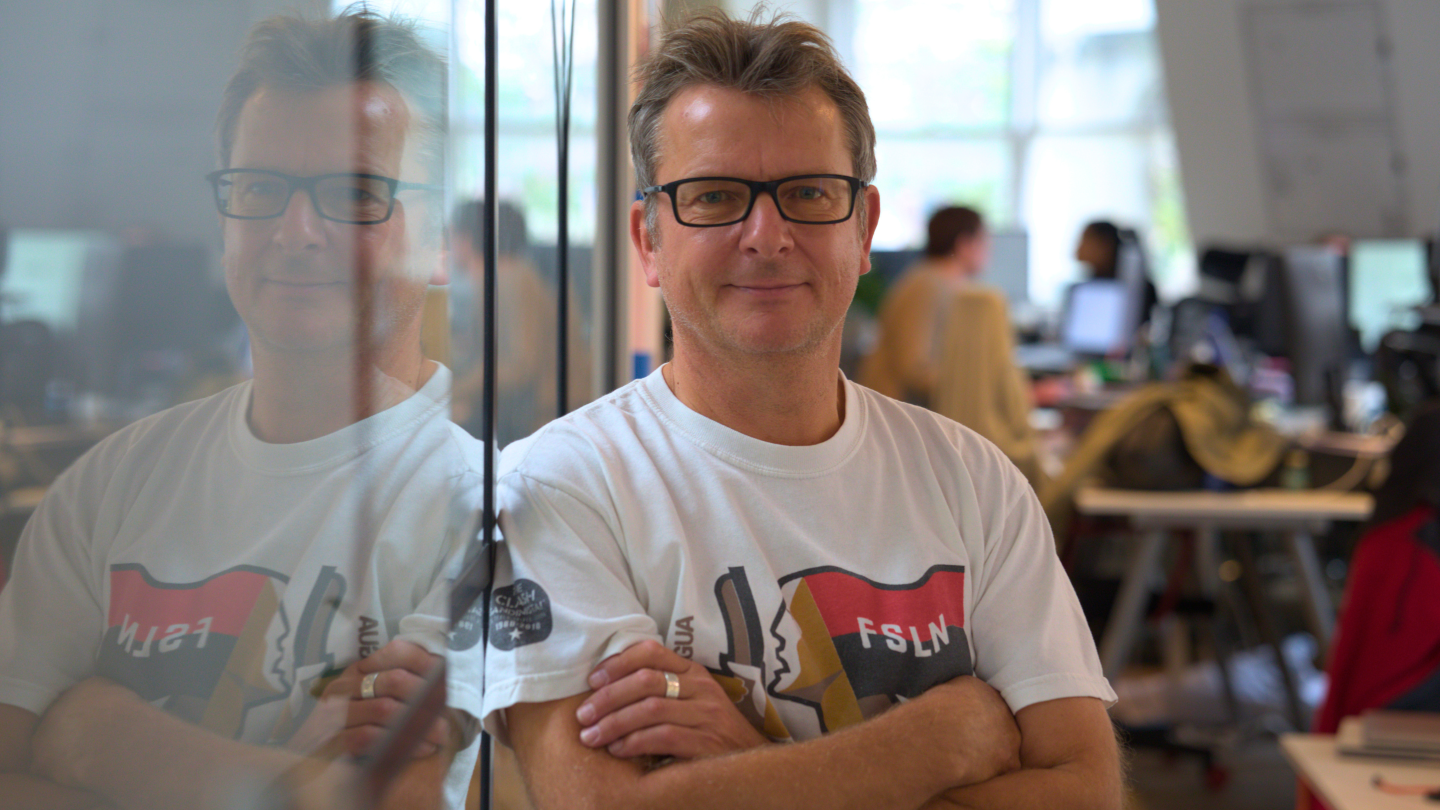
The AFM got a welcome boost ahead of this year’s market when British producer-financier Head Gear unveiled plans to launch a U.S. operation, promising to invest $120 million in production in its first year of operation. Head Gear COO Samantha Allwinton will run the U.S. division as director of operations.
For Phil Hunt, who launched Head Gear in 2002 with film financier (and oil industry exec) Compton Ross, setting up stateside has been a dream “for 25 years.” In the U.K., Head Gear has developed a reputation as the “producer’s producer,” working at every stage of financing and production — from presales and packaging to gap and bridge funding — to support about 30 films a year, including Talk to Me, Danny and Michael Philippou’s Australian horror breakthrough that grossed more than $90 million worldwide; Ali Abbasi’s Oscar-nominated “reality horror” film The Apprentice, about the making of Donald Trump; and Molly Manning Walker’s art house crossover hit How to Have Sex.
Head Gear also is active on the sales side through its international operation, Bankside Films, whose AFM slate this year includes the AI-themed sci-fi comedy Almost You, starring Juno Temple, Joey King and James McAvoy from Ted Lasso director Matt Lipsey. Bankside is selling the project, now shooting in Scotland, worldwide, co-repping the U.K. and North America with UTA Independent Film Group.
Speaking with THR ahead of the market, Hunt explains why he’s bullish about the U.S., with or without a federal tax credit, the impact of the creator economy on indie film and what he’s learned from taking on Trump – and Julie Andrews.
Why Head Gear USA, and how will it work?
I’ve wanted a U.S. business for about 25 years. It took that long to find the right person to run it. Now the timing is right as well: more U.S. producers need financing, and a federal tax credit could bring a lot more production into the country.
We’re putting about $120 million into U.S. film and TV in the first year. We’re not just a lender. We help producers package the project, build the financing plan, handle the business affairs and collect the money after release. We behave like a small studio. We decide whether a film goes into production, and we deliver about 35 films a year to our regular sales agents and buyers.
Whether we like it or not, the U.S. leads the rest of the world on global distribution of English-speaking movies. Being there is often not an option. But we’re a British company with the culture we have built over the past quarter of a century, and that means we uphold key principles. We’re transparent and do what we say we’re going to do — while bringing a great punk rock style.
‘Talk to Me,’ which Head Gear backed, was a breakout hit, earning more than $90 million worldwide.
Matthew Thorne/A24
How does the federal tax credit fit into your U.S. expansion plans, and what if it doesn’t pass?
If it passes, a U.S. production gets cheaper to make and lenders can borrow against the credit, the way we already do in the U.K. and Europe. That’s why we’re setting up now, so we’re ready the day it lands.
If it doesn’t pass, we’re still going to be investing heavily in U.S. movies. Nothing much changes that desire to open up there for the past 25 years.
What are the biggest lessons you take from the past year’s indie successes and failures?
The films that worked were made for a price that makes sense; good cast, clear idea, a budget the market can pay back. The ones that failed mostly cost too much for what they were. People priced the film on hope, not on what buyers actually pay.
Second lesson: The old safety nets are gone. Revenue is down and costs are up. If your plan only works when everything goes right, it won’t work. Third: Be honest early. When a producer tells us the problem on day one, we can usually solve it together. Those are the people we make films with again and again.
What has been the biggest disruption in traditional indie financing, and how has that changed how you put projects together?
Presales stopped covering what they used to. Streamers buy fewer films from independents and pay less for the ones they do buy. So there’s a bigger gap between what a film costs and what’s guaranteed up front. Gap is the new equity. Investors like us now fill part of what used to be covered by sales.
That means we build the film around the money from the start. We look at cast, genre and budget together, before the script is locked. We stay with low-cost, high-concept projects: action, thriller, horror. We also watch how much we have riding on any one genre or sales agent at a time.

Head Gear scored a cross-over arthouse hit with ‘How to Have Sex’ from Molly Manning Walker
Courtesy MUBI mk2 Films/Nikos Nikolopoulos
How was Almost You financed?
It’s a mix. Tax credit money from the U.K., a lender borrowing against it [us], some money from sales to territories, and equity from the producers and partners. Bankside came on early with the cast, which helped make the sales numbers believable.
How is the creator economy affecting indie film?
Creators have something indie films have always struggled to buy: an audience that already knows them. That matters more than ever because marketing a small film is hard and expensive. A creator with millions of followers brings people before the film is released.
But a big following doesn’t automatically turn into cinema tickets. Watching a free video is very different from paying to see a film. The ones who will make it work are the creators who treat a film like a real production: proper script, proper budget, proper distribution plan. I’m interested in that. I’m not interested in a follower count on its own. But most of all it’s about great storytellers, whether they are from the creator economy or not.
What’s been the biggest surprise for you, and which title (whatever the commercial success) are you most proud of?
There’s a lot that I’m surprised that failed so badly, but on a more positive note: from a commercial perspective, it’s got to be Talk to Me. No one knew that it was going to do the incredible business it did. It changed global strategies for many distribution companies.
On a more controversial note, it’s got to be The Apprentice, which talked to me in many ways. I’m always fascinated at the power movies can have globally. It was really the story of Frankenstein, how a monster was made. It’s the original horror — Trump is Frankenstein. It was almost “reality horror.” We got a cease and desist from Trump on the day of the film’s world premiere in Cannes, and of course we threw it in the bin … The way all the filmmakers went about making and releasing it is truly punk rock.
Sebastian Stan as Donald Trump in ‘The Apprentice.’
Pief Weyman/Rich Spirit
What project did you learn the most from, in terms of your approach to the business?
It’s got to be my second feature, Chunky Monkey, which I made in 2000 in the early days of my producing career. The great Greg Cruttwell wrote and directed it, and I was the sole producer — in the days when there was only one producer credit. Some folk called it a cult movie, others were disgusted by it. [The comedy features, among other things, a Julie Andrews-lookalike prostitute and the obscene use of Chunky Monkey ice cream.]
Particularly offended were Rogers & Hammerstein, EMI, Julie Andrews, Unilever and the original creator of the Chunky Monkey comic strip [Pauline Comanor], all of whom tried to sue us and totally failed. [Comanor] claimed Ben & Jerry stole the name from her. Unilever, who bought the ice cream manufacturers, were incensed about the nature of our depiction of “finding another pleasurable” use for the ice cream. EMI was being forced by the very conservative Rogers and Hammerstein [estate] to withdraw its signed agreement with us.
We rerecorded “The Hills Are Alive With the Sound of Music” with our Black Jesus singing and the pink panther playing the bongos. Julie Andrews just didn’t get our love note to her … I got more column inches over the period of a month than any studio movie. It was a David and Goliath story that stole the front page of many newspapers. The film was harmless, and it just shows you how people react without really reviewing the facts. While the film made no money, it was pirated a lot and got a cult following and put me on the map as a producer. I made sure everyone in the industry knew me after that. I realized then this business is all about marketing.”
