
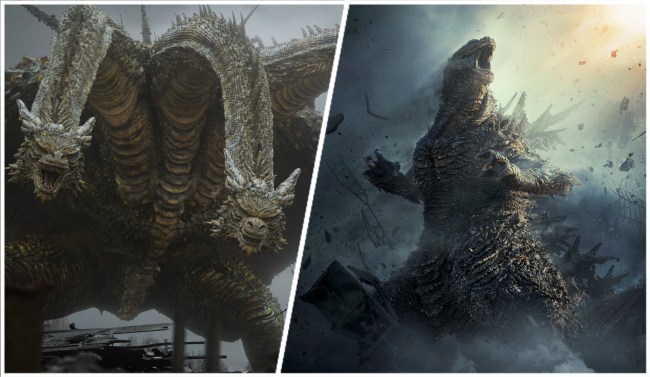
The VFX Oscar-winning Godzilla Minus One was no fluke: writer-director-VFX supervisor Takashi Yamazaki has topped himself with the more ambitious Godzilla Minus Zero, which takes place two years later in 1949 post-war Japan. It pits the legendary kaiju against its dragon-like nemesis, the three-headed King Ghidorah, and the visual effects are more complex and impressive, with 669 shots compared to Minus One’s 610.
In fact, Ghidorah dominates the sequel until a regenerated Godzilla rises from the ocean to do battle. But with a slightly larger budget from Toho Studios and an expanded team from the Shirogumi VFX and animation studio, Yamazaki achieves greater scope and spectacle. The sequel boasts R-rated action — a franchise first — and intricate animation. Yamazaki also makes Minus Zero the first Japanese movie filmed for Imax, with action sequences in the expanded 1.43:1 aspect ratio.


“I think more than the increased budget and headcount, we were able to increase the overall quality because we had more time to work on the VFX,” Yamazaki tells Gold Derby through an interpreter. He benefited from assigning additional VFX supervisors Takayuki Ueki, Eisin Okubo, and Kiyoko Shibuya to spread the workload.
“And we spent a lot of time on the R&D as well to help boost that quality,” Yamazaki adds. He is currently directing his first English-language movie, the mecha film Grandgear, produced by J.J. Abrams. “We had to build a city on a larger scale, and we did a lot of research into streamlining the process of generating a city. Also, there wasn’t as much sky in Minus One, so we wanted to make sure we had free control and camera movement within the sky. So we actually looked at a lot of drone technology and see what was possible and what the sky looks like when you’re controlling a drone, and transplant that into some of our camera shots.”

This was in service of the winged Ghidorah, who spews electromagnetic energy in the form of gravity beams and regenerates into a bigger, stronger monster, despite being electrocuted and nuked.
For Ghidorah’s design, Yamazaki wanted the creature to look like a god bird, so he made its tail very long and put a curtain around it. He also lured esteemed Japanese animator Atsushi Sato (The Amazing Spider-Man) out of retirement because of Sato’s experience with dragons and ability to make Ghidorah move naturally in the air.

“One of his biggest contributions was that scene where Ghidorah lifts itself up and gets that momentum as it’s elevating,” Yamazaki explains. “The fact that it’s a very giant creature but it can fly, I think a lot of his animation gave that sense of weight and reality that you want in a movie.”
The director also wanted Ghidorah to be able to lower its heads for greater flexibility and fright. “Normal monsters can only be seen from a human’s point of view, but Ghidorah can lower its head, so there’s a shot where a giant face attacks the back of a human. I think it’s a great feature for a movie,” Yamazaki says.

“Also, the twisted movement,” he continues. “There’s a very famous artist in Japan that we studied, Itō Jakuchū, who was very good at drawing very twisted creatures. Ghidorah is also like that. The moment he’s in the air, he’s twisting his body like a spiral.”
“There’s one sequence,” he adds, “where humans are running away from one of Ghidorah’s heads, but we get to place the camera on the ground and have all of that composed in a single shot. I would say that’s one of the unique traits that Ghidorah allows for.”

Conveying Ghidorah’s electrifying power provided another VFX challenge. This involves scenes of destruction in which the creature’s energy beams wrap antigravity force fields around buildings and trains, then suck them into the air and smash them to the ground.
“Ghidorah runs a beam of gravity, but I tried to capture that as a beam of energy that can control it,” Yamazaki explains. “So we leaned into this gravity beam idea that previous Ghidorahs have expressed but have him manipulate gravity itself, which is where the expression of the levitating type of visuals comes from. So we thought that would be a very fresh visual to put on screen for audiences.”

“Another thing that I think is quite unique,” he adds, “is when Ghidorah lifts humans and drops them. That’s a whole different kind of fear than being crushed by a kaiju, so I think that also opened up doors for different character reactions. We actually built a specific set for that purpose of filming people being dropped, so we approached it pretty carefully and properly.”
Meanwhile, the climactic clash between Godzilla and Ghidorah in the ruins of Ginza was the most difficult animated sequence. “That’s where Godzilla and King Ghidorah are all tangled up within each other and they’re dueling to the death,” Yamazaki recounts. “I’d say that’s the biggest contribution of Atsushi Sato. The idea of two giant kaiju interacting physically was challenging to pull off. Nowadays, it’s easy to say it’s CG, you can just do it. But it’s hard to get that illusion of collision. If you mess up, there’s no collision. Then the two models are going to clip into each other. To get that feeling of physical strangling and tangling was huge, and the team did a great job.”

