
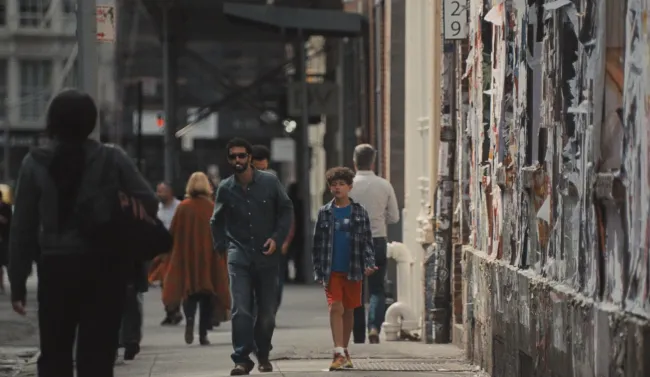
Warning: This story contains spoilers for Club Kid
Thanks to Harry Potter, Club Kid found its star kid.
Jordan Firstman‘s Cannes sensation, about a hard-partying New York nightclub promoter whose wild lifestyle is upended by the arrival of his previously unknown 10-year-son, was shot on a tight budget and on a tight schedule. And the filmmakers needed some last-minute magic to find a young British actor for the role.
“We didn’t have much time. We got financing on short notice and needed a visa for a young actor from London,” the film’s Oscar-winning producer Alex Coco revealed at a special screening this week. “We needed a great actor who fit the character as written, and it felt like a needle in a haystack.” A friend put Coco in touch with U.K. casting director Lucy Bevan, who, it turns out, was uniquely qualified.

“She had just cast HBO’s new Harry Potter series and had seen around 40,000 kids between 9 and 12, which was the age range we were looking for,” said Coco. “I asked her to send every kid who had just barely missed being cast.”
Bevan gave Coco and writer-director-star Firstman a list of about two dozen performers. “Jordan quickly identified Reggie [Absolom],” Coco recounted. “Reggie had been up for Harry Potter and was one of the finalists. … Jordan flew there, met him on his birthday and they hit it off. It was very lucky.”

That surprising casting tidbit was one of several topics Coco addressed after screening the film, which opens in theaters this weekend. The producer, who has worked extensively with Sean Baker, including on Anora (which earned Coco, Baker, and fellow producer Samantha Quan the Academy Award for Best Picture) and Red Rocket, discussed Baker’s influence on Club Kid, how the film owes a debt to Kramer vs. Kramer, and why they didn’t shoot an alternate ending.
Here are five factoids we learned about Club Kid, in Coco’s own words.
How did Coco come to produce Club Kid?
Jordan’s team contacted my agents and thought I might be a good fit for the project. I read the script and fell in love with it, and then with Jordan. It started an amazing, almost symbiotic creative relationship between us. We were very much on the same page from the start. Anora was made on a small budget in New York City, and this was, too, so there was a lot of overlap in how we approached the movie.

How long did it take to shoot?
The timeline was fast. We shot 26 days: 24 in New York and two in London. We crammed a lot into a short time. We were shooting around this time last year and wrapped Nov. 3.
We submitted [to Cannes] around March or April; the festival was in May. We were confident from the beginning. I’d had a bunch of films play at Cannes, and I felt this was a fit. A week before production, we sat down and went through what we were going to shoot and what our budget was. The plan was to play in Un Certain Regard and have all the dolls on the red carpet. That was our goal, and we met it.
Once we were ready to share the edit, I emailed Thierry Frémaux, who runs the festival, and said, “I think this is a film you should take a look at and pay attention to.” He watched it within 24 hours and said how much he loved it. We got word we were in about 24 hours after that.

Was there ever discussion of toning down the depiction of sex and drug use in the club scenes?
I wouldn’t want to pull back on something for a reason other than the artistic vision or what the director intends. It wasn’t prescriptive, like, “We need to pull back on the sexuality.” Some department heads and cast members who read the script had feedback. Jordan has a certain reputation, and people had seen Rotting in the Sun. His humor can be provocative, so people had expectations about a script for Jordan Firstman about a party promoter. The beginning met those expectations. Then the kid comes in, and people who didn’t know where the story was going were surprised. We liked that and wanted to protect it as much as we could.
Jordan and I talked about when the kid should come in. There was discussion about what page the story device should arrive on. We liked leading the audience in one direction and then subverting expectations. The movie opens in a world of strip clubs, sex, partying and drugs, and then becomes something else. That’s fun; it plays with the medium and structure.
Were the Kramer vs. Kramer-esque custody battle scenes intentional?
So much so. I love Kramer vs. Kramer; it’s one of my favorite movies. When I first read the script, I loved how the courtroom section just becomes a courtroom drama for a while. That’s memorable. We talked about it from the beginning.
In an early version of the script, Arlo was younger, around 8 or 9. I was giving Jordan notes for a few months before we took it out for financing. I’d signed on when my son was born, and I was in the hospital with him when I gave Jordan a note: What if Peter picked up Arlo and ran out of the club when things got bad? I hadn’t made the connection, but Jordan said it reminded him of Kramer vs. Kramer.
The script initially had more jokes and was broader and lighter. Jordan wanted to make something more dramatic than comedic, and Kramer vs. Kramer and a couple of other films became a north star.

One of Sean’s early films, Prince of Broadway, tells a similar story. It’s about a guy selling counterfeit goods on Broadway in the early 2000s who finds out he has a kid and has to take care of him. Jordan I talked a lot about that film, as well. It’s a similar story, but it’s so relatable. You may have bought a fake Gucci bag in New York, but you don’t know the seller’s inner life or what he’s dealing with. Sean’s camera stays behind, letting you experience the life of someone you might otherwise walk away from and never think about again. He tells a very human, relatable story, even about someone whose life is completely different from yours. Jordan does the same thing with this film.

Was there ever an ending where Peter got Arlo back or got to see his son again?
I don’t think we ever had that as the ending. There was some pressure to see Arlo at the end, perhaps on the other side of a phone call, but Jordan and I felt strongly that we shouldn’t do that. I learned something from Sean on Red Rocket: We had an alternative ending, and there was pressure to shoot it. Sean refused and said, “I’m not going to shoot it. You know why? Because if I shoot it, they’re going to make us use it.” I told Jordan not to shoot an alternative ending, because if you shoot it, it could end up in the movie.
That ending was crucial. After Peter gets in the car and drives away, we never see Arlo again. The audience may yearn to see him, but we don’t get that satisfaction because Peter doesn’t. We feel his hopefulness and the tinge of not getting everything we want. We’re with Peter in that seat, and I think there’s a reason for that.
