
Spoiler warning: Do not read until you’ve watched the season finale of Youth.
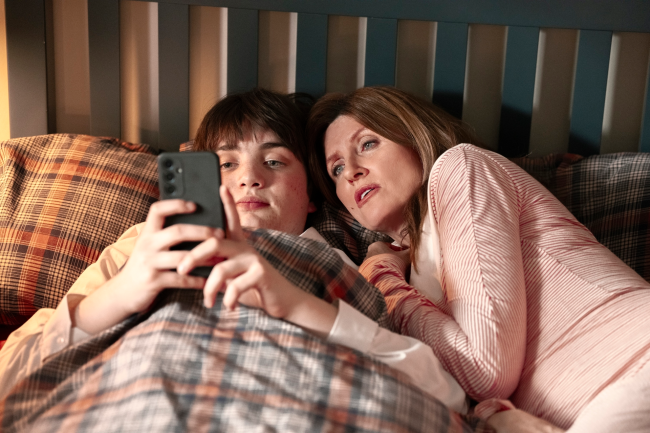
The first season of Youth ended with Alex in bed with a man… but not in a romantic sense. Yet it was the man she perhaps most needed to reconnect with: Her son, Ruari. After a chaotic night at the Women’s Lit Awards, mother and son finally found their way back to each other. Perhaps that’s as good as a happily ever after as Alex is going to get.
“I hope you understand why she makes bad decisions and how she ends up in those situations,” says Sharon Horgan, who created, wrote and stars in the HBO comedy.
Youth charts the exploits of Alex, a divorced 50-something literary agent who’s juggling her bumpy love life, her uneven career, her aging parents, and her not-quite-ready-for-adulthood son — not to mention the troubling health issues of women in their 50s.

It all comes crashing down in the season finale, where Alex is still reeling from having discovered boyfriend Patrick’s (Rupert Friend) pro-and-cons list about her, which included a “con” about not being able to have a family with her. She’s forced to put on a brave face at the Women’s Lit Awards — while battling a UTI — as her son, Ruari (Aran Murphy), buries his own love troubles in a vodka bottle, and her boss, Sam (Sharlene Whyte), faces the end of her own marriage. And then there’s the matter of her star author’s daughter threatening to make a scene unless she’s thanked — only to suffer a stroke. So maybe it’s not entirely her fault that Alex ended up waking up in bed with her former client, Malcolm Hammond.
Naturally, Patrick catches her on her walk of shame back home — and tries futilely to make amends. “You should be relieved, Patrick,” she says as she walks away. “I’m making it so easy for you.”
But she is in a more forgiving mood for Ruari, and after lying to him about her night — “I made some great friends, created some wonderful memories” — she curls up in bed beside him, to watch some YouTube videos.
Horgan says she’s grateful for the response to the show’s first season. “People have laughed, but they’ve also emotionally connected with the characters and the story, which is great,” she tells Gold Derby. Here, she breaks down where Alex’s love life stands, how her own experiences mirror the show, and what a potential second season might hold.
Gold Derby: Did the show end where you thought it would? Was that the finale you were aiming for when you first conceived of it?
Sharon Horgan: Pretty much. I always wanted the last episode to take place at the awards — a high-stakes setting. I always wanted her to be dealing with a UTI, because it’s such an issue for women, especially menopausal women, and it doesn’t really get talked about. I wanted her to have one on the worst day of her life. I also knew she would discover what he had written down — his list at the end of Episode 7 — and then deal with the aftermath. A lot changes as you write, though. Other chaotic ideas come along. Liv’s stroke was a later idea, for example. But a lot of it turned out pretty close to what I’d originally imagined.

Do you think she’s done making bad decisions, or is that just part of her DNA?
I think it’s part of her DNA. I hope you understand why she makes bad decisions and how she ends up in those situations. With Malcolm, I wanted her heartbreak to get the better of her, so she drinks herself into one of those states where you wake up and truly don’t know what happened — or whether anything happened. I wanted it to be ambiguous.
Her bad decisions don’t come from a bad place. They come from a place of coping. So, no, she’s definitely not done making them. I think we all go through phases. I’ve always had a reckless side to my personality. Sometimes I’m good at keeping a lid on it; depending on what’s happening in my life, good or bad, it can rear its head again.
As a writer, you put those decisions on the page and hope they don’t feel alien — that people watching will think, “God, I’ve been there.”
It’s a tsunami of things happening at once: her career, personal life, motherhood, and aging parents. Can she learn from it all, or is that part of the point, too?
Can she learn? Yes and no. Do we? I’ve learned from terrible mistakes and tried to pass that knowledge on to my daughters, but that doesn’t always stop me from continuing to make those mistakes.
There’s definitely a “once bitten, twice shy” element to her. She’s never going to end up with someone like [her ex-husband] Lorcan again. She’ll wait for the man who gives her what she wants and needs — but she’ll probably make more terrible mistakes along the way.

So are we done with Patrick? Have we seen the last of him?
I really don’t think so. I have ideas, and it’s not just because I love working with Rupert so much. Those relationships are complex. People come into your life for a reason and leave for a reason, but it’s not always the end. So, yes, I have some ideas.
Where does her relationship with her son stand? They seem to have reached some kind of peace.
You get to that place with your adult children, and then something else comes along. Hopefully they’re an odd couple — that’s what I loved at the heart of the show. A teenage boy and a menopausal woman who are more similar than they think, very separate but also really needing and loving each other. They’re all they have, really.
I wouldn’t want things to stay exactly as they are. If your kid drops out of college, you want him to sort his life out. I’d be interested in the next stage of adulthood for him and what it means. He’s fallen in love, which is interesting, but he still doesn’t have a community. He hasn’t been able to work on that. All of that interests me.
And then there’s her relationship with her boss, Sam. Can that be repaired?
Sam is such a dynamic character who has had to fight for what she has. Her attitude is, “F–k you if you think you’re going to take it from me or interfere with it.” She’s the same in her relationships.
She and Alex have such a great, complex relationship: Sam is her friend and her boss. Friendships like that can weather a lot. If you’ve worked together that long, you’ve been through it all. You have to be a bit Teflon with each other. One minute you’re gossiping about personal stuff; the next, you’re being put in your place and told what to do. It’s a schizophrenic dynamic, and I think it will continue.
What about the response to the show has surprised you most?
You always hope that writing a female central character won’t mean that women are the only audience. I’ve been delighted by how much millennials have enjoyed it. Of course, we have the parents and people in their 50s, and the teenager, but there isn’t anything specifically for millennials. They still recognize the feelings and emotions. It’s a “there but for the grace of God” kind of thing — or a ghost of Christmas future. It’s been a lovely surprise that a younger generation is enjoying it. It’s great when a show reaches beyond the demographic you’re writing about.
As the writer and star — wearing so many hats — what does that allow you to do with the show?
Being so involved gives you a bird’s-eye view. You can curate the show toward what you had in your head at the beginning. If you have incredible collaborators — a director you work well with, great designers, producers and script people — everyone works toward that vision. You oversee it and make sure all the parts come together.
It’s a lot to have on your plate, but it feels worth it in the end. In the edit, you’re choosing the music and collaborating with the composer. It’s your vision coming to life, without compromise. And if it goes wrong, it’s your fault, because you made those choices.
What do you want people to take away from the show?
I want them to feel they’re not alone — that what they’re going through is universal. This stage of life is really hard. You look around and your parents are getting older, getting ill or dying. Friends are going through things, too. You reach a point where terrible things start happening, including to you and your body.
But this is also an incredibly precious, important time, and you have to have fun. You have to make time for yourself. That’s what Alex is trying to do: live her life. You get one go at this, so try to have fun.
If there’s a second season — and let’s hope there is — what would you want to explore?
This season was very much about her epiphany: “I have one life. I’ve got a certain number of years, and I need to find someone now.” There was a panic, and a bad relationship with aging. If I were to do it again, I’d want her to evolve and look at life a little differently — to take stock of what she has.
Obviously, she’ll continue to f–k up; that’s life and that’s the character. But I’d like her to find a way to accept herself and her age a bit more. It might be fun to see her go after some kind of balance, safety and happiness within herself.
I don’t know if she’s capable of that.
I don’t know either. But we’ll see.
The interview has been edited for length and clarity.
