
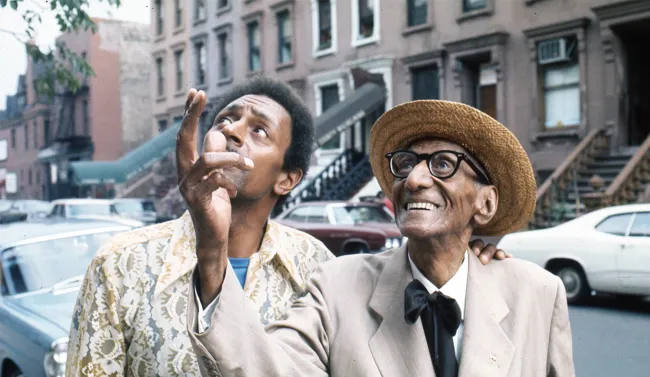
In August 1972, filmmaker William Greaves threw a party at Duke Ellington’s Harlem townhouse and invited the surviving giants of the Harlem Renaissance. Eubie Blake, Aaron Douglas, Arna Bontemps, Richard Bruce Nugent, James Van Der Zee, Leigh Whipper, and Countee Cullen’s widow, Ida Mae Cullen, were among the guests, many of whom hadn’t been in a room together in decades. Four cameras rolled all day, and one of them was run by Greaves’ 26-year-old son, David.
Greaves considered it the most important footage he ever shot, and he kept coming back to it for the rest of his life. He died in 2014 without finishing it. Now David, along with his daughter and producer Liani Greaves, and editor-producer Anne de Mare, has brought it home with Once Upon a Time in Harlem, now in theaters from Neon. And the Greaveses say the 100-minute film is only the start.


Asked what was most painful to cut, David says, “Pick one. It was all pain. There was nothing light about it. How do you cut down Regina Andrews when she’s talking? How do you cut down Richard B. Moore? My daughter and the editors laugh at me because, gee, they said you can’t have all of this Richard B. Moore in the film.”
That’s where Liani jumps in. “The great thing to keep in mind about this film is that nothing is on the cutting room floor. Nothing will be left on the cutting room floor,” she says. “We are working now on the archive. There was 60,000 feet of film that was shot for this project, and what we’ll be doing is presenting that archive as a public-facing archive to the country. So you’ll get to be able to watch the whole of, as my dad says, the Regina Andrews interview, or any of the interviews that we have, all of the audio that we have. We’ll be sharing that with the public. Dad always calls this film a trailer for the archive.”
The plan is to house it at an institution, which is still being decided, and make it free to access online. “If you’re studying Eubie Blake, you can type in his name and then you can listen to the Eubie Blake interview, or you can go ahead and read other material that’s mentioned in the film,” Liani says. “It’s an education in and of itself, and so we want to be able to connect the dots for people.” De Mare is spending the next year on the archive through a fellowship at Harvard University.

The restoration started with William’s wife and longtime creative partner, Louise Archambault Greaves, who landed the first grant from the Ford Foundation in 2021. A feature film wasn’t her original goal. She pictured a museum installation where people could listen to sections of the footage.
“My grandfather always considered this to be the most important footage that he’d ever shot, that he’d ever put on film. And he made a lot of movies. He made 79 movies. He was involved in over 200 films,” Liani says. “So for him to say this was the most important event that he ever put on film, that’s what my grandmother knew. And so the last thing that she was working on in her life was around making sure that people were seeing this footage.”
After Louise died in 2023, the family and de Mare sat down with the footage and realized they had a movie, and David stepped up to direct. Going back to it, he says, was “a challenge and a pleasure.”
“Coming back to it was a wonderful way to re-engage, if you will, with my father and what he was doing. It was a way to remember my time in the editing room,” David says. “When I first started looking at the footage on a computer screen and I wanted to go back, my hand automatically shot out to where the control panel would’ve been on the editing table some 50 years earlier. So in the same way that muscle memory kicked in, my editing room muscles kicked in as well.”
He’s quick to point out that he can’t give “a fly-on-the-wall recitation” of that day in 1972. “I just was one of the folks who was on the camera and working. So it was a time of following the action, following the energy, and following the direction that my father was giving,” he says. “And you see some of that on screen. As a matter of fact, we put as much of that on screen as we could to include him in this film, because that was a necessary component. He had to be part of it.”

Liani says her grandfather would never have put himself in the film, but he belonged there. “He grew up in the glow of the Harlem Renaissance. He was born in 1926, but these people were the people that he was looking up to at that time. And so it was important for us to add him in,” she says. “When people ask me about why did it take so long, it’s just because it had to. We had to be here today to be able to really look back even at that 50-year period. Now in 2026, we’re looking back at 1972 at those people. And I think that that level of reflection is kind of in its perfect timing.”
David, a longtime journalist, says he went looking for moments that could change how people think about history, like the story of Jimmy Walker, the Jazz Age New York mayor who resigned amid a corruption scandal.
“If you read about Jimmy Walker, he was a philanderer, he was corrupt, all those kinds of things. And if that’s all you know about Jimmy Walker, that’s who he was. But on the tarmac there, when Charles Lindbergh turned away from Bill Robinson’s handshake and Jimmy Walker reached out and grabbed it, and the way you see Leigh Whipper mimic that, gee whiz, Jimmy Walker had a whole other persona that folks did not know about,” he says. “And the same is true with Richard Moore when he talks about Theodore Roosevelt being booed and hissed in Harlem. I love the word ‘hissed’ because it says so much. It’s an emotional word.”

The history had to entertain, too. “Irvin Miller, talking to J.T. Gibson and getting $5,000 from him. Well, gee whiz, a Black man loaning another Black man $5,000 in the ’20s is like $100,000 today. And that’s worthy of a seminar: segregation, integration, class, economics, all of that is in that one conversation,” David says. “So the choices had to work on several levels. And the participants themselves, they were so photogenic. They were so full of energy. That’s where that comes from. It comes from them, their energy, the kind of people they were, the kind of natural creative minds that they had.”
Speaking of New York mayors, Mayor Zohran Mamdani is teaming with Neon for four free screenings of the film this weekend (Oct. 24-25). They run Saturday and Sunday at AMC Magic Johnson Harlem, Film Forum, and Film at Lincoln Center, bringing the movie back to the neighborhood where William was born and raised.
David says audiences of every age have been responding “in a, dare I say, visceral way.”
“Young folks, old folks, senior citizens, forgive me, and high schoolers,” he says. “It’s touching chords in their longing or what they thought they knew, and it’s introducing them to a time and a people that they were not aware of, that they did not know existed. And they are universally very happy to have the opportunity to meet these folks.”
The film has awards momentum too. It won the Library of Congress Lavine/Ken Burns Film Prize, picked up five Critics Choice Documentary Awards nominations including Best Documentary, and is predicted to earn a Best Documentary Feature nomination in Gold Derby’s Oscar odds. For Liani, the Oscar conversation is about getting the film to more people.
“The film is doing the work that it was intended to do, which is not just stop people at the moment of seeing the film and being appreciative of learning about this new history, but also inspiring them to create more art, to be in collaboration with the people that are around them, to be in community with each other,” she says. “So for me, having those conversations about the Oscar and all of that is really about more people being able to have that experience and see the film.”
After all the debate, the movie ends on a coda with Eubie Blake. Asked whether the footage brings back memories, he says something like, “I don’t know anybody in there.”
“It cracks me up every time,” Liani says. “But you have to remember that Eubie Blake was a musician, and he was traveling from place to place to place. So he was not necessarily in those rooms where the thinkers were sitting around thinking and doing art and all of that. He was out playing gigs. And so he didn’t really know so many of those people. They knew of him, but as a working musician, he was out working, taking gigs.”
