
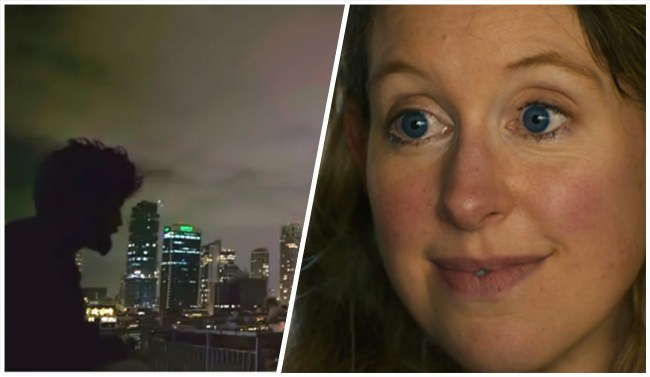
You can see everything in this year’s Best Documentary Feature race: a Gaza exposé, a long-lost Harlem house party, and Nathan Fielder hanging out with Elizabeth Holmes. For now, the Gaza doc is out front. Naza is the early front-runner in Gold Derby’s Oscar odds, and it comes from Yuval Abraham and Rachel Szor, two of the Oscar-winning directors of No Other Land. Close behind are Once Upon a Time in Harlem and Fielder and Lance Oppenheim’s You Can See Everything, which just had one of the biggest box-office openings ever for a documentary.
Best Documentary Feature
1.
2.

Once Upon a Time in Harlem
3.

4.

5.

No Other Land won this category at the 2025 Oscars, and Naza is off to a strong start of its own. It won the Special Jury Prize at Venice last month after a record-breaking standing ovation. It features testimony from 24 anonymous Israeli military intelligence officers and soldiers, whom Abraham interviewed at night on Tel Aviv rooftops about the army’s methods in Gaza after the Oct. 7, 2023, Hamas attacks. The title comes from the language they use on the job.


“Israeli intelligence officers use the term [Naza] to describe the number of civilians they expect to be harmed in a particular airstrike,” Abraham explained. “It is a euphemism — a substitute for saying ‘human beings.’”
Back home, the response has been ugly. On the New York Times podcast The Daily, Abraham said Prime Minister Benjamin Netanyahu compared the film to ballistic missiles aimed at Israel, and the death threats have gotten so bad that their families have told them not to come back. Still, Naza is finding an audience, and without a distributor. Released independently, it has passed $800,000 domestically and $6 million worldwide. The duo has done this before: No Other Land never landed a U.S. distributor either, and it still won the Oscar.
In second is Once Upon a Time in Harlem, which just edged past You Can See Everything. In 1972, filmmaker William Greaves threw a party at Duke Ellington’s Harlem townhouse for the surviving luminaries of the Harlem Renaissance and filmed the whole thing. The footage sat unfinished for decades until his son David, one of the original cameramen, completed it. Neon opened it Friday after stops at Sundance and Cannes. The branch has gone for this kind of rediscovered history before: Summer of Soul, which used long-unseen footage of the 1969 Harlem Cultural Festival, won in 2022.

In third is You Can See Everything, which etched its name into the box-office record books this weekend. The Elizabeth Holmes doc opened to an estimated $15 million from just 855 theaters, landing at No. 2 behind Street Fighter. That’s the second-biggest opening ever for a non-music documentary, behind only Fahrenheit 9/11, which debuted with $23.9 million in 2004.
The A24 film follows Holmes and her partner, Billy Evans, in the weeks before she reported to prison in 2023 to serve an 11-year sentence for defrauding investors. The directors stayed in the guest house on the couple’s San Diego property, and Fielder ends up a character in his own movie.
Critics love it, too. With a 99% on Rotten Tomatoes and a “must-see” 99 on Metacritic, it has a real claim to best-reviewed movie of the year, and A24 is reportedly pushing for it to become the first documentary ever nominated for Best Picture. Hollywood is on board as well. The crowd at its Academy Museum screening earlier this month included directors Gus Van Sant, Adam McKay, Zach Cregger, and Curry Barker, along with stars like Elizabeth Olsen, Steven Yeun, and Hannah Einbinder. One Oscar-nominated filmmaker from the documentary branch told Gold Derby it “exceeded every expectation.”
That last endorsement matters because experts questioned early on whether the doc branch would take Fielder seriously. He’s best known for Nathan for You and The Rehearsal, with their quirky humor built around uncomfortable social interactions. Oppenheim, though, is an established documentary filmmaker, with Some Kind of Heaven and HBO’s Ren Faire to his name.

Then there’s the subject. The branch has been notoriously tough on celebrity documentaries. Last December, it left nine of them off its shortlist, including Mariska Hargitay’s My Mom Jayne, which beat eventual winner Mr. Nobody Against Putin at the Producers Guild Awards and went on to win two Emmys. Of the 50 films the branch has nominated in the past decade, only six focused on someone already famous.
But is You Can See Everything too big to fail? Box office hits have done well here before. Bowling for Columbine ($21.6 million), March of the Penguins ($77.4 million), and An Inconvenient Truth ($24.1 million) all rank among the top-grossing documentaries in domestic box office history, and they won three of the five Oscars in this category from 2003 to 2007.
Still, the branch isn’t afraid to pass on a hit. Morgan Neville’s Fred Rogers doc Won’t You Be My Neighbor? grossed $22.8 million in 2018, the most of any documentary in the past decade, and wasn’t even nominated. (Free Solo won that year.)
That’s why the nomination may be the film’s biggest hurdle. The documentary branch picks the shortlist and the nominees, but the entire Academy votes on the winner. If You Can See Everything makes the cut, it would likely be the most widely seen and best-reviewed film in the lineup — the kind of broad appeal that plays well with the full membership.
In fourth is American Doctor, Poh Si Teng’s feature directing debut, which premiered in competition at Sundance. It follows three American physicians — Thaer Ahmad, who is Palestinian; Mark Perlmutter, who is Jewish; and Feroze Sidhwa, who is Zoroastrian — from Gaza hospitals to the halls of Congress. Teng previously produced the Oscar-nominated short “St. Louis Superman.” Along with Naza, that’s two Gaza documentaries in the top four.

Rounding out the top five is Alex Gibney’s Musk, which is holding steady despite a few obstacles. For starters, it runs 3 hours and 52 minutes. It’s also had trouble getting ads out. TikTok suspended the film’s ad account just as it hit theaters (Bleecker Street is appealing), and Elon Musk’s own X has refused to run them. Meta and YouTube turned them down, too, before reversing course. Gibney has the pedigree, with a win in this category for Taxi to the Dark Side in 2008 and a nomination for Enron: The Smartest Guys in the Room in 2006, but Musk faces the same celebrity-subject hurdle as You Can See Everything.
Outside the current top five, Ava DuVernay’s 14th ranks sixth and Pegah Ahangarani’s Rehearsals for a Revolution is seventh. Also in the mix are One in a Million, Everest: The Other Side, Nuisance Bear, Jane Elliott Against the World, and The History of Concrete. The Academy’s shortlist arrives in December.
