
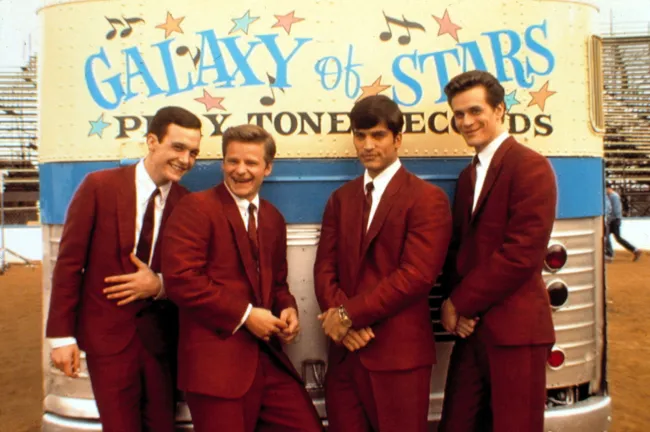
Thirty years ago, a band called The Wonders — or, if you’re a purist, The Oneders — burst onto movie screens with a song called “That Thing You Do!” that’s guaranteed to worm its way into the ears of anyone who heard it. Sure, viewers don’t actually know who is “doing that thing you do” or what thing is actually being done — but does anyone really care? The song has been a bop since the Tom Hanks-directed film of the same name opened in theaters on Oct. 4, 1996. And there’s no doubt that it’ll remain that way for another thirty years.
Funnily enough, the film itself didn’t exactly set the world on fire. That Thing You Do! just barely eked out a $35 million gross upon its initial release. “It wasn’t received all that well,” remembers Johnathon Schaech, who played the fictional band lead singer, Jimmy Mattingly II. “The people that saw it loved it, but the critics were kind of mixed… those same critics are now praising it!”

“For some reason That Thing You Do! just holds to this nostalgic truth that everybody adheres to in a weird way,” agrees Steve Zahn, who played lead guitarist Lenny Haise.
Time has certainly been kind to the movie, which follows the rise and fall of the one-hit Wonders. In his directorial debut, Hanks — who also appears in the film as the band’s manager, Mr. White — demanded a level of authenticity that everyone worked hard to achieve, and that effort has become part of what makes the movie endure. That authenticity carries over into the infectious title track, written by the late Adam Schlesinger of Fountains of Wayne and Crazy Ex-Girlfriend fame. The singer-songwriter expertly crafts an early ’60s sound that literally captures that time in a bottle. (Schlesinger died in 2020.)
Gold Derby spoke with multiple members of the film’s cast and creative team to assemble this oral history of The Wonders. They may not have existed for very long — or, indeed, existed at all — but the music they made stands the test of time.
Johnathon Schaech (Jimmy Mattingly II): When you watch the movie, you don’t get sick of the song. In the beginning it’s just a little bit of it, and then they add elements and refine it to make it better and fuller so that by the end it’s a fully produced song. We didn’t know any of that when we were filming it.
Tom Everett Scott (Guy Patterson): Ethan [Embry] came into it knowing how to play guitar so bass wasn’t really hard for him. Steve was finger-picking John Prine songs on an acoustic all the time, and learning the nuances of the electric guitar. My sisters and I were all in band, and I played trumpet for eight years in junior high and high school.
Steve Zahn (Lenny Haise): Tom [Hanks] was really adamant about us learning our instruments so that he never had to worry that that we weren’t going to be in sync. So he was really adamant and headstrong about us being really disciplined.
Merideth Boswell (set decorator): You would have never known that Tom was a first-time director. Obviously, he knew how to handle the actors, but he was also amazing with the art department. He had a lot of trust in us; he knew me from Apollo 13, which was wildly complicated and also a period production. He was just one of those directors that was smart enough to let people do their jobs — but also look at who he hired! He hired Tak Fujimoto as cinematographer, and Colleen Atwood as the costume designer. He stacked the deck with pros out of the gate. I wonder with the new model of filmmaking now if a first-time director would be allowed to do that.
Schaech: Tom [Everett Scott] had never played the drums before, so he and I were the ones that were constantly trying to do everything correctly, because they would take a camera and they would pan down to the drum kit or to my guitar, and we’d have to be hitting the right thing at the right time. I think they just edited everything to our favor.

Scott: Steve said to me very early on when our music teachers got us together to rehearse, “I just don’t want to look fake-y.” And I was like, “Yeah, me neither.” I hate when you’re watching something and you’re like, “That guy doesn’t know how to play.” So that was our mission. “No fake-y.”
I knew how to read music, so my drum teacher, Billy Ward, said: “Here’s the drum parts, and we’re going to learn how to hold the sticks and look cool and learn these songs.” He was the greatest, and we met every day for a month; seven days a week for four hours each day. They would keep the rehearsal studio open for me, and I would just stay for another four hours. I made it my nine to five job, and I had that luxury. You don’t get that on a lot of movies.
Zahn: We created this facade that we were really playing with the understanding that if a take didn’t work or they had to cut, they wouldn’t cut the music. Tom [Hanks] let it just bleed out. It was this fun mask that we were wearing where people thought we actually played the song, but we didn’t.
Scott: Tom’s probably the best director I’ve ever worked with. His attention to detail, his passion for all those things that spark memory — I wish he directed more, to be honest. Every step of the way, he would be like, “You can do no wrong.” That was one of his mantras, and we just let him guide us.
Zahn: My character, Lenny, is kind of like Tom in a weird way. Every day, he and I would just come up with funny s–t; he’d go, “At the end of the day, I want you to play cards with the old guys; maybe you’re playing poker or crazy eights.” I’d say, “Oh great!” and then we’d shoot it. Usually, those kinds of scenes never make the movie, but they made it in here.
Scott: Steve was so funny. Every day ended with Tom sitting next to Steve going, “All right, now on this take, you say this.” They would just go back and forth with funny buttons to scenes.
Schaech: We filmed a lot of the movie in order, and that had a lot to do with the fact that our characters had to perform to get better and better. But we all felt like we were actually performing every time.
Boswell: Tom loved old variety shows, so we were working in that palette. When I watched the movie again, I’d forgotten how spot-on all the performance set pieces were. He had a genuine affection for those one-hit wonder bands; that genre of musicians who gave it their all and then things fell apart. We just hit the ground running. I don’t remember being as overwhelmed as I would be right now if I had to do those sets again. That banana leaf paper? Now you can just have that stuff printed if you can’t find it in the archives, but 30 years ago you couldn’t. If I’d had to do a period appliance store again back then, I think I’d just start crying.
Scott: I loved that Patterson’s Appliances set. It was fun to just stand around in there and take it all in, in my mock turtleneck.
Boswell: I can’t shut up about the appliance store. Finding that many crisp products that look new? The radios had to all look like televisions, and the televisions were a particular hell because they had to turn on. Everybody thinks their prop house is just sitting there with this stuff, but those props have been thrown in the back of trucks so many times. We also had to have point-of-sale things, and the woman standee that Steve carried around was a headache.
Zahn: I just remember the standee starts falling and I catch it just in time.
Schaech: I can’t tell you the amount of musicians and singers who have said that the scene where they hear their song on the radio just resonates so strongly. It’s a fun sequence, and then you see it cut together and you’re like, “Yeah, that’s exactly what you’re supposed to do.”
Scott: Hearing the song on the radio paralleled our own lives. I remember Liv [Tyler] and Ethan running in, and trying not to laugh at all that because it was fun to watch everybody do their thing plugging the giant appliances in, turning them on, and cranking up the music. And then Tom said, “I know it might sound crazy, but I want you to hold hands in a circle and dance around.” It was totally joyous, and we would laugh our butts off. Then he told me: “You spin out, look right into the camera, and say, ‘I am Spartacus.'” We did that in one take, and that was it. They were like, “Well, we can’t improve on that. Moving on.”
Schaech: When we started filming that scene where Liv tells me “I wasted thousands of kisses on you,” I kept thinking, “It’s over for Jimmy — everyone’s gonna hate him after this.” But then I said, “[Maybe] if he could just tell the world what he really was about.”
So I asked Tom [Hanks] for extra strings to string my guitar, and while she’s ending our relationship I’m stringing my guitar. I’m trying to say, “It’s not about us, it’s about the music.” He wasn’t upset because he was afraid he wasn’t going to be able to get girls; he was more afraid that he wasn’t going to be able to get the fans that he needed to get to the next album that they needed to make. I remember that Tom wasn’t certain what I was doing, and then he said, “It’s about his guitar.” And I’m like “That’s why I’m stringing it.”
Scott: Tom took us downstairs [after the final performance] and we watched the dailies. He had never shown us dailies before; he described himself as someone who would adjust the way he walked the next day if he saw dailies, and he didn’t want that for us. But at that point, he was so proud of what we had done that he took us down to the screening room and we watched back our performance of that final number. There were tears in his eyes, and that made me cry. He was just so happy with how it looked, and said: “Thanks for saving my show by learning the drums.” It was such a sweet, wonderful moment. We all felt pretty good.
Damian Chazelle is a huge fan of That Thing You Do! [When I was in La La Land] Emma Stone and Ryan Gosling did the whole “I quit, I quit” scene for me. I never put it together until that movie came out that I was sitting in a jazz club that’s very reminiscent of The Blue Spot in That Thing You Do!
These interviews have been edited and condensed.
