
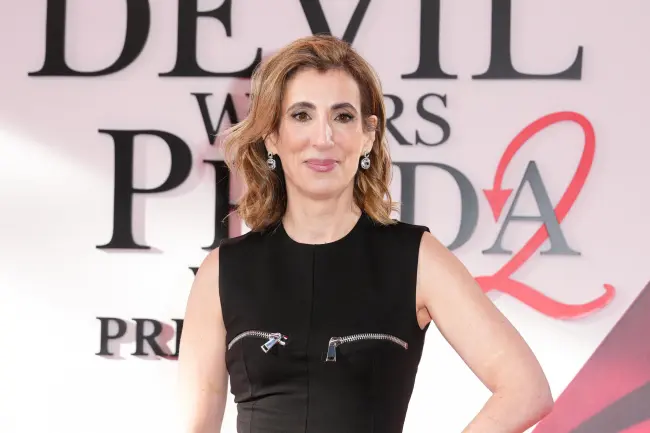
“My general motto in life is, ‘if Meryl Streep thinks it’s a good idea, then I think it’s a good idea, too.”
That’s what Devil Wears Prada screenwriter Aline Brosh McKenna — the architect of those indelible one-liners — says convinced her that she and director David Frankel had the goods for a trip back to the runway. The two had resisted any suggestion of a sequel for years — but 20 years later, they finally sparked on an idea that would bring Andy Sachs back into Miranda Priestley’s orbit.
McKenna put her razor-sharp pen to work — crafting another round of those wicked, “groundbreaking” one-liners, along with a narrative that finds the balance of power ever-shifting between the characters, not to mention Emily Blunt’s Emily Charlton, now the head of Dior — a powerful advertising client who must be wooed back into the Runway fold.

Here, McKenna reveals to Gold Derby why she took the chance on revisiting the beloved original, why Nate didn’t make the cut, and which one-liner we’ll be quoting.
Gold Derby: It’s been 20 years. Why was now the right time to go back to the runway?
Aline Brosh McKenna: David and I had chatted about it over the years, but we were definitely sure we were not going to do it. But then there were just so many changes in the world that we started to get interested in where these characters were, and what they were doing and what they were up to that it seemed like a good time to re-explore it. And then we found out that Meryl was open to it. We went to talk to her, and she was interested in our ideas, and she felt like it was worth exploring. And my general motto in life is, “if Meryl Streep thinks it’s a good idea, I think it’s a good idea, too.” With her confidence in it and David’s confidence in it, we then brought it to the studio, and that’s something that’s a bit unusual, which is usually the studio asks for a sequel or a reboot or a remake, but this was an instance where the filmmakers and the acting team felt like it was time to revisit it.

What were those ideas that you wanted to explore that intrigued Meryl so much?
There was a little kernel for me, which was, what if Miranda got in trouble and Andy was the only person who could save her? That was really what I started noodling on, and then the little wrinkle of that was it’s not really Miranda’s choice to have her there. And so that created the conflict. There was a huge gulf in the first movie, and we needed another huge narrative gulf in this movie. And so that provided that.
You also wove in some headlines about the state of journalism and technology right now.
Those are businesses that I follow and have followed for the 20 years since the previous movie. And there have been such changes. Everybody’s struggling to monetize and advertise, how to give consumers what they want and run businesses that are profitable, because a lot of these places have become unprofitable, and sometimes you wake up and your beloved institution has just been deleted, as she says in the movie. All of those issues are very pressing, but they’re only interesting when they’re filtered through characters that we are interested in and relate to and admire. It’s a human story where humans are affected by a larger world of economy.
How did you take those issues and bring them to the characters that we know and love so much?
Well, they end up in a predicament where they’re trying to figure out what their future is going to be. I think what resonates for me about it is, I’m also in a business that doesn’t know how it’s going to work going forward, how AI is going to affect the business. Those are pressures that people are under as we speak, in many businesses. That uncertainty felt like it was going to lead to some great conflict, and that’s really always what you’re looking for in a story.
With the film that’s become so beloved, what did you want to keep from the original? What were your must-haves and what were you willing to let go of?
I can’t say that I thought of it that way. You’re a writer, you’re led by the story and where the story is going to take us. And so we crafted a story where everybody was in a very specific pressing predicament, and they were brought together to work together, or to really be in conflict. And so there wasn’t really a laundry list of must do this and can’t do that, except that there’s an interesting contrast, I think, in this movie, between the surface joys of working in this business and the actual realities of what it’s like to work in the business. And so that contrast, I think, in this movie is almost a little heartbreaking.
But the movie does include so many callbacks to the original.
We weren’t working from a wish list, but [we worked them in] as the story took us to places where it felt right, because that’s what happens in life, right? That’s what a private joke is. Literally, it’s something that you know recurs and that you bring up, and so it was very important to make sure that none of those callbacks and Easter eggs are anything that you need to know the first movie to enjoy the second movie. You don’t have to have seen the first movie to enjoy the second movie. I think it would have felt sweaty or forced, and the audience would have felt it if we had shoved things in there because we felt like they need to be there. And never at any point did the studio ever ask us to do anything like that.

And in terms of characters, obviously, once Meryl got on board, I imagine everyone else was lining up.
David spoke to everybody after we met with Meryl, and everybody was really excited to revisit it. Part of why we were, for so many years, not thinking about a sequel, was it just seemed like, how would all these people come back together? And then it just was this moment where it felt like, “Oh, it’s absolutely the right time.”
But not for Nate. Goodbye, Nate. Was there ever any thought about bringing him back?
It’s been 20 years, and he’s her boyfriend from college, and so I’d like to see some statistics on who’s still with their boyfriend from college. Andy had gone around the world and had adventures, and I felt like she would have had a lot of boyfriends in the meantime. I think they’re probably lightly in touch and maybe see each other when they’re with mutual friends from college. But it didn’t seem realistic to me that he would still be a big part of her everyday life.

The fashion industry is also in a different place with the new film. What did that mean for you in terms of the writing of it? Did it give you more freedom?
I think they embraced it almost right away when the first movie came out. It definitely grew over time. But I think the movie has a love of fashion, and I think that was palpable. David and I love fashion, and so I think that was palpable in the storytelling, and I think people who love fashion could see that. So we also had a lot of folks this time excited to partner with us and provide clothing and give backstage access. The world of fashion is much more visible to me now than it was when I wrote the first movie. What I love that we have a lot more reality. And you see at least three, four, five — I lost count! — extremely famous fashion designers and you’re going backstage and you’re using a real couture house. There are no invented designers this time.
The devil does wear Prada this time.
Last time she was wearing a Prada handbag the first time you saw her.
And Anna Wintour herself embraces the film this time.
She embraced this movie sight unseen because she hadn’t read the script when she came by to visit. I think the first movie made her feel confident that it’s not a takedown, it’s not a skewering. In my mind, it has never been a direct one to one correlation with Anna. So I think she took a leap of faith in supporting the movie. And she knows Meryl and Annie and Emily quite well at this point.
How much input did the actors in their characters this time out?
I wrote the script, and then David and I met with everybody and talked about the script and where it was and where we thought it was going. Emily actually had a great observation, which was, in the original draft of the script, I didn’t have a scene where all four of them were together. There were scenes where three of them were together, but not all four. And so we found a place that all four of them are in a scene together. And of course, when she said that, I felt so goofy, because of course.
How much has Miranda changed? She’s still got her sharp tongue, but HR has definitely gotten to her.
The types of economic pressures that we were talking about are sort of overwhelming at this point. They’re existential. And I think this is an existential crisis. That was something I think that was very interesting to see was this character under pressure and needing help, and in some instances, accepting help, which is not something we have seen before. And then she has a wonderful evolution of her relationship with Nigel as well. David and I were often pinching ourselves, truly.
Do you have a favorite one-liner this time?
I often like the things that actors bring themselves, and I love the way that Meryl goes [tilts head], “Uh-uh.” It’s hard to wrap your mind around, like getting up every day and going to see a baseball game with Babe Ruth in it. It’s hard to wrap your mind around that you’re working with someone who, as esteemed and acclaimed as she is, is also so intelligent and kind and respectful and collaborative and professional and sets such a high bar in every single way. So it’s hard to describe what it’s like to work with someone who’s the best at what she does. She really is incredible.
What do you think is going to be the moment that’s going to endure the most from this film?
My God, I have no idea. You tell me! That’s like asking about your children. I don’t have any idea, but who would have thought that “Florals? For spring? Groundbreaking!” would be what it was. I wrote because David needed a few pieces of dialogue for the beginning of a scene, and I just wrote it and emailed it and never thought about it again. And now I have a T-shirt and a pillow. You just don’t ever know, and that’s the risk and the joy and the surprise of it all.
And I’ve got to ask about your Crazy-Ex Girlfriend reunion with Rachel Bloom.
I’m glad you asked me about that, because I did not get Rachel Bloom in there. We had a list of people reading for that character, and I asked them to read her. Rachel made an audition tape, and she went through the same channels as everyone else. All I ever did was put her on the list. She had to be approved, just like everybody else, and went through all the steps just like everybody else. And I’m so, so proud of her. I think she’s terrific in the movie. I think she’s so funny and energetic, and I was so tickled to see her on set and stand next to her at the premiere.
