
Shantay, you all stay.
The sixth episode of All’s Fair‘s second season — in which the entire cast is replaced by RuPaul’s Drag Race queens — is one of the campiest hours to ever air on television. And that’s saying something, considering it’s a part of the Ryan Murphy universe, where the dial is almost always turned up to 11.
“It was completely surreal,” writer-director Charles Rogers tells Gold Derby about the episode aptly titled “Queens.” “None of this is something I ever foresaw for my career at any point in my life, but I think I’ll remember the magic of it on my deathbed. It was one of the most David Lynchian, John Waters-y, Ryan Murphy fever dreams you could ever make up.”

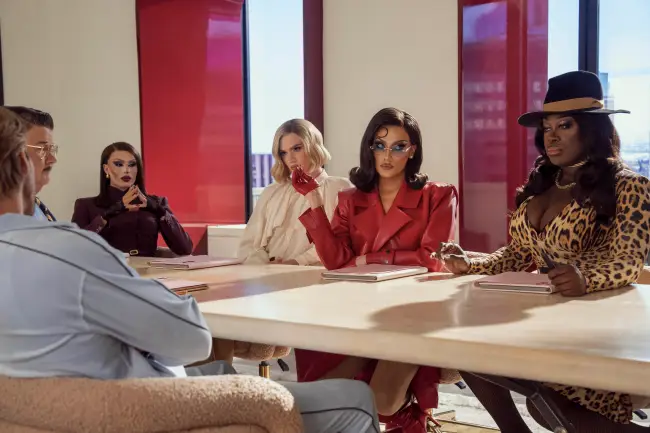
When new HR rep Reese Calloway (Ivy Wolk) attends a drag show hosted by Monet X Change, she realizes that everyone she works with is essentially a drag queen. Viewers then see the law firm through Reese’s eyes, with Jewels Sparkles as Allura Grant (Kim Kardashian), Marcia Marcia Marcia as Liberty Ronson (Naomi Watts), Bob the Drag Queen as Emerald Greene (Niecy Nash-Betts), Daya Betty as Carrington Lane (Sarah Paulson), Olivia Lux as Milan (Teyana Taylor), and Lady Bunny as Dina Standish (Glenn Close).
“I hope that it has a life on gay internet and on gay social media,” Rogers says about the potential audience reaction. “It’s like a hall of mirrors of queer sensibility.” He adds that the episode tries to explore “how many layers of self-awareness you can balance in the name of camp,” all while still trying to be as “intelligent and creative as possible.”
Read on for our full Q&A with Rogers, in which he talks about the original concept for the episode, how the queens worked with Paulson’s movement coach to perfect their characters, and whether Drag Race host RuPaul Charles was invited to the kiki.

Gold Derby: Take us into the writers’ room. How did the idea come about?
Charles Rogers: This idea really came about when Ryan stated an intention for this season to really own — and prove that the show has always owned — its understanding of itself. In a world where the first season was under the microscope and people wanted to decide what it ultimately was, this was the creative team’s way of letting the world know that we have so much of a handle on the show that we’re turning the dial ourselves.
It’s quite possibly the campiest TV episode of all time. How do you hope it’s received?
I hope that it has its own life. I hope that it has a life on gay internet and on gay social media. I think this episode is really saying and doing a lot with the queer lens. It’s like a hall of mirrors of queer sensibility, where you have drag queens playing a cast that was already being draggy to an extent. It’s really about how many layers of self-awareness you can balance in the name of camp, and trying to pull that off as intelligently and creatively as possible. That was the assignment.
One of my favorite quotes is Olivia Lux’s Teyana Taylor saying, “What I want is what’s all’s fair.”
I love that line. That was something I told Olivia to say on set. I felt like somebody needed to say “all’s fair.” [Laughs.] There needed to be that trailer moment where somebody invokes the title, and I loved that, semantically, it’s wrong.
What was your favorite moment?
My favorite moment was something Jewels Sparkles improvised, that she’s eating air for lunch. I just think sometimes the dumbest joke is the smartest. Jewels thought that up on set, and I was like, “Please, please, please.” We’d planned for her to be slurping oysters. I was like, “Just scrap it. Don’t even reset the oysters. We’re moving on to her cutting up and forking air.”
Which drag queen’s performance really impressed you?
They literally all did, and I’m not just saying that. I can’t believe how good all of them were. I don’t think Olivia gets enough of a shout-out because she really brought it. Her Teyana is sleeper incredible, and she really acted. She brought a level of commitment that made what could otherwise have been the fifth drag queen feel like she had such a place in the episode. I really am so proud of the job she did.

I also think Marty Lauter [Marcia Marcia Marcia] is such a consummate professional. She really came ready to act, and you could tell, “Oh, this drag queen in particular is obviously the actor.” Not that they aren’t all actors — they literally are all actors in this episode — but I was really delighted by how ready Marty was.
I could just go down the list. I couldn’t believe how amazing they all were, and how incredibly lovely, kind, and warm they were. There wasn’t one problem person or problem moment in the entire construction and execution of this episode. It was a love fest. It reminded me that I love directing, I love comedy, and I love being in it with people, making something really insane and extreme and taking that assignment very seriously.
Did the queens work with the actresses? Daya Betty really captured that character’s accent. Did Sarah Paulson work with her, or were they separate?
All of the queens worked with Julia Crockett, who is specifically Sarah Paulson’s movement coach. Daya, in particular, got a really up-close workshop about Sarah and what Sarah brings to that character, and how to embody it in the ways Sarah does. Julia worked with everyone, did a lot of work on the side, and was a presence on set. It was very helpful and very cool to have her.
How do you come up with the nasty reads the ladies give each other? What is the formula?
I think there’s just a heinous, icy bitch in me who is constantly thinking terrible things. [Laughs.] But I keep that person at bay because I also love people, and no one deserves to be read. I’m reading myself on that level all day long. That’s the actual truth. So it’s kind of not hard for me, in writing, to point it toward other characters.
Can you tell us about the theme of the episode, which was women supporting women — or women suffocating women at one point?
The point of this episode was really born out of a lot of the themes of this series that have been challenged publicly. This was our way of saying, “Yes, we know this show is set in a very extreme fictional universe. It’s a celebration of extravagance and wealth, and sometimes those messages get overlapped with messages about modern feminism, or maybe a slightly left-behind feminism.” What we wanted to do was say that this show, at the end of the day, is intended to be a fun dessert. If you are taking any of that a little too seriously, then you’re sort of not giving yourself permission to enjoy what is so fun about the show.
In creating Ivy Wolk’s character, we wanted a younger perspective that could challenge and speak to all of those things people had spoken to while reviewing the show. We didn’t want it to be a dogmatic indictment of either generation, or either point of view, or anything specific to gender. It’s really about how so many contrasting points of view can live together and work together. At the end of the day, every generation and every movement has its pain and its wounds, and those are very valid. That’s why people arrive at the points they live or die by.

There’s a moment when Daya Betty walks on the table and it collapses under her. Was anyone injured? Were there any drag queens bleeding on set?
We had a stunt double do it in one take, absolutely perfectly. I should talk more about the lore of this table. The original marble table is something like 1,000 pounds, something insane. There had been a production mandate never to move it. It hadn’t been touched, moved, or adjusted since it was placed at the beginning of the first season. While we were scouting, I asked, “Is it possible just to make a breakaway table?” Our production designer [Catherine “Cat” Smith] said, “Yeah, we can.” Lo and behold, the table was moved and replaced with a breakaway one, and the rest was history.
Where was Mama Ru? Did RuPaul get an invite for a potential cameo?
I think Ru is such a titan and has her own kingdom. Ru deserves to oversee, and not to be a guest.
Best of luck at the awards season coming up, where you’re campaigning as a comedy.
As we should!
This interview has been edited for length and clarity.
