
Gandalf the Grey is sitting on his ass. When we first see the wizard in this episode of Prime Video‘s The Lord of the Rings: The Rings of Power, he’s parked himself outside the palace of the Dark Wizard, Gandalf’s kindred spirit Pallando. The former Blue Wizard, who’s already killed one Istar that we know of, must be brought back to the light and help lead the forces of Rhûn against Sauron’s kingdom of Mordor, not in alliance with it. It’s up to Gandalf to do this. And before he does, he just sits there for a while with the weight of it all, until he’s ready to get up and do or die.
It’s a quiet moment, a subtle one. Considering that the rest of Gandalf’s storyline involves him getting tossed around like a rag doll by Pallando and then strapped to the back of an oliphaunt as the truly staggering forces of Rhûn march to Mordor with the Grey Wizard as a sacrificial lamb, it’s a moment you might easily forget. But it shows that as over-the-top as Rings has gotten, to its credit for the most part, it knows how to pare itself back down to a human scale, even if the character involved isn’t, strictly speaking, human.
It doesn’t always work as well as that, though. In Middle-earth, Galadriel and Celeborn part ways from the eagle who rescued them from Gundabad, so that Sauron can’t track them through the air. Does this make any sense at all, given that getting heroes from one place to another safely through the air is the whole purpose of the eagles in Tolkien’s legendarium? None at all! But the show is determined to give us a whole Galadriel/Celeborn romance, even if it has to graft a backstory of several thousand years spent in captivity and the personality of a swashbuckling adventurer onto the otherwise nondescript character to get it.
For this viewer, the romance is one area where Rings of Power’s powers of invention fail it. The sweaty effort to turn Celeborn into an interesting character — or worse, a cool dude — wouldn’t even be necessary had he simply been around and a part of Galadriel’s life this whole time. That way, her mind-fucking by Sauron while she was off on a mission would have had so much more teeth.

Anyway, the happy couple should have just stayed on the eagle, because the still-living orc Marnûkh gives up their destination to save his orc-children from Sauron. Sauron being Sauron, of course, those Shagrat rugrats were all already dead by the time he asked the question. This guy stinks!
Galadriel and Celeborn are hunted through the great forest known as the Greenwood — not yet turned into Mirkwood by Sauron’s murky magic — by orcs, who catch up with them when Galadriel hallucinates that Celeborn is Sauron and falls out of the tree where they’ve been hiding. Celeborn gives himself up to throw the orcs off her scent, so he’s there to greet Sauron when the Dark Lord arrives on beast-back. Sauron sneers that he hasn’t seen Celeborn since he rode the dragon that set the Elf-lord’s legion on fire millennia earlier. He seizes Celeborn to use as bait, though he says he himself will be the real lure for the Lady. (Specifically, he says “She’ll come to you, she’ll come for me,” which is suggestive language!)
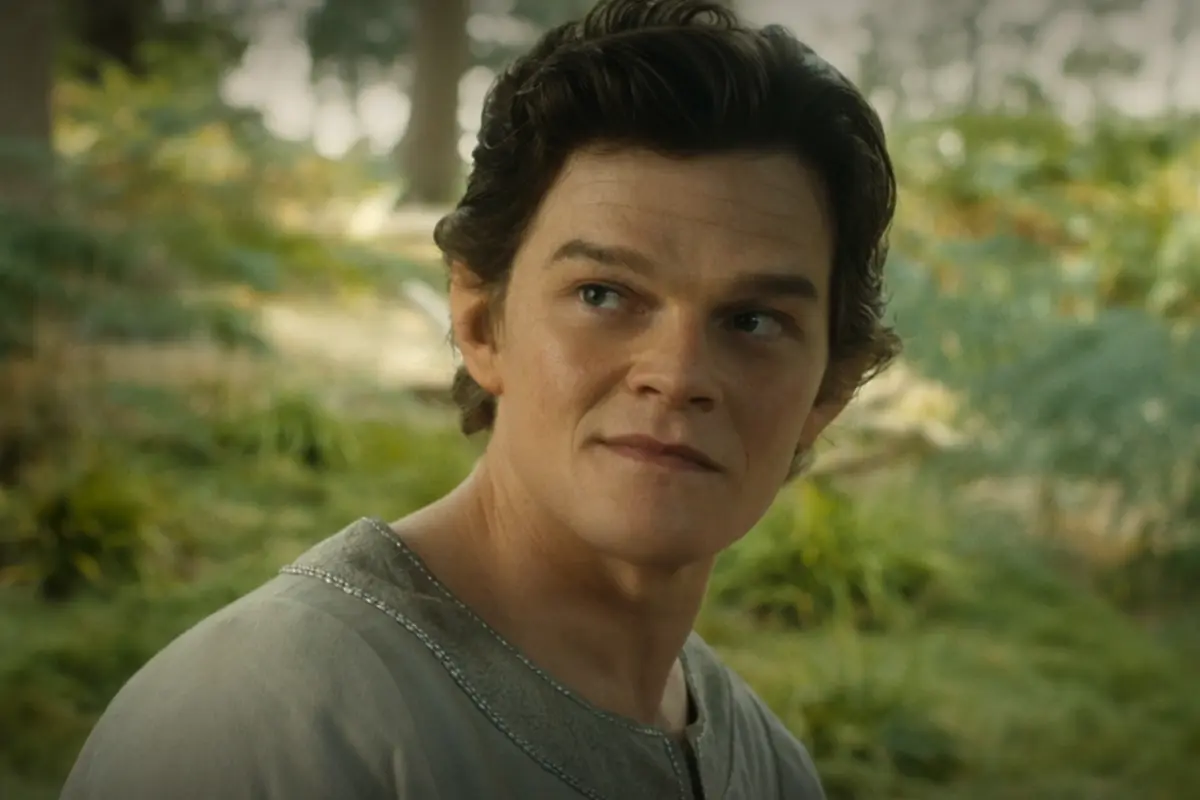
The Elf-lords Elrond and High King Gil-galad, meanwhile, sail to Númenor to ask the powerful human kingdom’s help in defeating the threat of Sauron, a must-have alliance now that Mordor has partnered with Rhûn. Their best hope is that it’s still the kind of place that Elrond’s human brother Elros had in mind when he founded the place thousands of years earlier. A flashback reveals that the two Elf brothers (both played by Robert Aramayo) were given the choice of which species they’d belong to; Elros chose to aid Men in forging a new civilization. Their sundering is moving and sad to watch, even as their continued love keeps them bound together.

But in the present, the vibes are off in Elros’s island kingdom. King Ar-Pharazôn is friendly enough to them — once they finally get in to see him, that is — but his courtiers regard them the way you’d look at a trained chimpanzee wearing a tuxedo. Some of that is Elrond’s resemblance to Elros, but there’s the inescapable sense that these humans feel they’re higher in the pecking order than their pointy-eared kindred.
Smartly, Gil-galad tailors his message to Ar-Pharazôn’s ego, pointing out that Sauron’s claim to the the Lord of Men rightfully belongs to the King of Númenor. His highness explodes when Miriel, his predecessor and rival, is brought up, but he’s viscerally repulsed by Sauron. Or is he? “That smug smile…and that hair…” he sputters, sounding almost like he’s crushing on the Dark Lord.
Convinced that the king is dangerous, Elrond seeks out the Faithful, after revealing himself to Isildur. But when the pair arrive, Míriel mistakenly believes the Elf has come to help them in battle…because Elendil is about to lead the faithful’s forces in what appears to be the first all-out battle in the kingdom’s civil war.

It’s bad timing for Elrond, but good timing for us. Rings of Power is very good at battles at this point, and some Game of Thrones–style human-on-human faux-medieval combat should hit nicely. What’s more, the complicated political situation Gil-galad and Elrond will find themselves in now intrigues me: We’re not used to seeing Elves begging for aid at all, let alone from a king whose internal enemies are the Elves’ natural allies. One day in the future, Elrond and Isildur will have a very important decision to make together, but it looks like a moment of decision is upon them already.
Sean T. Collins (@seantcollins.com on Bluesky and theseantcollins on Patreon) has written about television for The New York Times, Vulture, Rolling Stone, and elsewhere. He is the author of Pain Don’t Hurt: Meditations on Road House. He lives with his family on Long Island.
