
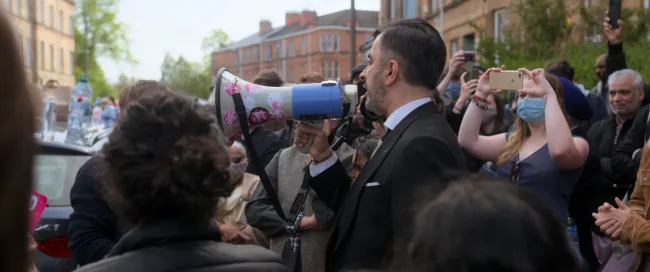
Five years ago, documentarian Felipe Bustos Sierra was living near Kenmure Street in Glasgow, Scotland’s Pollokshields neighborhood. On May 13, 2021, the street became the site of a large, peaceful protest against a Home Office immigration raid. Although he was only a 10-minute walk away, Sierra stayed home — and regretted it. One week later, he started making the documentary Everybody to Kenmure Street.
“I received the same message as everybody,” Sierra told Gold Derby, referring to mass text messages sent to people across the area when two men were detained by officers on the day of Eid al-Fitr. “I didn’t really see the hope” in showing up, he admits. Judging from past experience, he assumed that “by the time I would get there, the van would’ve left, or there would be some sort of police repression, and I didn’t feel like getting a bat in the face that day.”

The son of a Chilean journalist who had been exiled to Belgium after the 1973 coup d’état, Sierra “grew up with protests and going on marches and solidarity movements.” His first documentary feature, Nae Pasaran (2018), was about Scottish factory workers who refused to service Chilean Air Force jet engines in protest against atrocities committed by the Pinochet dictatorship. Although he shared details about the Kenmure Street protest on social media, Sierra was “ignoring it until the afternoon, when I realized it was becoming something completely different.”
As Sierra soon found out, a large group of people surrounded the Home Office van carrying the detained men, preventing it from leaving and eventually leading to their release. “I’d missed out,” Sierra admits, “not just as a filmmaker, but just as a human being. How often do you go to a protest and get exactly what you want within hours? I never felt that in my life before, and I missed out on it because of that sort of pessimism. So the next day I was on the street,” talking to people who had been there. Within a week, “I’d talked to enough people to understand not only would we have access to a huge amount of footage,” but also that “there was a bigger story to tell that the papers weren’t telling at the time.”

Because the world was still dealing with COVID-19, Sierra was limited in how much practical filmmaking he could do during the first four months. Instead, he met with a different protester at a local park each day and talked about “what they had witnessed.” The director talked to about 150 people and found that “there was very much this sense — which felt quite electric — that it was as spontaneous as it appeared to be, that most people had never been to a protest before in their life. There was something hyper-local about having to witness that in your neighborhoods, and you’re not hearing from campaigners. You’re hearing from people in your book reading group on WhatsApp, or your babysitting network.”
Since everyone present was filming that day, Sierra received “hundreds of clips that were six, eight seconds long” from people who “clearly were not trying to document,” but rather “trying to capture a moment that they were witnessing, put it on WhatsApp, put it on Instagram, and maybe get five more people to join the protest.” This turned out to be “a blessing and a curse” because “initially we felt, well, everybody’s filming, so we’re going to have a lot we can work with. We realized that the way people were capturing and spreading the word became a big influence on how we made the film.”
Sierra and his editor, Colin Monie, started by cutting together footage of the initial police raid, which came from many different people. “We realized there was such an immersive sense of equality to that.” Because a lot of the footage was shot on cellphones in portrait or landscape mode, Sierra and Monie “started using split screens and syncing up moments from different angles. There was something very sensory and very immersive about it. It was like, we have one really good scene here: can we apply that to the rest of the film? So in a way, we kind of backtracked through the whole film.”
Ultimately, “it was kind of a film made through word of mouth. People were finding out what we were doing, that we were going beyond the headlines, and that we were not looking at politicians and institutions. We were looking at people who were living on that street, and trying to get a sense of what the day had been and how it had affected them. So very quickly there was a lot of trust.” That helped reassure people who were worried about revealing they had been at the protest. Sierra eventually secured the participation of human rights lawyer Aamer Anwar, who was there that day, and one of the detainees. Their involvement, he says, “made our storytelling a lot sturdier and a lot more in-depth than it would’ve been.”

Many agreed to be interviewed on camera, and Sierra went through “a process of talking to every single person I could find, people I would recognize from the footage.” Sometimes, he would “go door to door,” asking people if they were there. That “created a circle of trust around the project,” which took years to complete. “We never thought it would take five years to make,” he admits. “We felt we couldn’t make the film fast enough. But we were also very worried about potentially putting a target on anyone’s back. We knew we were making a slightly biased film, that it was going to be solely told from the perspective of the protesters, which meant that the journalistic process of getting everything checked was important.”
Of equal importance was “the safeguarding of everybody that was in the film, which led to decisions not to name everyone onscreen.” Sierra also decided to put people onscreen “for just a few seconds, and then the baton gets passed to somebody else, because we didn’t want to make anybody a target.” He also wanted to “reflect the fact that there hadn’t been any sort of leader at the protest. All of these things were challenges, but I suppose we knew early on this was the right way to make this film.”
One person who was nervous about appearing on camera was Van Man, so named because he literally crawled underneath the van carrying the detainees and wrapped his arm around one of the axles to prevent it from leaving. “Van Man became a bit of a mythical character in the weeks following the protest, and he refused any sort of interviews.” By the time Sierra found him, Van Man “talked about that feeling of being put on a pedestal in papers and the way people talked about him. He felt his contribution had been turning up at the right time, and literally buying time for somebody else” who might have a better idea of what to do. “It made him realize how little prepared he’d been for that,” which was compounded when an off-duty nurse showed up to tell him what to expect if he chose to stay under the van for, as he put it, “however long it takes” to free the detainees.

Like Van Man, the nurse was reluctant to appear on-camera because “a lot of her work involves working with police officers,” so her ability to remain anonymous is “something that allows her to be” at protests. These two characters, as well as a key protestor, “needed some level of safeguarding,” and were eventually portrayed by actors in dramatic reenactments. This, Sierra admits, “was a problem. This was not the film I was picturing to make initially. I thought I would make this very authentic” documentary with “protestors only: their voices, their faces. When they agreed to give me their testimonies that would be relayed by somebody else, I thought actors might bring an artifice that would take away from the integrity of the film and what we were trying to do.”
To justify this, Sierra thought, “what can I bring to the film that they brought to the protest? This element of imagination. This element of there’s something new. It was the ace in the sleeve for the protestors.” When trying to think of who could embody Van Man, his mind went to two-time Oscar winner Emma Thompson, who had been a fan of his previous film and served as an executive producer on Everybody to Kenmure Street. “I just pictured Emma Thompson under the van” and “it made me laugh. There was something quite defiant and mischievous about it, which I felt mirrored what Van Man himself had contributed.” So he reached out to Thompson, who immediately agreed. “Sometimes filmmaking is that easy.”
Everybody to Kenmure Street begins with a long prologue using archival footage to highlight the history of protest movements in Scotland. While interviewing the protesters, Sierra found that “a lot of people talked about the things that inspired them in their life, and that they wished they’d had the chance to emulate this, in a way. So that started putting the thread of those sequences together.” Throughout his research, Sierra kept coming back to Jimmy Reid, a legendary activist in Scottish history. To his pleasant surprise, he found out that Reid’s daughter “lived on Kenmure Street and had captured the footage that went viral at the end of the day” of “the guys being released.” Such happy accidents made Sierra realize “there’s something that needs to be explored here” about the history of Scottish resistance.

“I also talked to so many people for whom this was their first protest,” Sierra adds, “particularly young people” whose reason for going “had nothing to do with history. It was just anger that this was happening in front of them. There was this pattern of I’m angry because I feel like this keeps happening, and nobody does anything about it, so I’m going to do something about it.” With the prologue, Sierra wanted to show them that “you’re surrounded by people who inherited and benefited from that history” of resistance. “I feel like a lot of people who were initially strangers found themselves a chemistry in response to what was happening in front of them, and in talking to each other realized there’s lots of us. There’s probably more of us than there are of them, and there’s been lots of us throughout history. It’s just about getting enough people at the right time to do the right thing. That’s how history moves forward in more compassionate ways.”
Everybody to Kenmure Street premiered at the 2026 Sundance Film Festival, where it won the World Cinema Documentary Special Jury Award for Civil Resistance. “While we were making the film, we felt this was a film for Glasgow. This was a film for Scotland,” Sierra says. When it premiered at Sundance, protests had erupted federal agents fatally shot two American citizens in Minneapolis. “We realized all of a sudden the film spoke to a whole different kind of people.” Sierra wasn’t expecting audiences to receive his documentary as “the first anti-ICE film,” and that they would be “blindsided by its ending,” to the point where some asked, “is this like an alternate reality hybrid documentary about what’s possible?” Sierra has been heartened when audiences tell him “it’s a relief and a morale boost to watch the film” because it is “a validation of things that we’ve always held dear, but think that maybe the times are against us.”
