
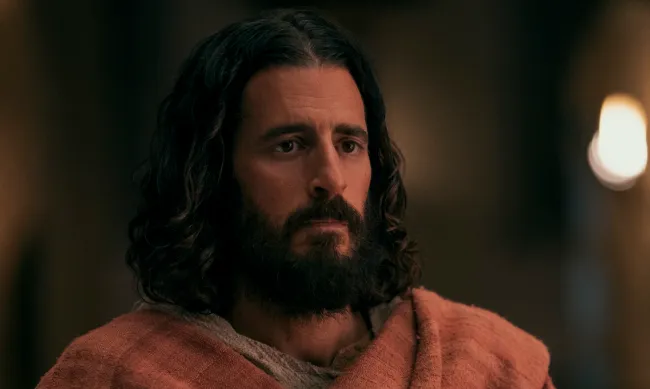
It’s all been building up to this. When The Chosen launched as an independent — and largely crowdfunded — series back in 2019, creator Dallas Jenkins set out to trace the full arc of the much-mythologized life of Jesus of Nazareth, from his earliest days as an itinerant preacher to his eventual death outside the gates of Jerusalem. With the debut the show’s sixth season on Prime Video, viewers have reached the oft-told passion play portion of this story heading into the holiday season.
Unfolding in near real-time, the season’s first three episodes depict Jesus’s early morning arrest and trial in front of Jerusalem’s religious elite. It’s during that trial — which occupies much of Episode 2 — that the preacher is struck for the first time, presaging the physical trial he’s about to endure as the story progresses. And Jonathan Roumie, who has played out Jesus’s journey across the show’s six seasons, was well-aware that blow would impact audiences more than himself.

“I knew that was going to be tough for people to see, because nobody has ever seen Jesus struck before,” the actor tells Gold Derby. “But something that came to me in that moment was the opportunity to show the world the philosophy he taught, which is to turn the other cheek.”
Conferring with Jenkins, who directed the three-part premiere, Roumie asked for a take where he could improvise that cheek-turn, without telling his scene partner what was about to happen. “When he’s hit and Jesus turns the other cheek, it threw him off,” the actor recalls. “He was like, ‘What do I do?’ It created this really wonderful little moment, and I’m glad Dallas left it in the episode. It was like, ‘He’s the real deal.’ He meant what he said by turning the other cheek, and this was his opportunity — since he says so little — to say a lot just using his actions.”
As Roumie notes, that moment exemplifies his particular acting challenge in Season 6. After five seasons where Jesus is an active character in his own life — preaching sermons, leading his disciples, and challenging Judea’s entrenched power structure — at this point he becomes reactive as he recognizes and eventually accepts his fate. That requires Roumie to become a largely silent presence throughout the season’s six episodes as Jesus surrenders to events beyond his control.
“It was a welcome challenge for me, because I’m a huge fan of silence,” the actor explains. “I’m a huge fan of subtext and saying something without saying anything — just using your face, and the kinetic energy between two actors and reactions. That’s sometimes so much more powerful than actual words.
“For me, having a season where I didn’t have so many words and could just really sit in the emotion of the scene and the drama of a scene [was great]. I love that kind of stuff, and it’s more of a challenge because you’re bereft of words. You have to work through that without the facility of language, which is fun and juicy for an actor.”

Some of the few words that he does speak are heard in the Season 6’s first episode, which picks up with Jesus’s disciple, Judas (Luke Dimyon), betraying him, as foretold, with a kiss. “Friend,” Jesus remarks, as Judas kisses him on the cheek. “Do what you came to do.”
“Luke and I didn’t talk a whole lot ahead of time about that scene,” Roumie recalls. “The way we work is very similar; we’ve done our preparation, so we’ll use the moments before a scene to be there for each other and maybe connect a little bit. For me, the overwhelming emotion I was experiencing in that moment was just sorrow — the sorrow for the choice that Judas made, as well as Jesus knowing all along that he was going to make that choice. Even with free will, he was always going to choose to do what he did, so Jesus can’t help but feel sorrow for him.”
For his part, Dimyon remembers feeling more nervous than sad while performing that scene, albeit for reasons that were very specific to his predicament as an actor. “I’m a self-proclaimed short king,” he confesses. “The kiss itself was very, very technical of trying to get it correctly in frame. There was a good solid hour or tow of me planting it on Jonathan’s cheek multiple times, and then our director of photography would say, ‘Luke, could you just get a little higher?’ I would be up on my tippy-toes just thinking, ‘Stay strong calves — you must kiss this man!'”
When his calves weren’t protesting, though, Dimyon emphasizes he felt the emotional weight of the scene. “It’s very endearing and heartbreaking, but I can’t help but remember how difficult it was to just get the kiss in the frame. I’m lucky to have worked with Jonathan for multiple seasons, so we have a friendship and a rapport. Before filming the kiss, I remember that we took some time and just looked at each other as we shared that moment.”
As Jesus retreats into silence across the first three episodes, Judas becomes more loquacious as he tries to convince the other disciples that turning their leader over to the authorities was the only way forward. But his initial certainty in that choice wavers as the hours tick by, awarding Dimyon some meaty dramatic material to play.

“Some of my favorite stories involve heroes having to make a great choice and show their resolution in doing it,” the actor says. “In our own lives, we’ll do things we’re uncertain of and try to accomplish them for a greater ideal. I see Judas as doing that when he makes his own choice, but I also see the uncertainty the he pushes away out of the desperate need to make this choice work.
“It’s almost like a bad bet — he’s doubled down thinking he can win the house, but he’s just in survival mode,” Dimyon adds, alluding to Judas’s ultimate fate, which will be shown later in the season, but isn’t a spoiler to anyone who knows the story. “He doesn’t want to think that he’s betrayed his friend and rabbi for nothing. But then he realizes the pawn that he is in fate’s game and he can’t process it. He doesn’t know how the game ends — so he sadly takes himself off the board.”
