
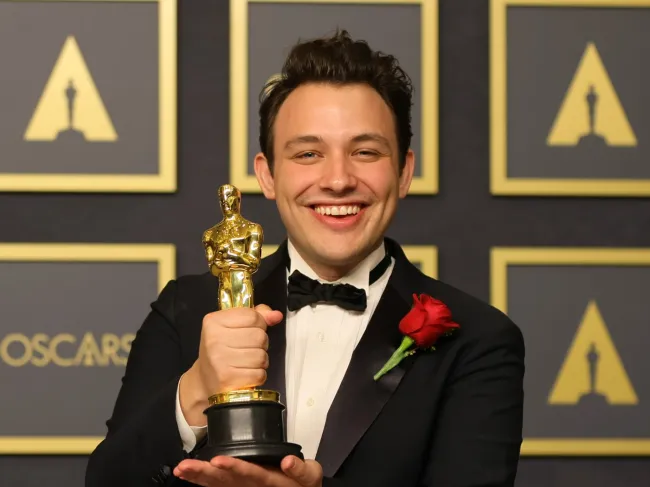
Ben Proudfoot has won two Oscars for short documentaries — and he’d like a word with anyone who calls the format a “stepping stone.”
He earned his first nomination for “A Concerto Is a Conversation” in 2021, then won Best Documentary Short for “The Queen of Basketball” in 2022 and another for “The Last Repair Shop” in 2024. His latest, “The Buffalo Miracle,” is a 37-minute doc about a McDonald’s that stayed open through Buffalo’s deadly 2022 blizzard, and will be available to stream on HBO Max.
Proudfoot tells Gold Derby those wins did more than help his career.
“There’s no question that it’s had a huge impact on my ability to get movies made and get them distributed. And I’m extremely grateful for all of my interactions and experiences with the Academy. I’ve had several lifetimes of love and appreciation for my films from the Academy,” he says. “I also think it’s made me really think a lot about advocating for the format of the short documentary.”


He’s heard every version of the knock against shorts.
“This is a format that has often and historically been subjected as a lesser art form. It’s a student art form. It’s a stepping stone, proof-of-concept thing. If there’s not enough material in the story, let’s make it a short. ‘Oh, it’s only a short. It’s just a little short.’ And I just think that’s all bulls–t,” he says. “You don’t go to an art museum and judge a painting by its length and width. Nobody asks, ‘What’s your favorite song? And how long is that song?’ In so many other art forms, the runtime or the size of it is irrelevant, as I think should be the case in film.”
As he sees it, a lot of that comes down to money.
“Film is so expensive that the people who are able to have enough money to make a three-hour film or four-hour film oftentimes overlap with our most celebrated directors, our most powerful storytelling initiatives,” he says. “But it doesn’t mean that the story that they’re telling is inherently better or more important.”
Shorts at the Oscars
Proudfoot says the short categories haven’t always had a guaranteed spot at the Oscars.
“I’m a proud member of the shorts branch of the Academy, and I’m really proud that all three short categories are still part of the Academy. There were times when many people were trying to get them kicked out,” he says. “There was even a time when the short documentary Oscar was voted to be removed from the broadcast and from being given out in the ’90s, and people had to fight and get it back in. So there’s a long history of people fighting on behalf of the short film, and I’m proud of the Academy for always, from day one, recognizing the format.”
Proudfoot saw that fight up close. When he won for “The Queen of Basketball” in 2022, Documentary Short was one of eight categories the Academy handed out before the live broadcast, with the speeches edited into the ABC telecast. After immediate backlash, the Academy brought all the categories back to the live show the following year.
Oscar rules define a short as 40 minutes or less, including credits. Unlike features, shorts don’t need a traditional theatrical run to compete, though that’s one way in.
“It can play in a theater. So if it plays in the movie theater like ‘The Buffalo Miracle’ did, it’s in consideration for the Academy Awards,” Proudfoot says. “And another way of qualifying is if it wins a qualifying award at a film festival.”
Shorts can also qualify by winning a gold, silver, or bronze medal at the Student Academy Awards.
Since “The Buffalo Miracle” played in theaters, Proudfoot could have films in both documentary races, with his feature The Eyes of Ghana competing for Best Documentary Feature.
Short or Feature
The Eyes of Ghana, which opened in theaters Oct. 30, almost wasn’t a feature at all. Proudfoot originally planned his documentary about Chris Hesse, the personal cinematographer to Ghana’s first president, Kwame Nkrumah, as a short.
“All credit there goes to Moses Bwayo, one of our producers. I originally wanted to make it as a short documentary, but Moses, from the beginning, was very insistent that it be a feature so more elements of the story could be included,” Proudfoot said in a recent Gold Derby interview. “Practically, when you have a movie about an archive, you have to show what’s in the archive. … It’s still a really tight 90-minute film, but it ended up being a feature rather than a short.”

Proudfoot says he isn’t choosing between features and shorts anytime soon.
“They’re all films that I have a deep connection with, and in most cases have spent years on. So they’re impossible to confuse, because they’re like children. They all have their own personality, their own set of collaborators, their own mission in life,” he says. “I only wish I could make more films. People are often saying, ‘Oh my gosh, you have so many films coming up.’ I’m sitting over here trying to figure out a way to make more films. There’s just so many good stories to tell. We’ve got to tell them all somehow.”
