
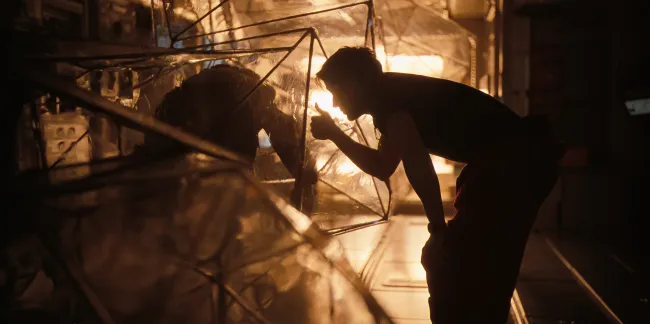
At its core, Project Hail Mary is a two-hander between Ryan Gosling and a rock. Rocky, the five-limbed Eridian engineer who became the year’s most unlikely movie star, has no face, no eyes, and no expressions. Creature maker Neal Scanlan and actor-puppeteer James Ortiz made the extraterrestrial come to life on set, infusing Rocky with an indelible personality. But many elements of Rocky’s breakout performance were crafted long after the cameras stopped rolling by editor Joel Negron, frame by frame.
“The whole movie was the hardest scene,” Negron tells Gold Derby. “This is the hardest movie I’ve ever worked on. There was so much footage, there was so much emotion to try and convey.”

Ortiz says that he and Gosling improvised on set for hours at the urging of directors Phil Lord and Christopher Miller. Screenwriter Drew Goddard told us that the directors’ cut of the film ran four hours. Negron says his own assembly ran even longer.
Negron, who is firmly in the awards mix as Project Hail Mary has emerged as a major contender, spoke with Gold Derby about how he helped shape the film in post-production: catching up on a shoot already underway, building Rocky’s performance one shrug at a time, deciding when to let the theater go silent, and cutting scenes that the filmmakers were “crying” to lose.
From Jump Street to outer space
Negron’s history with Lord and Miller dates back to 21 Jump Street. They hit it off and he later worked with them on Apple TV’s The Afterparty, where Miller was showrunner and Lord a producer, and then on Cocaine Bear, which they produced. In between, the duo kept trying to bring him back. “They wanted me to get on some of their animated movies like Spider-Verse, but I was in the middle of other things, so I couldn’t,” he says.
He spent those intervening years on effects-heavy studio films, including Thor: Ragnarok, several Transformers movies, and Jungle Cruise. That turned out to be ideal training for a film whose co-star was built in a creature shop.
“I’ve gotten used to just looking at nothing and imagining something there,” Negron says. “And it’s always editing. Every step of the way, you’re editing. You don’t just put the scene together and the shots just pop in. You’re constantly just, ‘Oh, I got a new shot. Oh, I need Rocky to do this, and he’s not, so I need a different shot.’ … So in editing, I’m kind of doing what an actor does. I’m imagining what’s going to be there and how people and things should react to it.”

“The rock had so much more personality than the shark”
The call about Project Hail Mary came during the pandemic, while Negron was cutting Jungle Cruise from home. Lord and Miller started with a question about Gosling, whom Negron had worked with on Shane Black’s The Nice Guys.
“I said, ‘Oh, man, he’s great. You guys have to work with him. He’s funny. He’s dramatic. He’s got great physical comedy,'” Negron recalls. “At the time, I just thought they were looking for him for a comedy. … I said, ‘You guys definitely need to get together. You have the same brain.’ And then I said, ‘What are you guys working on?’ And they told me that they had a manuscript called Project Hail Mary, and 90% of the movie takes place with Ryan Gosling having a relationship with a rock alien. I said, ‘Let’s do it. Let’s do it.'”

Negron figured he had valuable experience with a lone actor facing off against another entity. “I’d done a movie called The Shallows a few years ago with Blake Lively, and a shark was just circling her, and that was the whole movie. So I thought, ‘If I could do that, I can do this.’ But little did I know this was much, much more than that, and way more dramatic, and way more emotional. And the rock had so much more personality than the shark.”
When production began, Negron was in the middle of another Shane Black film, Play Dirty. After they worked out the schedules so he could leave Play Dirty, he joined Project Hail Mary two weeks into the shoot. By then the footage was already piling up. “So I was behind, because they shot a lot of film,” he says. “I came in two weeks late, so I had a pile of film ready for me, and I had a lot of catching up to do.”
He also knew the script wouldn’t stay fixed. “The thing about Phil and Chris is, since they’re writers, they’re constantly reimagining and constantly trying to figure out things. They do that in preproduction, they do that while they’re shooting, and they do that in postproduction,” he says. “When you’re editing, it’s kind of like you’re still writing, because you’re making things up, you’re changing things, you’re adding lines.”
Four hours and nobody left for the bathroom
Negron’s first assembly didn’t leave anything out and exceeded four hours. “I don’t cut it. I leave it all there, because I put myself in their shoes,” he explains. “If I was a director, I would want to see everything I did. I wouldn’t want some guy to say, ‘Hey, that wasn’t good. I took that [out].’ I always have in my brain what can be lifted. But I like to show the director everything in case there’s something I miss.”
On Project Hail Mary, that meant a huge amount of material. Takes ran long, and no two of Gosling’s takes were alike. “Sometimes we had a one-page scene and we would shoot that take for 40 minutes just to find other stuff,” says Ortiz. All told, the filmmakers shot 700 hours of film.

The cut also kept changing. Composer Daniel Pemberton wrote alongside the edit from early on. “Once they started editing, those ideas would find their way into cuts,” Pemberton says. “Sometimes they’d take tracks just to get a vibe; other times I’d write whole new things based on the edit. … I pretty much ended up living in the room next to their edit suite in Los Angeles.”
Even at four hours, the director’s cut played well with the small audiences who saw it, Negron says. “They loved it. They loved Rocky. They were super emotional.”
Before each screening, Lord gave the audience permission to step out. “Phil would always say, ‘You’re not offending us. We know it’s long. We know we have a lot of work to do. We know that we’re gonna get it to movie length. But if you guys need to get up to go to the bathroom while you’re watching the movie, please do,'” Negron recalls. “And nobody did. In all of our screenings, people were so into the movie, they waited until the four hours or whatever was over before they got up to go to the bathroom. So I thought that said a lot about our movie.”
Building Rocky one shrug at a time
Lord and Miller wanted Rocky to be a practical puppet, not a digital creation, for one reason. “Our argument, and I think it proved to be true, is that Ryan needed a scene partner,” Lord explained before the film’s release. The physical puppet made things easier for Gosling, but it made Negron’s job harder.
Negron says it starts with Gosling. “He is amazing. I’m the editor, and I see where they call cut or where they call action, and I’m believing that he’s talking to an alien rock.”
Scenes were shot one side at a time. “They shot all of Ryan’s side of the footage first,” Negron explains. “And then the next couple days, they would shoot the Rocky side, and they did a lot of experimentation. I would cut together the Ryan side, and they would see that, and they would see what Ryan did, so they would try and react to what he’s doing.”

Much of the Rocky side was improvised. Ortiz says he promised Gosling early on “that we could be improvisational,” which gave Negron a lot to work with. “There was a lot of ‘Let’s try this’ or ‘Let’s try that,'” Negron says. “And so I had hours and hours and hours of footage of Rocky doing different things, and I would just scour through it.”
That footage had its own limits. “Sometimes the puppeteers were a little bit too cumbersome, so they couldn’t have him in there at all,” he says. “Sometimes it was just two arms or maybe just a carapace.”
With no face to read, Negron looked for body language and built Rocky’s reactions out of it. He points to the scene where Grace takes his helmet off to breathe the air Rocky has made for him.
“When he says no, he doesn’t want to do it, I found a piece where it looks like Rocky’s shrugging his shoulder, like, ‘Oh, man, come on.’ And then when he was anticipating him doing it, I found a piece where he was leaning forward,” Negron says. “Look for bits of body, because there’s no face, no eyes, and in some cases no arm, no fingers or hands.”

When the footage didn’t have what the scene needed, animation filled the gaps, which brought its own problem. “With the animation, there’s no face, so you’re still trying to get this emotion from this rock,” he says. “But it was a chore, and it was a fun chore.”
Rocky’s voice was also settled in the edit. Ortiz voiced the character live on set, reading opposite Gosling, and the filmmakers tried other options once the cut came together. “After the movie was all put together, we auditioned a few other voices, and they just didn’t really seem like they worked,” Negron says. “We’re so happy and so lucky to get James and his voice. He just had this unique voice that sounded like what that alien would sound like.”
The sound of silence
During the cut, Negron worked with Pemberton’s demos and with temp music from the composer’s earlier films. “It took a little bit to find the tone, but once we got it, it was pretty amazing,” he says.
Music and needle drops kept changing places as the edit evolved. “There might be a scene where I’ve scored it, and then they bring a needle drop in instead,” Pemberton says. “Other times there’s a scene where I’m replacing where they thought they were going to put a song in because I’ve done something that works better.”
One of the film’s most effective choices was to lose the audio entirely. “In some of the highly dramatic parts of the movie, we just dropped all the music and dropped all the sound effects,” Negron says.

A prime example is when Rocky breaks out of his Habitrail to save Grace. “There’s a section in there where there’s all this mayhem, all this sound, the ship’s breaking apart, and then Grace gets knocked out, and then everything just goes dead silent. Like, nothing,” he says. “When you’re in the theater watching with the audience, it’s so amazing.”
Audience response also helped Negron gauge his changes. “The other thing I love doing is seeing how they react when I change something — when I make something longer or shorter, or change a take, or try a different version of a scene,” he says. “That’s really satisfying when you have an audience of 300 or more laughing. The whole entire audience is laughing — or crying, in this case, too.”
“Grace will die. Rocky fix.”
Asked which scene was hardest to get right, Negron smiles and says, “All of them.” Then he narrows it down to the moment where Rocky gives Grace fuel, and Grace realizes he can go home.
“That was drama. There was not much comedy in that. It was just all drama,” Negron explains. “It was difficult to find the pieces of Ryan, because there was a lot of good stuff, a lot of good drama, but we had to make sure that they were juxtaposed perfectly with Rocky, who again has no emotion. It’s hard to tell emotion. And so we worked a lot on that scene.”
It was hard to write, too. “I wrote that scene so many times to get it to where it was,” Goddard told us. The scene was still changing well into post-production, according to Negron.
On the shoot day, Gosling went off script and walked out of the room, and Ortiz had to improvise something to stop him. “It didn’t quite land, but it worked enough,” Ortiz says. “Months later, when we were doing some final audio cleanup, I got a chance to look at that scene and it still wasn’t working.”
His fix borrowed a line from earlier in the film. “Rocky says, ‘Rocky could not fix,’ when he’s referring to the crew members he couldn’t save. What if we just invert that here? … ‘Grace will die. Rocky fix,'” Ortiz says. Lord and Miller “said yes. And they were so excited about it.”
“You sleep, I watch”: The scenes that got away
To get from four hours down to theatrical length, the filmmakers mostly trimmed moments rather than dropping whole storylines. Five deleted scenes were included with the film’s home release. Four of them are longer versions of moments that are still in the movie. Three come from Grace’s long stretch alone before Rocky shows up: an extended wake-up in which Grace pulls out his own medical tubes and the robotic arm Armando force-feeds him paste; a montage of Grace melting down; and a longer zero-gravity struggle into his spacesuit. Cutting them gets the audience to Rocky sooner. In the production notes, Lord describes the film as one that “presents as a space adventure, a disaster movie, and then a third of the way through, it becomes an intimate character study between two individuals who have to learn how to communicate.”
The other two are Rocky scenes. “Maybe We’re Cousins” is an extended exchange in which Grace and Rocky theorize that Astrophage may have spread life between their worlds, which would make them intergalactic cousins. It ends with Rocky copying Grace’s thinking poses. Fans of the book had noticed its absence. It’s also a scene built entirely on Rocky’s body language, the same thing Negron was searching the footage for.
The cut Negron felt most is “You Sleep, I Watch.” The night before Grace and Rocky go out to collect Taumoeba, Rocky keeps checking whether Grace has fallen asleep yet.
“Rocky kept saying, ‘Are you asleep yet? Are you?’ It was almost like these two kids at a sleepover or at camp,” Negron says. “And Rocky was so endearing, and it was so emotional. And Grace was like, ‘No, I need to go to sleep now. Come on, we’re going to do a lot tomorrow. Let’s go to sleep now.’ And it was just a cute little scene.”
It was shot early, Negron says, while the filmmakers were still working out who Rocky was. “We played that scene for the producers and for the crew, and they’re like, ‘That’s our Rocky. That’s absolutely our Rocky.'”
Even so, it repeated a beat that stays in the film, where Rocky tells Grace, “I watch you sleep.”
“It’s just a shame we had to cut it out, because we had already had that same kind of scene,” Negron says. “And we loved it so much. It was painful to cut out, but we were looking for time too, as well. We were crying when we had to cut it out.”
