
Warning: This post contains spoilers for the finale of The Good Daughter
Peacock’s The Good Daughter wrapped its six-episode run with a finale full of twists. Rose Byrne and Meghann Fahy star as sisters Sam and Charlie Quinn, who spend the finale uncovering who was really in their house the night their mother was killed in 1989, what their father Rusty (Brendan Gleeson) was hiding from them, and who actually pulled the trigger in the Pikeville school shooting that put Kelly Wilson (Shayna Benardo) in jail.
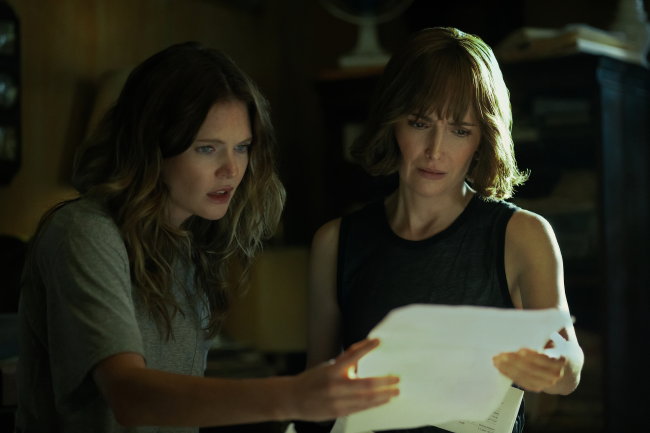
Most of the truth comes out at the Quinn farmhouse. Sam and Charlie drive out looking for a photograph of their mother and instead find their father’s records — bank statements, canceled checks, and a 20-year-old confession. Mason “Huck” Huckabee (Jake McDorman) turns up while they’re still going through it, and over the next several minutes — including a fistfight with Charlie’s husband in the yard — he tells them everything.

Steph Green directed all six episodes of Karin Slaughter’s adaptation of her own 2017 novel, and she walked Gold Derby through some of the finale’s biggest moments.
Who was the second masked man who killed Sam and Charlie’s mother?
Huck. The sisters always knew Zachariah Culpepper was one of the two men who broke in and killed their mother. When the other one said, “Come on, brother, stop f–kin’ around,” they took it literally and assumed it was Zach’s brother Daniel. It wasn’t a family name — Huck calls every man “brother.”

Why did Huck target the Quinn family?
Because of his sister, Anna Leigh. Rusty defended the man who raped her and tore her apart on the stand to win an acquittal. She later died by suicide, and Huck was the one that found her body when he was only 17.
He then paid Zach Culpepper $5,000 to kill Rusty and the man who raped his sister. He believed Sam and Charlie would be at track practice that day. Instead, everything went wrong. Rusty wasn’t at home and the girls’ mother, Gamma, was killed instead.
“I was so desperate for somebody to pay,” he tells the sisters at the farmhouse. “I didn’t mean for any of it to happen.”
Green says what set the whole story in motion wasn’t the verdict in Anna Leigh’s case — it was that nobody believed her. “That is the catalytic event in terms of all of this amazing storytelling.”

What happened to Charlie the day her mother was killed?
Zach caught her in the woods and sexually assaulted her. Huck, who had already left Sam for dead in the creek, heard Charlie screaming and pulled Zach off her. “She’s just a kid, you piece of s–t!”
“The only reason any of us survived is because I stopped him,” Huck says.

How did Charlie’s husband know about the rape?
Rusty told him the morning before he died — which is how Ben (Michael Dorman) gives it away while beating Huck in the yard, saying “He raped my wife!” Charlie had made her father promise never to tell when she was 11 years old, and he kept it from Sam for two decades.
“He said that agreeing not to tell was the hardest decision he had to make,” Ben tells her. “You only keep secrets when you’re ashamed. He was never ashamed of you.”
Was Daniel Culpepper innocent?
Yes, and his family said so for 20 years. Sheriff Keith Coin (Jayson Warner Smith) shot Daniel, and the sisters conclude Coin planted the revolver on Daniel and put Huck’s high tops in the burn barrel to make the case stick.
Huck’s parents then paid Zachariah’s son, Zachariah Jr., $2,000 a month to buy Zachariah’s silence, with Coin negotiating the terms. Huck didn’t learn any of it until a decade ago, when his mother was dying.
What was Rusty hiding?
Huck’s written confession, and the money from that deal.
After his mother died, Huck went to Rusty to turn himself in. Rusty wouldn’t let him, because reopening the case would drag Sam and Charlie through new trials, appeals, and lawsuits. Instead, he took the money and made Huck sit at the kitchen table and write out everything he’d done.

Rusty kept the payments going so the decision would eventually fall to his daughters — keep paying, or take the confession to police. He hinted at it with the Emily Dickinson line he quoted to Sam twice, once when she arrived in Pikeville and again before he died: “The truth has to dazzle gradually.”
“So it’s up to you now,” Huck tells them. “Both of you.”
Why isn’t Huck charged with murder?
Because the sisters don’t tell the police everything. Sam hands over only his confession to stealing the gun Kelly used, which carries up to 10 years, and keeps the 1989 murder confession to herself. She calls it “a temporary fix.”
How do they realize Kelly didn’t act alone?
An argument about Huck’s own case cracks it open. Ben, a prosecutor, brings up transferred intent — a gun in your hand doesn’t mean your finger pulled the trigger — and Sam goes back to the school security footage, where she finds the faint outline of a second arm alongside Kelly’s.
Green and Slaughter blocked that shot with their own bodies before anyone filmed it. “I remember standing in Karin’s office and we sort of imagined we were in the hallway and we had our arms up and we were looking at what it felt like to put an arm next to that arm,” the director says.
Months of calibration followed, because the clue had to be findable without being obvious the first time through. “There were definitely edits we did where we felt like, oh, that was so obvious. Everyone would’ve seen that earlier, and it makes our characters look like they missed something. Well, we can’t do that,” Green says. “And then there were other places where it was so subtle, the arm, that it felt like, what? Squint to the TV, lean in, huh?”
Who killed Douglas Pinkman and Emma?
Judith Pinkman (Paula Malcomson), Douglas’ wife. Charlie goes to see her alone and finds her at the kitchen table gluing a broken plate back together, and Judith admits to all of it.
The plate comes straight from Slaughter’s novel, and Green staged the scene around what it says about the woman holding it. “For me, it’s just such desperation,” she says. “Here’s something I might be able to fix, surrounded by the broken pieces that I have created, my life. This is so deliberate, this hope of being able to just fix this plate amidst all the utter destruction that is all around her.”

Why did Judith do it?
She walked in on her husband having sex with Kelly. When she confronted him, Douglas told her it was God’s will that the two of them raise the baby — Judith would quit teaching, turn her office into a nursery, and do the work.
“You have no idea what it’s like not to matter,” she tells Charlie. “I came into that marriage a full person — my own ideas — and little by little he just erased me.”
Who was the father of Kelly’s baby?
Douglas Pinkman, her principal. He had been having sex with a student under his care — statutory rape — and he planned to bring the baby home for his wife to raise.

How did Judith get Kelly to pull the trigger?
Judith was Kelly’s teacher and knew she was easy to manipulate. Over weeks, she convinced her that Douglas was going to force her to end the pregnancy. “I trickled poison into her ear. Slowly at first. Then it was easy.”
It still didn’t work. Kelly froze in the hallway with the gun in her hand, so Judith stepped in behind her, closed a finger over Kelly’s and fired. That left her the grieving widow, the hero who tried to stop a school shooter, and the beneficiary of her husband’s life insurance. Emma came around the corner during the struggle that followed — she was shot by accident.
Judith pulled the trigger six times in all, and she had planned to kill Kelly too. “I was going to shoot her in the head,” she tells Charlie. “But I ran out of bullets!”
What happens to Judith?
She clears Kelly first, stating on Charlie’s recording that she murdered Douglas and Emma. Then she recites a line from Exodus, forces Charlie out of the house at gunpoint, and takes her own life.
What happens to Kelly?
A plea deal and five years in prison. Her mother will raise the baby until she’s out.
Green doesn’t read that as a clean win. “In a way it’s the beginning of justice for Kelly,” she says. “It’s the beginning, I hope — in my terms of what she deserves — which is much more care and consideration than she’s gotten.”
Where do Sam and Charlie find Rusty’s hidden photo of Gamma?

Rusty had asked Sam to bring a framed picture of his late wife, Harriet “Gamma” Quinn (Olivia Williams), to the hospital. He also told her the photo he really wanted was at the farmhouse, and that Charlie would know where to look — which is what gets both sisters out to the property together. Going through his things, Charlie notices the back of the frame is taped shut, and finds a second photo of their mother hidden behind the first.
Green’s team shot about 450 photographs of Gamma before choosing one, though she doesn’t think the picture is the point.
“I find the delightful quality of this family — and of Rusty — is that they’re saying one thing, needing a different thing, having you find another thing, and then ultimately getting to the truth,” she says. “He wanted them to find it in the way they found it, and he wanted them to be together and to have come back together as sisters.”
