
Warning: This post contains spoilers for Episodes 1-5 of The Good Daughter
Some beautifully told stories are so haunting, you can only bear to watch them once. Karin Slaughter’s adaptation of her bestseller The Good Daughter, streaming now on Peacock, is one of those tales.
The drama begins 20 years ago, when the rural Georgia home of defense attorney Rusty Quinn (Brendan Gleeson) is invaded while his wife, Gamma (Olivia Williams), and their daughters, Charlie and her older sister, Sam (Drew Ann Cheek and Audrey Grace Marshall), are there alone. Gamma is shot and killed in the ensuing struggle, while the girls flee into the woods.

When the intruders catch the sisters, Sam tells Charlie to run and stays behind to fight. Left for dead after being felled by a bullet to the head, Sam grows up with partial sight and a lifelong limp, not to mention a tenuous relationship with her sibling.
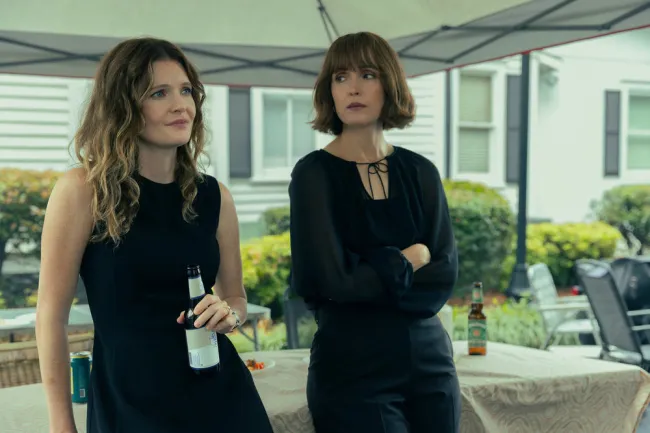
Episode 3 reveals exactly why Charlie and Sam — now adults and played by Meghann Fahy and Rose Byrne, respectively — have been estranged for 10 years. A flashback shows that Charlie chose to stay in Georgia, marry her love Ben (Michael Dorman), and work alongside their father rather than follow fellow lawyer Sam to a firm in New York.
Viewers then witness Sam’s shocking eruption as she tells Charlie that both she and her mother suffered so the younger girl could get away that night and, eventually, from that town. The scene then shifts to Charlie’s perspective. Behind the bathroom door, Sam shouts at and pleads with Charlie as Charlie experiences her first miscarriage. The sequence was filmed in a hotel in downtown Atlanta, with Fahy getting the chance to experience Byrne’s performance firsthand.
“Meghann had heard all of that blame, shame, grief, and anger,” says Steph Green, who directed all six episodes. “What Rose did with that was absolutely incredible. She was explosive. Sam finally boiled over all the sacrifice that she had thought about for years. And in that incredible release of pain, she actually moved toward where she needed to get, which was a sort of deep, deep sorrow and grief.”
Slaughter says the monologue gave her goosebumps, and Fahy was equally moved. “Rose had a hard job: It was very wordy, and earlier in the scene she’s at a three, and then she goes to 1,000 really, really quickly, and she did it in a way that was emotionally effective,” the actress says. “Literally having a door between the two of us was tricky because as actors, you want to connect with the person, even in the moment where you’re screaming at them.”

Byrne admits the staging required a leap of faith on her part. “I really just put my trust in our director that it would make sense in the story, which is so rich but complex,” she notes.
For Slaughter, the fact that Sam has no idea what’s happening to Charlie was important. “Charlie doesn’t really have the voice to tell her, to ask for help, and that echoes back to their childhood — this loss of voice, loss of ability to ask people to be there when you need to lean on them,” says the author, who also believes the female-led crew provided the space for Fahy to give a heart-wrenching performance of her own.
With limited time to film in the hotel room, Green estimates that they worked until 5 a.m. “Meghann did that work very, very late or very, very early, depending on how you want to say it. She’s capable of anything, but I don’t think it hurt that we were all very fried and raw. Even though Charlie needed her sister desperately, the secrets had started long ago. They had never recovered from those, and here again, another secret would tear them apart.”

Charlie only reveals her original secret — that she didn’t, in fact, get away that night — to Sam in the fifth episode, as they mourn their father at a funeral home. Via flashback, we learn that Charlie wasn’t able to run fast enough in the woods; one of the assailants caught her and sexually assaulted her. Charlie told only her father, and Rusty honored her wish to keep it tucked away until she was ready to deal with it.
“The most important line in that whole father-daughter scene is when Rusty says, ‘Whatever you did out there is exactly what you should have done.’ I’m an advocate for that line for anyone who’s been through a bad experience, because you’ve survived it,” Slaughter says.
“And if you think about the fact that in a young girl’s life, her relationship with her father may be the first meaningful relationship she has with any man,” the author continues. “And Rusty giving her that makes Charlie the sort of woman she grows up to be. It makes her have a relationship with a man like Ben, who’s so wonderful and he respects her and listens to her, because that’s what she expects. That’s what Rusty did to her when she was a child.”
That moment is one of executive producer Bruna Papandrea’s favorite scenes in the show. “It’s when you realize you need an actor like Brendan Gleeson,” she notes. “He has such compassion, such vulnerability, and also great strength when Rusty sees his daughter and the complexity of what’s just happened, also to his wife. There’s so much going on in that scene, and it’s almost like you could see it without words.”

Casting Olivia Williams as Gamma, a wife, mother, and physicist, was essential. She needs to make a lasting impact in limited screen time: the show’s first loss, Gamma is also its greatest light. The memory of her reminds adult Sam that she promised to always find Charlie. When asked what she hopes teen girls, including the actresses she bonded with, take away from the series, Williams struggles to answer.
“That is a very, very hard question,” she says. “It just makes me upset that we haven’t come anywhere in those 20 years. A sex crime against a woman is still quite low on the agenda of crime. I have a very dear friend who lived in a coercive, controlling relationship, and she’s frightened to accuse her ex-husband of rape because she can’t guarantee that he’ll go to jail.
“And if he doesn’t go to jail, she, having accused him of rape, will live in fear of him coming and attempting to kill her, which he has done in the past,” the actress notes. “I wish I could say to a young woman, ‘If you are sexually assaulted and go to court, you will be protected by society.’ I’m afraid I cannot.”
