
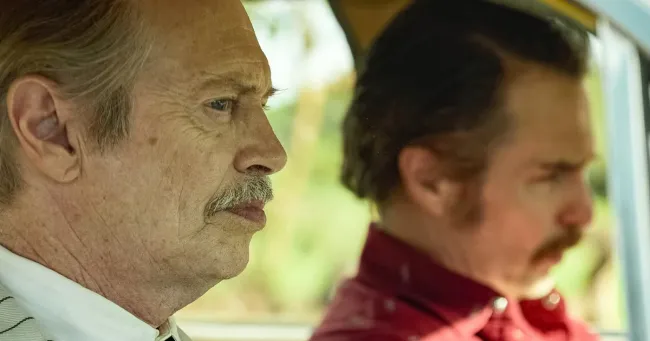
When already-famed playwright Martin McDonagh crossed over into feature film with 2008’s In Bruges, critics found similarities between his hyper-verbal writing style and the works of ’90s indie boom directors like Quentin Tarantino and the Coen Brothers. Now, 18 years later, McDonagh is putting out his fifth film, but his first to feature Steve Buscemi, a major collaborator of both.
In Wild Horse Nine, Buscemi plays MJ, a CIA bureau chief stationed in Chile in 1973, who must deal with the problems posed by John Malkovich’s Chris, who may be about to cause a major headache for the spy agency.
Gold Derby spoke with Buscemi about finally working with McDonagh, what made the independent film scene of the ’90s so special, and a little about his role in the upcoming X-Files reboot from Oscar winner Ryan Coogler.

Gold Derby: When you were approached for Wild Horse Nine, was traveling to Easter Island part of the pitch to you from the jump?
Steve Buscemi: Oh, I didn’t care where he was going to shoot it. I just knew that I wanted to work with Martin [McDonagh]. I was at the Venice Film Festival four years ago when Banshees [of Inisherin] was there, and I was there with my film, The Listener, and Martin and I just really hit it off. I would see him at some of the gatherings or parties, and we just had such a great time together and such an easy back-and-forth flow. And of course, I said “I would love to work with you,” and he said the same. I’ve had that happen at other times in my life, and then you never see the person again. So I was thrilled that he followed through. Really, before I read it, I was just like, “I know I’m doing this. I just hope it’s as good as I want it to be.” And of course, it exceeded my expectations.
Nowadays, when you’re receiving interest from filmmakers, what makes a piece of material something that you want to do at this stage of your career?
I mean, just good writing is, I think, at the top of the list — just good writing, good characters, and if the character that I’m playing is important to the story. I felt like all the boxes were checked off in this. And also, it’s the cast, and it’s who’s directing and who’s doing it. Sometimes location is a consideration, but to me, on this, that was just a bonus — to be able to shoot it in Rapa Nui. So yeah, I just look for stories that are compelling to me, and then it’s the people that I’m working with.
So what was the actual procedure of getting to Rapa Nui and getting to where you were actually filming?
Well, you fly to Santiago, and then the flight from Santiago to Easter Island is like another five hours.
Wow.
It’s a long way to go, but it’s totally worth it, of course.
I have to imagine! Was there time for some sightseeing?
Yeah. No, I was there for three weeks because Martin brought me in. I was only in one scene on the island, but I have all those phone calls with Sam [Rockwell]’s character, and Martin wanted me in the next room. So whenever you see Sam on the phone, or me on the phone, we are in the next room with each other doing the off-camera. So that was important to Martin. He also brought in Parker Posey to Rapa Nui to do her off-camera phone scenes, because her character doesn’t even end up in Easter Island. At least my character does. But yeah, one of the things that was important to Martin was that the actors all be together.
You’ve worked with a few writer-directors who have a really distinct voice. When you’re approaching material that feels so much like a Martin McDonagh script — or, in the past, whether it was the Coens or Tarantino — is there an acclimation to a voice in terms of your performance?
It’s something that I don’t really think about. I just try and commit and learn my lines and be collaborative with the director and my fellow actors. And yeah, there’s an innate understanding of what the tone is — understanding, like in the case of this film, that it’s funny, but the humor comes from a real place. It’s not jokes. And that underneath it all, these are real people, and there’s a sadness to all of the characters in the film. So it’s kind of your job as an actor to bring that inner life. And yeah, we talk about backstory a little bit. I did with Martin. I think maybe I did more so with Sam, because most of my scenes are with Sam, so we talked about what our relationship was, or is, just leading up to those moments that you see them have scenes together. And it’s fun. The writing is so rich and layered that it’s fun to come up with stuff that is not in the script. Some of the things get discussed with Martin, but some things don’t. You just sort of take a chance and bring what you think is appropriate, and then you have a great director there to say, “I like what you’re doing. You could do more. Go more in this direction.” Or, “No, don’t show this part yet. We want to keep this hidden,” because the film is full of surprises, and that’s what I loved about it too.
Were there rehearsals, or were all those discussions on set?
There were rehearsals. I came into the project a little bit later, so I missed the rehearsals that were in New York, but I know that Martin did that with Sam and John [Malkovich] and Parker and Mariana [di Girolamo]. So for me, it was more having conversations with Martin and then rehearsing when I got to set. That was sort of the beauty of shooting on a location where we were all staying at the same resort. We would see each other for breakfast or dinner, and John and Sam were always running lines when they weren’t on set. There was just that commitment that everybody had to make this the best possible film that we could.
Before I wrap up, we just had John Turturro in talking about The Only Living Pickpocket in New York. I’m so glad to see you, him, and Giancarlo [Esposito] in it, calling back to the indie boom of the late ’80s and early ’90s. There’s so much nostalgia for that time. For someone who lived it and was part of that — why was that such a boom time for creativity and for filmmaking, do you think?
I don’t know. I don’t know what it was about the ’90s. I know for myself, I was living in the East Village all throughout the ’80s, and that’s where I met people like Jim Jarmusch and Sara Driver and Bette Gordon and Tom DiCillo — all people that I then got to work with when they were making films. And there was a community. There was just a like-minded community of people that wanted to create their own work and not depend on outside forces to validate them. It was all about creating your own work and forging your own path, and it was that way in music and in theater and in art, and then in independent film. To me, it was a very New York-centric thing. I know it was happening in other cities too, but New York at that time — for whatever reason, I’m not sure — was just a time when there was a lot of experimentation and a lot of people just wanting to make their own path.
Any plans to get back in the directing chair anytime soon?
Yeah, there’s always something that I’m trying to work out. Directing takes a lot of time. It takes a lot of time to get movies off the ground. But yeah, that’s something I would like to continue in the future.
I would love to see it. And just before I let you go, I saw your name come up with a flurry of great casting news around this new X-Files project from Ryan Coogler. Have you already worked on that, or is that something coming down the road for you?
No. Well, he made the pilot, so I already shot it in Vancouver, and now it was picked up to go to series, and we’ll see where that leads to.
