
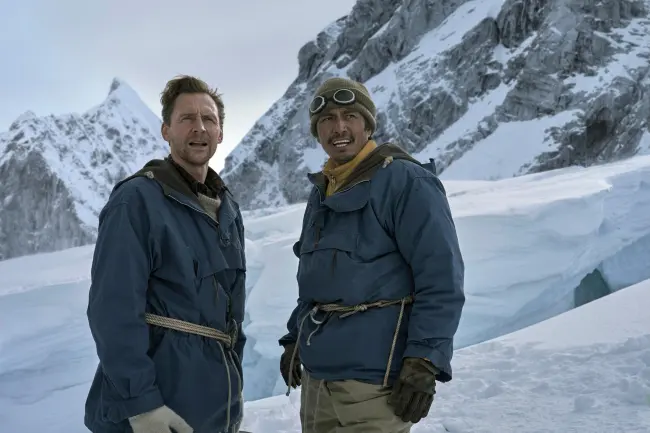
For her narrative feature debut, Tenzing, director Jennifer Peedom quickly realized she was stepping far outside the bounds of a normal movie set. The acclaimed documentary filmmaker faced extreme weather and harsh environments at every turn to chronicle the historic 1953 Everest expedition of Sherpa mountaineer Tenzing Norgay.
Peedom — the BAFTA-nominated Australian director behind acclaimed documentaries such as Sherpa (2015), Mountain (2017), and River (2021) — brings the biographical drama to life with a stellar cast. The Apple Original Film stars Genden Phuntsok as Tenzing, the Nepali-Indian mountaineer who was the first to reach the summit of Mount Everest. Tom Hiddleston plays New Zealand mountaineer Edmund Hillary, alongside Willem Dafoe as expedition leader John Hunt, Lhakpa Tsamchoe as Tenzing’s wife, and Caitríona Balfe as Jill Henderson, honorary secretary of the Himalayan Club and co-organizer of the climb.

Shot by cinematographer Stefan Duscio, the film traces the legendary ascent primarily through Tenzing’s perspective. Peedom says the harsh conditions and daily challenges helped forge a special connection with the cast and crew. “We would helicopter in every day. We would get out, the helicopters would leave and it would just be us. We were doing a lot of climbing. I think those experiences bond you,” she says.
Peedom shares the literal and figurative highs and lows of making — and surviving — the production of Tenzing in our video interview above the full Q&A transcript below.
Gold Derby: You’ve made documentaries in the Himalayas for more than two decades, including Sherpa. What drew you to tell Tenzing’s story as your first feature film?
Jennifer Peedom: I’ve done a bunch of films in the Himalayas over 23 years. I did my very first documentary there as a young solo, camera operator. I was always drawn to that part of the world, but in particular to the Sherpa stories. I found them fascinating. I was much more interested in them than the foreigners that we were generally hired to film. I made a documentary in 2015 about the Sherpas I followed on an Everest expedition, from the Sherpas’ point of view, because I wanted to show how things really worked on Everest. It was in the aftermath of that film that I realized there was this story about Tenzing Norgay, the original Himalayan Sherpa to climb Everest with New Zealand mountaineer Edmund Hillary. So little was known about him, about his story. It’s an incredibly epic story. There’s a love story, there’s family, there’s identity, there’s belonging, and there’s a lot of loss. I realized I couldn’t tell it as a documentary because it hadn’t been documented. So documentary had really taken me as far as I could go. To tell this more interior emotional journey, I needed to step into drama.

The film appears to rely very little on CGI. How important was it to capture the climb for real?
Because of my documentary background, I knew that we could do it for real. I had accumulated these incredible people, these very experienced mountaineers, cinematographers, Everest guides, and many, many Sherpa friends. With those people, I knew we could do it safely and in a way that also helped the audience understand the visceral nature of climbing Everest and the wind, the cold, the sounds, and all of those things. I wanted to do it for real, to give the audience that experience.
What was it like filming with Willem Dafoe and Tom Hiddleston in such freezing, mountainous conditions?
I really carefully chose people that I knew would flourish in that environment. Having been on a number of expeditions, I knew the kinds of people that would be up for that sort of experience, because you don’t want to set anyone up to fail, and there will be suffering involved. It’s very cold. It’s windy. In the middle of winter in New Zealand, it is absolutely freezing. I was colder on that shoot than I had ever been on Mount Everest. I think part of that is that you’re standing around, not climbing. They were cold, but they were so excited to be there. You know, Willem insisted that we let him do real climbing. He went off on second unit one day to do more climbing. When you see him up there doing that climbing for real and having the time of his life, it was like being on an adventure together.

Gold Derby: Where did you film the Everest climbing sequences?
Peedom: The physical climbing sequences, from base camp up, were shot in New Zealand’s Southern Alps. And that is because those mountains are as big from bottom to top as the Himalayas. But they just start at much, much lower altitude. So, it’s physically possible without oxygen to take crews up there. You don’t need this massive acclimatization process that you would need if you were shooting on Everest itself. When the shoot was over, the main unit cinematographer, Stefan Duscio, went back to Everest with the second unit director and they tracked all the way to Everest, with a small crew. So we were able to then blend the New Zealand Alps with, with Everest itself.
What were some of the toughest challenges of filming in those conditions?
The amount of clothes that you needed to wear just to get ready for the shoot every day. I was in three layers of thermals. We had heated socks, and we had heated footbeds. You’d have to plug them in every night when you got home. It took ages to get dressed. Then you had to put on your safety equipment, your harnesses, and all of that kind of thing. You couldn’t take off your gloves. It was well below zero. And Stefan Duscio, the cinematographer, was hand-holding a huge amount of the actual climbing footage. And often you’d only get one take; sometimes you’d be lucky to get two, or at best three, because at any minute you could be pulled off the mountain. That happened a number of times. The head of safety, who was also our locations consultant, was Guy Cotter, who has climbed Everest five times. He had the ability to call cut in the middle of a take if he saw weather coming up and the helicopter pilots needed to get us off. And it happened a number of times, which made for a very nerve-wracking kind of shoot, because you don’t know at any minute when the rug’s going to be pulled out from underneath you. We learned to work really quickly, and we just adapted. Often you might have five hours to shoot something. Suddenly you have two hours, and you just have to do it incredibly fast. The actors and the crew would just have to get on board with that, because we may not be able to get back to that location again.

How did Tom Hiddleston prepare to play New Zealand mountaineer Edmund Hillary?
He had to he had to learn the Kiwi accent, which is no small feat. He also had to do a lot of climbing training. I really wanted him to experience this landscape. So the first thing Tom did when he arrived in Nepal was, after meeting Edmund Hillary’s family the very first day, fly up to the Himalayas and he went on a trek for five or six days. He met with one of my Sherpa friends up there to learn the Sherpa language and to experience the culture. Genden and Tom went trekking together for 5 or 6 days up towards Everest Base Camp, and they got to see Everest together for the first time. They got to visit the monasteries. They even met, the last surviving member of the ‘53 expedition, who was the youngest member of the expedition. They sat with him for two or three hours and talked about the expedition and got beautiful insights. I know for both of them, it was life changing. And they carried that into their performances.
What was the most challenging day on set?
The very first day in the mountains we weren’t able to fly because of weather. When we got up there, clouds came in and the helicopters couldn’t come. There was a tiny break in the weather where we managed to get Willem Dafoe off the mountain because he’d finished his scenes for the day. We were there for over an hour, crouched at our helipads, hearing the helicopters. They were almost getting to us. And then the very last minute, because they can’t fly after sunset, it was a ticking clock to pick us up. We had supplies. We would have just camped the night out on the mountain. There were sleeping bags, there was food, there were tents, but were with some pretty big actors at this point. Eventually the helicopters popped in and took us all back to safety. And I think we’re all very happy to have a warm bed that night.
This interview has been edited and condensed.
