
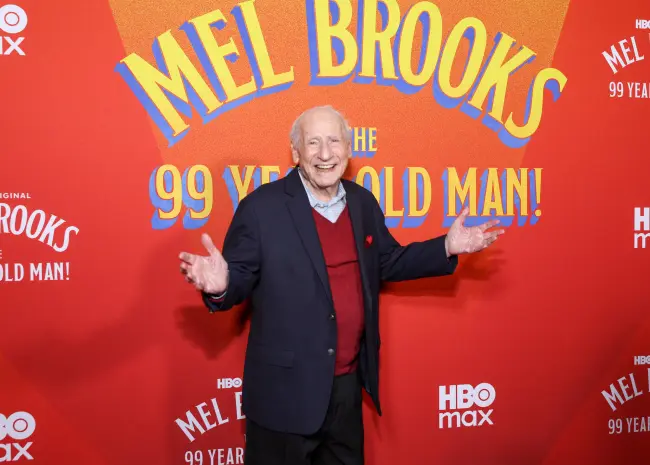
On Sunday, the American Cinematheque emailed its members to announce that Mel Brooks would attend that night’s screening of The Twelve Chairs for a Q&A. Brooks’ 1970 follow-up to The Producers is not available digitally on any service, yet it remains one of his personal favorite projects.
“As far as moviemaking, maybe The Twelve Chairs is one of my most perfect movies because it has a lot to say and it says it cinematically very well,” Brooks said after the screening. “Also, another perfect movie is Young Frankenstein. I took a page out of Hitchcock’s book. Every shot is really designed.”
In the film, based on the novel by Ilf and Petrov, Vorobyaninov’s (Ron Moody) mother-in-law reveals on her deathbed that she hid the family’s jewels in one of 12 dining room chairs. The chairs are seized by the state after the Bolshevik Revolution.

Vorobyaninov teams up with con artist Ostap Bender (Frank Langella) to find the chairs. Meanwhile, after delivering the last rites, priest Fyodor (Dom DeLuise) tries to find them himself.
“There is one wonderful shot that I take credit for,” Brooks continued. “I grabbed the Arriflex, the camera, and fell down, laid down in the potato field, and shot the setting sun through those cypress trees. It’s one of the best shots I’ve ever made in my life, and it’s in this movie.”
Brooks originally wanted his The Producers star Gene Wilder for the role of Vorobyaninov. Wilder declined.
“Gene thought that he just wasn’t old enough to have the experiences to play the part,” Brooks said. “I was very lucky to get Ron Moody, who was absolutely wonderful in the role. He’s funny, and he’s very moving.”
DeLuise would improvise. One ad-lib, when Vorobyaninov confronts him, made Brooks stop filming.
“When Vorobyaninov stares down at his face, nose to nose, and says, ‘You took the sacred oath of confession and used it for gain. You’re not worth spitting on,’ Dom ad-libbed, ‘You are,’” Brooks said, mimicking DeLuise’s spit. “He was a bit of a genius.”
The Twelve Chairs also features Brooks’ acting debut as Tikon, the former servant who tips off the men to the location of the chairs. Brooks would appear in most of his subsequent films, but he was never supposed to play the role.
“I was supposed to get somebody from England,” Brooks said. “The guy got sick, and they said, ‘If you can wait a week, stop filming for a week, we’ll get him down to Yugoslavia.’ I said, ‘I can’t wait a week. I can do that part.’ I’m glad I did it because it was fun, and I really enjoyed that kind of acting. I had never done that kind of acting before. It was very enjoyable to be so insanely expressive.”
The film’s theme song is “Hope for the Best (Expect the Worst).” Brooks recalled that his wife, Anne Bancroft, encouraged him to write it.
“Anne sent me up to the attic and said, ‘You wrote “Springtime for Hitler,” you can write anything,’” Brooks said. “It occurred to me, the good and the bad, there’s no guarantee. As I was writing, I came up with ‘Live while you’re alive, no one will survive.’ That set me on the right path to writing ‘Hope for the Best, Expect the Worst.’ By the way, Brahms wrote the melody, so it’s me and Brahms.”
Brooks’ frequent composer, John Morris, worked with the filmmaker on The Twelve Chairs. Brooks praised Morris’ instrumental melodies and recalled how they created the Blazing Saddles theme song.
“I said, ‘He rode a blazing saddle,’” Brooks said. “He said, ‘You can’t ride a blazing saddle.’ Anyway, he immediately came up with [the melody], and I wrote the lyrics.”
A mild spoiler about the ending doesn’t ruin the comedy that comes before it, so Brooks openly discussed how he gave the film a more hopeful conclusion than the book.
“It’s a wonderful ending in which Vorobyaninov decides that friendship is worth more than money,” Brooks said. “The book ends in murder. One of them kills the other one. I said that doesn’t work in a movie. You don’t sit for an hour and a half and then go, ‘What?’ I ended it the way it should end.”
Alas, The Twelve Chairs did not repeat the success of The Producers. Brooks rebounded in 1974 with Blazing Saddles and Young Frankenstein.
“It literally is a foreign movie,” Brooks said. “Foreign movies did all right. It was different. It was strange and different. Movies work by word of mouth. I think it was hard for somebody who even liked it to explain the movie.”
Brooks attributes the film’s unavailability to its production company.
“This movie was owned by the Universal Marion Corporation,” he said. “They made ships and anchors. They never made movies.”
Still, UMC was pleased with Brooks’ work.
“Universal Marion were so happy with the movie they gave me an anchor,” Brooks said.
Had The Twelve Chairs been more successful, it might have moved Brooks’ trajectory away from satire and parody. Then again, maybe not.
“I probably would’ve made more emotional pictures and maybe fewer comedies,” he said. “I don’t know, or it wouldn’t have made a difference. You’re destined to do things.”
Brooks continued to imbue his comedies with emotion and positive messages. Blazing Saddles tackled racism through its story of Black sheriff Bart (Cleavon Little).
“If a movie has something to say, it’s better,” Brooks said. “Blazing Saddles had a lot to say. It had a message. All men are really created equal. It says it. It does it. It’s good if the movie has a message and it’s not just a story, an adventure.”
Another overlooked favorite of Brooks’ was his 1991 film Life Stinks. Brooks played a businessman trying to prove he could live as an unhoused person for a month.
“It was a tough movie to make because I was literally living on the street, and there was a lot of urine,” Brooks said. “It was not easy to make. The message was good. It was about loving people instead of loving money.”
